

A platform dedicated to providing unbiased reviews of newly launched applications, analyzing everything from their features to their full potential.
info@scoutforge.net© 2026 Scoutforge. All rights reserved.
A platform dedicated to providing unbiased reviews of newly launched applications, analyzing everything from their features to their full potential.
info@scoutforge.net© 2026 Scoutforge. All rights reserved.
A platform dedicated to providing unbiased reviews of newly launched applications, analyzing everything from their features to their full potential.
info@scoutforge.net© 2026 Scoutforge. All rights reserved.
Cycling through all six. Tap any point to stop.
Measured on six things
Track your brand in AI search answers and reach out to publishers cited by ChatGPT, Gemini, Google AI Overviews, Perplexity and Claude.
HTTPS is enforced, but the header probe found no HSTS, CSP, frame protection or Referrer-Policy, and no SPF/DMARC records — a real gap for a tool that sends outreach email from domains it manages for customers. No SOC 2, ISO or security page published.
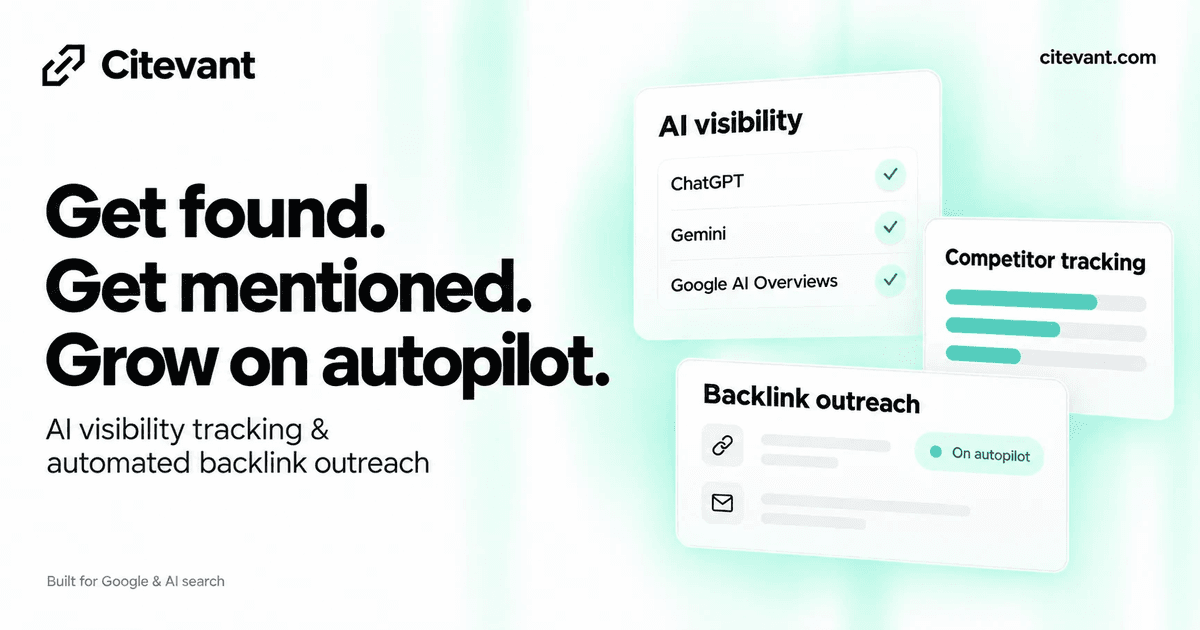
Citevant helps businesses track and improve their visibility in AI search. It monitors answers from ChatGPT, Gemini, Google AI Overviews, Perplexity and Claude, tracks competitor mentions and identifies the articles those engines cite. Citevant discovers relevant publisher contacts and sends personalized outreach requesting contextual brand mentions. Teams can follow visibility, outreach replies and Domain Rating from one dashboard.
Drawn from the product itself, not from a survey.
Written by AI from measured evidence, scored out of 100.
Citevant is an AI-search visibility tracker with a genuinely sharp wedge: it watches what ChatGPT, Gemini, Google AI Overviews, Perplexity and Claude say about your brand, finds the articles those engines cite, and pitches the publishers for contextual mentions. That's a more defensible angle than the pile of generic 'AI SEO' dashboards, because the citation data is the product. The site is fast on desktop, cleanly designed and answers the objections buyers actually have. The problems are structural. There's no demo, no docs and no free tier — you pay $19 before you see a single screen of the dashboard. Security headers are largely absent, and the missing SPF/DMARC records are a real risk for a tool that sends email from domains it manages for you. Accessibility scores well but publishes no conformance statement. And the pricing is a single $95/mo plan with no ladder, which caps how many people can try it. It's an early, well-positioned product with a real idea and a thin trust layer.
Onboarding is a clear 3-step flow and the FAQ pre-empts the real objections (penalties, sender reputation, DNS). Single plan keeps pricing simple. But there's no public docs, no live demo and no free tier — you commit $19 before seeing the dashboard.
Clean dark SaaS landing page with disciplined spacing, consistent branding and a heavy testimonial wall. Section flow (How it works → Results → Testimonials → Pricing → FAQ) is textbook and easy to scan. No app UI is shown, so the dashboard itself can't be judged.
Lighthouse desktop 98/100 and mobile 86/100, with CLS 0 and TBT 88ms — a stable, well-built page. The mobile LCP of 3.9s is the one real drag and sits just outside Google's 'good' threshold.
HTTPS is enforced, but the header probe found no HSTS, CSP, frame protection or Referrer-Policy, and no SPF/DMARC records — a real gap for a tool that sends outreach email from domains it manages for customers. No SOC 2, ISO or security page published.
Lighthouse accessibility 96/100 with only two failing audits — color contrast and mismatched accessible names on labeled elements. Responsive and mobile-friendly. No WCAG statement or a11y page published, so the score reflects automated checks plus a clean, keyboard-friendly layout.
Genuinely timely problem — brands need to know what AI engines say about them — with a concrete wedge: find the articles AI cites, then pitch those publishers. Single $95/mo plan and no free tier caps the top of the funnel.
Citevant's site is a competent, well-structured dark-mode SaaS page: clear hero, a three-step 'How it works', a results block, a testimonial wall and a tight FAQ. The design work is real — consistent branding, disciplined spacing, a single obvious CTA. What's missing is the product itself. There's no dashboard screenshot, no interactive demo, no docs. For a tool whose entire value is a monitoring dashboard and an outreach inbox, showing zero of the interface is a strange choice. Usability-wise, the onboarding story is clean: connect your site, weekly scans run automatically, outreach sends from a managed inbox on a separate domain. The FAQ answers the objections that actually stop people from buying — Google penalties, sender reputation, DNS setup, approval workflow. But the friction sits at the front door: no free tier, no live demo, and a $19 trial before you see anything. A buyer has to trust a testimonial wall to hand over a card.
Speed is a tale of two devices. Lighthouse desktop scores 98/100 — the page is essentially instant on a laptop. Mobile scores 86/100 with an LCP of 3.9s, which is the one number that matters for a product whose buyers are often on phones. CLS 0 and TBT 88ms mean the page doesn't jump or stutter, so the LCP is a payload issue, not a layout one. Security is where the picture darkens. HTTPS is enforced, which is table stakes, but the header probe found no HSTS, no CSP, no frame protection, no Referrer-Policy and no X-Content-Type-Options. More concerning for this specific product: no SPF and no DMARC records on the domain. Citevant registers domains and sends cold outreach email on customers' behalf — that's exactly the operation where missing email authentication records get you spoofed or blacklisted. There's no SOC 2, no ISO, no security page and no bug bounty. For an early-stage tool that's not unusual, but the email-auth gap is a real, fixable flaw, not just an unverified checkbox.
Accessibility is a genuine strength: Lighthouse scores 96/100 with only two failing audits — insufficient color contrast and mismatched accessible names on labeled elements. Both are fixable in an afternoon. The site is responsive, keyboard-navigable and mobile-friendly. What's absent is a WCAG conformance statement or an accessibility page, which would turn a good automated score into a verifiable claim. Growth is the more interesting question. The problem Citevant names is real and getting more urgent: buyers increasingly ask ChatGPT and Perplexity what to buy, and brands have no idea what those engines say about them. The wedge is specific — find the articles the AI engines actually cite, then pitch those publishers for contextual mentions. That's a smarter angle than generic backlink packages, and it's the kind of data advantage that compounds as more scans run. The limits are real too: one $95/mo plan, no free tier, and a category filling up fast with AI-visibility trackers. The idea has room; the go-to-market is narrow.
Conclusion
The honest read: Citevant is selling into a category that's about to get crowded, and its differentiator — knowing which articles the AI engines cite — is the part worth paying for. If the team fixes the email authentication gap, publishes a security page, adds a free tier or a real demo, and shows the dashboard on the homepage, this becomes a much easier recommendation. Right now it's a promising wedge wrapped in a landing page that asks for trust it hasn't yet earned. Worth a $19 trial if AI visibility is on your roadmap; not yet worth a blind $95/mo commitment.
Named competitors, point by point. Nobody paid to appear here or to be left out.
 Citevant Citevant |  | |
|---|---|---|
| AI search visibility tracking | Weekly scans across ChatGPT, Gemini, Google AI Overviews, Perplexity and Claude, with competitor share-of-voice tracking. | Not specified in provided data. |
| Citation and publisher outreach | Finds articles AI engines cite, locates publisher contacts and sends personalized contextual mention requests automatically. | Not specified in provided data. |
| Pricing model | Single plan: $19 for a 7-day trial, then $95/month, cancel anytime. No free tier. | Not specified in provided data. |
| Security and compliance signals | HTTPS enforced; no HSTS, CSP, SPF or DMARC; no SOC 2, ISO or security page published. | Not specified in provided data. |
| Onboarding and demo availability | 3-step setup (connect site, weekly scans, automated outreach); no live demo, no public docs, no free tier. | Not specified in provided data. |
Comparing options? See Citevant alternatives, scored side by side

Puzzly is an all-in-one B2B lead generation platform that...

White-label reputation management software for agencies s...

A UULE-powered local rank tracker for SEO agencies, offer...

A free, open-source platform offering 110 AI agent skills...

White-label website audits that close deals for digital a...

Frame-perfect video-to-GIF maker that runs entirely in yo...

A top-rated virtual assistant agency that matches busines...

A unified platform replacing 12-20 disconnected tools for...

An all-in-one platform for creators to sell digital produ...

An AI-enhanced executive search firm delivering pre-mappe...

Specialized SEO services for moving companies to dominate...

Analyze your landing page and get a score, teardown, and ...
A platform dedicated to providing unbiased reviews of newly launched applications, analyzing everything from their features to their full potential.
info@scoutforge.net© 2026 Scoutforge. All rights reserved.