Cycling through all six. Tap any point to stop.
Measured on six things
Unify device management across Android, iOS, Windows, mac...
Growth
35Marketing claims large scale but searches yield almost no independent reviews, community, or funding signals. Only LinkedIn presence noted.
Screenshots
1 / 1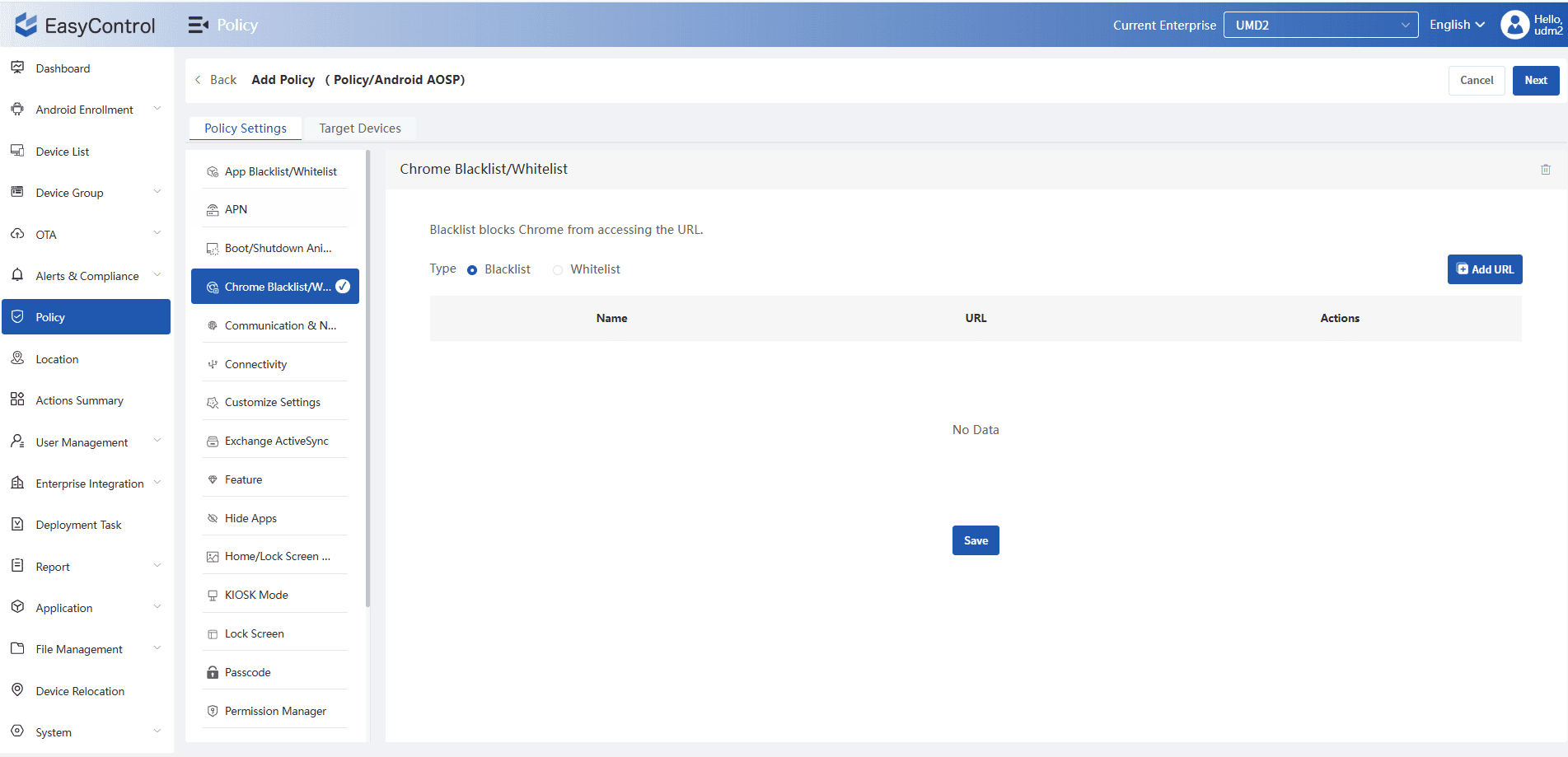
About this app
EasyControl UDM is a unified device management platform that brings Android, iOS, macOS, Windows, and Linux fleets under one console. It offers policy control, app lifecycle management, compliance monitoring, and remote support. With support for Android Enterprise and AOSP, it handles dedicated/kiosk devices and mixed-platform environments. Deployable via cloud, on-premises, or hybrid, it also features AI-driven automation and a partner delivery model. Trusted by over 1,500 customers managing 150M+ endpoints, it simplifies device operations at scale.
Key features
- 1Unified console for Android Enterprise, AOSP, iOS, macOS, Windows, Linux with policy, app lifecycle, and compliance.
- 2Flexible deployment: cloud, on-premises, or hybrid plus dedicated/kiosk and rugged device support.
- 3AI-driven automation, remote support, and partner delivery model with staged OTA and OEM collaboration.
Target customer profile
Drawn from the product itself, not from a survey.
Demographic
IT administrators in enterprises with 500+ devices across multiple OS platforms
Pain points
Managing separate MDM tools for each OS leads to operational complexity and inconsistent policies.
Primary needs
A single console to enforce policies, deploy apps, and monitor compliance across all devices.
Demographic
Organizations deploying dedicated or kiosk devices in retail, logistics, or manufacturing
Pain points
Kiosk and rugged device managers lack integrated policy control and remote support.
Primary needs
Dedicated device lockdown, staged OTA updates, and remote troubleshooting from one platform.
Demographic
OEM/ODM partners and solution integrators managing device fleets for clients
Pain points
Deploying and maintaining custom Android builds or mixed fleets requires heavy manual effort.
Primary needs
Automated rollout, compliance baselines, and partner delivery tools to scale deployments.
Scout Review
Written by AI from measured evidence, scored out of 100.
EasyControl UDM delivers a genuinely unified console for mixed OS fleets including strong Android Enterprise and AOSP support, kiosk workflows, and flexible deployment options that differentiate it from narrower tools. Core capabilities around policy, app lifecycle, compliance, and remote support are well articulated on the site with practical examples. However, the experience is held back by average design execution, slow mobile performance, incomplete security headers, and notably thin independent validation of its scale claims. It suits IT teams managing 500+ heterogeneous devices who value one console over best-of-breed point solutions, provided they are comfortable with a contact-sales pricing model and can tolerate some UI friction.
Measure by measure
Usability
58Solid docs and trial availability support onboarding, but dense app navigation and empty-state forms create friction for daily workflows.
Design
55Average visual execution with clear hero layout and consistent branding, but dense ungrouped sidebar and low-contrast screenshots reduce polish.
Speed
45Mobile Lighthouse at 42/100 with slow LCP and TBT; desktop better at 66/100. No external benchmarks available.
Security
50Basic HTTPS/HSTS and email auth present; missing CSP and other headers. No public SOC 2 or audit evidence found despite enterprise positioning.
Accessibility
80Strong 97/100 Lighthouse score with only minor contrast and label issues. No broader a11y documentation or multi-language claims verified.
Growth
35Marketing claims large scale but searches yield almost no independent reviews, community, or funding signals. Only LinkedIn presence noted.
Improvement areas
- Mobile performance optimization needed (current Lighthouse 42/100).
- Publish security attestations and complete missing HTTP security headers.
- Increase independent review visibility and customer proof points beyond self-reported numbers.
Design & Usability
EasyControl UDM presents a functional but unrefined interface. The homepage hero effectively communicates unified management across five OS platforms with clear CTAs, yet the in-app experience suffers from an overly long sidebar lacking visual hierarchy. Policy management screens default to empty tables without guidance, increasing cognitive load. Documentation stands out positively with structured guides for enrollment, compliance, and integrations, plus recent release notes through March 2026. The 14-day trial lowers the barrier to testing, but the combination of dense navigation and muted product visuals suggests the product prioritizes capability over delightful daily use. Compared to peers like Jamf or Intune, the console feels more utilitarian than polished.
Speed & Security
Performance metrics reveal clear room for improvement, particularly on mobile where Lighthouse scores 42/100 driven by a 10.5-second LCP and elevated TBT. Desktop fares better at 66/100, indicating the site itself is usable but not optimized for speed. Security posture includes HTTPS and HSTS enforcement plus SPF/DMARC, meeting baseline expectations, yet the absence of CSP, frame protections, and any published SOC 2 or ISO certifications limits trust signals for enterprise buyers. No breach history or negative incidents surfaced in research. The platform positions itself for regulated and OEM environments through flexible cloud/on-prem deployment, but verifiable compliance artifacts remain absent from public channels.
Accessibility & Growth
Accessibility performs strongly on automated checks with a 97/100 Lighthouse score, though two minor issues around color contrast and accessible names persist. Broader WCAG claims or multi-language support are not prominently documented. Growth trajectory is the weakest dimension: despite bold claims of 1,500 customers and 150 million endpoints, independent verification is scarce. Searches across G2, PeerSpot, and general web yield mostly generic comparison pages rather than user testimonials or community activity. Only a LinkedIn profile appears as social proof. The product has maintained changelog activity into 2026 and offers structured docs, suggesting ongoing development, yet it lacks the visible traction of established alternatives like Microsoft Intune or VMware Workspace ONE.
Conclusion
For organizations tired of juggling separate MDM tools, EasyControl offers a credible single-pane alternative with real multi-platform depth. The gap between its ambitious marketing numbers and publicly visible traction is the main caution flag. If the product can tighten the interface, publish security attestations, and surface more customer proof points, it has clear potential to move from competent to compelling in the UEM space.
Suggestions for improvement
- Add visual grouping and collapsible sections to the left navigation to reduce scrolling fatigue.
- Implement CSP and additional security headers while pursuing a public SOC 2 report.
- Publish at least 3-5 detailed customer case studies or G2 reviews to substantiate scale claims.
- Optimize hero and dashboard images for faster mobile LCP and improve empty-state guidance in policy forms.
Alternatives comparison
Named competitors, point by point. Nobody paid to appear here or to be left out.
 EasyControl UDM EasyControl UDM |  VMware Workspace ONE VMware Workspace ONE |  Microsoft Intune Microsoft Intune |  Jamf Pro Jamf Pro | |
|---|---|---|---|---|
| Unified multi-OS support (Android, iOS, macOS, Windows, Linux) | Native support across all five platforms with AOSP and kiosk focus | Broad UEM coverage but more complex setup for mixed fleets | Strong Windows/Microsoft integration; limited dedicated/kiosk and AOSP depth | Excellent Apple-only focus; no native Android/Windows/Linux support |
| Dedicated/kiosk and AOSP device management | Core strength with kiosk lockdown, rugged fleets, and OEM collaboration | Supported but requires additional configuration layers | Limited native support for dedicated/kiosk and AOSP scenarios | Not applicable; Apple-centric product |
| Pricing model | Contact sales; tiered Pro/Enterprise with custom quotes | Enterprise licensing, generally considered complex and costly | Per-user subscription integrated with Microsoft 365 | Subscription-based with tiered Apple-focused plans |
VMware Workspace ONE
Comprehensive UEM platform but more complex and costly for mixed OS fleets.
Microsoft Intune
Strong Windows and Microsoft 365 integration, but limited support for dedicated/kiosk and AOSP devices.
Jamf Pro
Excellent for Apple devices, but lacks native support for Android, Windows, and Linux.
Comparing options? See EasyControl UDM alternatives, scored side by side
Sources
What the review was written against. A verdict with no sources is an opinion.
- peerspot.com×6
- easycontrol.io×3
- linkedin.com×2
- youtube.com×2
- aws.amazon.com×2
- zoho.com
- easycontrol.quora.com
- devhunt.org
- easyaudit.ai
- iplocation.io
- goodfirms.co
- scoutforge.net
- g2.com
- softwareadvice.com
- smallseotools.com
- whatsmydns.net
- instagram.com
- secureframe.com
- tidalcontrol.com
- reddit.com
- play.google.com
- apivoid.com
- continuumgrc.com
- isms.online
- hosted.com
- ispartnersllc.com
- konfirmity.com
- eurodns.com
- godaddy.com
More Development & Engineering apps
View all Development & Engineering
CreateMyCoin
92A no-code Solana token creator that deploys SPL tokens in...

Vibe Coding Agent Skills
92A free, open-source platform offering 110 AI agent skills...

CC Switch
91Open-source desktop app for switching AI coding providers...

DemoVexa
90Turn your code into professional product demo videos with AI-generated scripts, animated UI, and natural voiceovers.

TaxID
90Fast EU VAT validation API for developers, covering 27 EU...

BeartIMAGE
88BeartIMAGE is a free, web-based image processing platform engineered for fast, bulk photo editing and conversion directly in your browser.

Claw Messenger
88Claw Messenger is an iMessage API service that gives AI a...

DataHabibi
88AI-powered Dubai real estate data platform with 12M+ DLD ...

ButterKit
82macOS app for App Store screenshots: 3D mockups, auto-tra...

PERM Processing Time: Current DOL Queue & History
88PERM Processing Time is an independent data analysis platform that helps users navigate the U.S. Department of Labor’s permanent labor certification process.

StockFit API
87A developer-first financial data API providing structured...

ProcessSpy
87A native macOS process explorer and advanced monitor that...


A platform dedicated to providing unbiased reviews of newly launched applications, analyzing everything from their features to their full potential.
info@scoutforge.net© 2026 Scoutforge. All rights reserved.