Cycling through all six. Tap any point to stop.
Measured on six things
Turn your app idea into a production-ready PRD for AI age...
Accessibility
52Skip to content link present. No WCAG statement or accessibility documentation found. Dark theme with yellow accents may create contrast issues. Keyboard navigation not explicitly verified.
Screenshots
1 / 2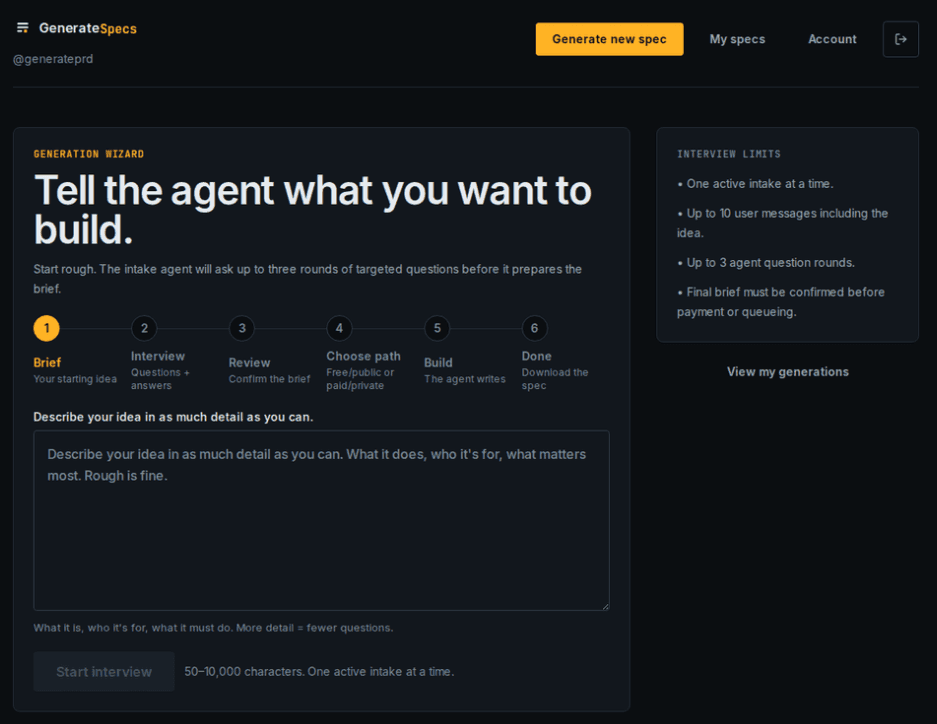
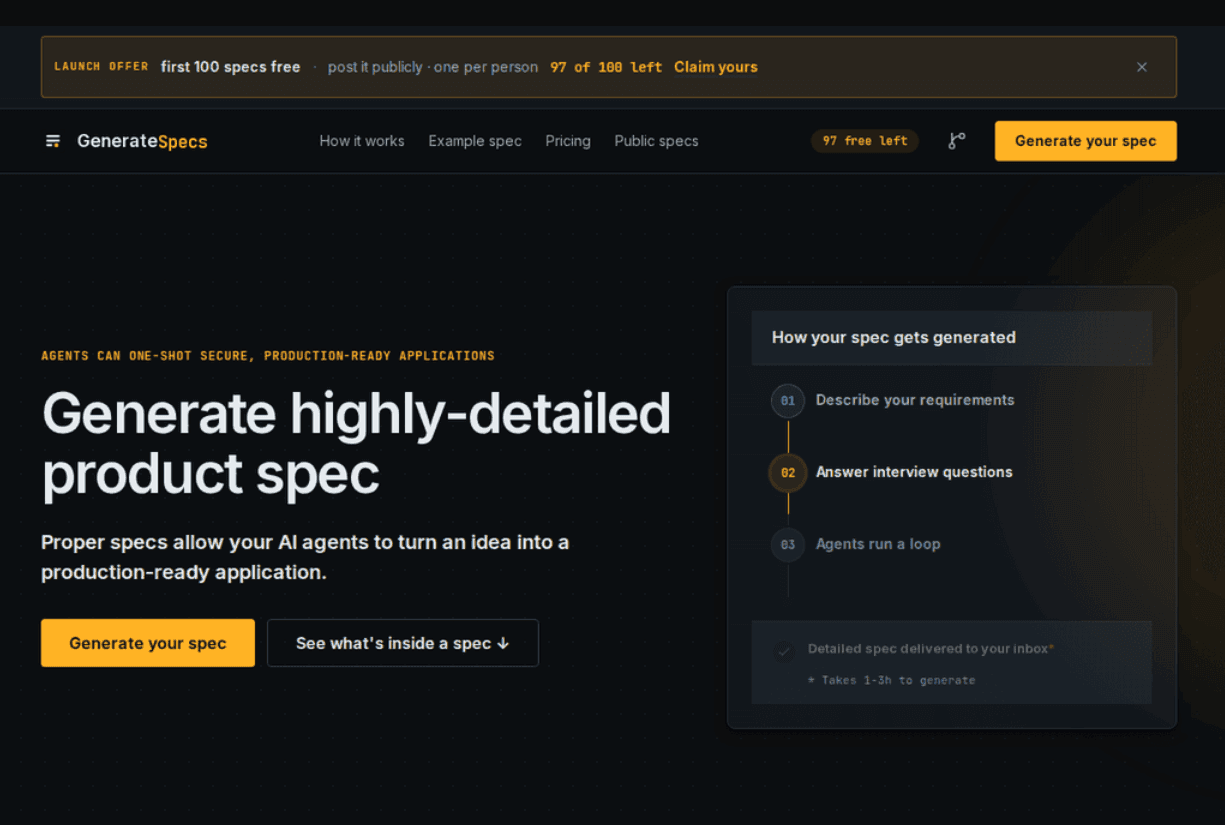
About this app
GenerateSpecs is a game-changer for anyone tired of getting prototype-quality results from AI coding tools. Instead of feeding your coding agent a vague one-paragraph prompt and hoping for the best, GenerateSpecs uses a team of AI agents to interview you about your idea, then writes an extremely detailed product requirements document (PRD) – think 6,000 to 12,000 lines – that covers everything from system architecture and database schema to exact tech stack, every feature screen-by-screen, every API endpoint, security considerations, and even a step-by-step build plan for your AI agent. The result? Your AI coding agent can move from guessing to building a production-ready application with real code quality. The process takes about 60 to 90 minutes, and you can watch it generate live. I've been using it to spec out my own side projects before handing them to Claude or Codex, and the difference is night and day. With proper specs, my agents no longer miss critical pieces like authenti...
Key features
- 1AI agent team conducts structured interview to extract requirements
- 2Generates 6,000-12,000 line PRDs covering architecture, schema, API endpoints, and build plans
- 3Copy-paste prompts for Claude Code and Codex with orchestration instructions
- 4Live generation viewing during the 60-90 minute spec creation process
- 5Public library of finished specs for reference and expectation-setting
Target customer profile
Drawn from the product itself, not from a survey.
Demographic
Indie hackers and solo developers
Pain points
Struggle to create comprehensive specs for their app ideas, end up with one-paragraph prompts that lead to incomplete AI-generated code.
Primary needs
A tool that quickly turns their rough ideas into detailed, actionable specs that AI coding agents can follow to build production-ready apps.
Demographic
Startup founders and product managers in early-stage startups
Pain points
Need to move fast without a full engineering team, find it difficult to define all requirements upfront, and often miss critical features or architecture decisions.
Primary needs
An efficient way to generate thorough PRDs that ensure the MVP gets built correctly the first time, saving time and resources.
Demographic
Developers experimenting with AI coding agents (Claude, Codex, etc.)
Pain points
AI agents produce prototype-quality code when given vague prompts, leading to frustration and wasted effort.
Primary needs
A way to provide their agents with detailed specifications that unlock the full potential of AI coding, achieving production readiness.
Scout Review
Written by AI from measured evidence, scored out of 100.
GenerateSpecs addresses a real, growing pain point: AI coding agents need detailed specifications to produce production-ready code, not prototypes. The product's structured interview process and comprehensive 6,000-12,000 line spec output directly tackle this problem. The dark-themed interface is polished and the wizard flow is well-structured. Security headers are strong for an early-stage product. However, the 60-90 minute interview commitment is substantial, accessibility documentation is lacking, and the domain is only 0.1 years old with limited traction signals. The launch offer of 93 free specs remaining suggests early adoption phase. For indie hackers and developers frustrated with AI prototype quality, this could be a valuable tool — if the spec quality justifies the time investment. The copy-paste prompts for Claude and Codex are a thoughtful touch that reduces friction.
Measure by measure
Usability
68Structured 6-step interview flow with visible progress, character limits, and live generation viewing. Copy-paste prompts for Claude/Codex reduce friction. Public spec library helps set expectations.
Design
62Consistent dark theme with yellow accents across wizard and landing visuals. Clean hierarchy and structured process cards. Homepage render unavailable; judged from catalogue images only.
Speed
55No performance measurement available this run. Spec generation takes 1-3 hours per site claims, which is a product constraint, not a site speed issue. Site load speed unverified.
Security
72Strong HTTP security headers: HSTS, CSP, frame protection all present. 10/12 checklist points. Missing SPF and DMARC records. No formal certifications mentioned, but solid baseline security posture.
Accessibility
52Skip to content link present. No WCAG statement or accessibility documentation found. Dark theme with yellow accents may create contrast issues. Keyboard navigation not explicitly verified.
Growth
68Clear wedge: detailed specs for AI coding agents, underserved by generic tools. Structured interview and 6,000+ line output differentiate from ChatGPT/Notion. Category has headroom as AI coding adoption grows.
Improvement areas
- 60-90 minute interview process is a significant time barrier for casual users
- No accessibility statement or WCAG compliance documentation
- Missing SPF and DMARC email authentication records
- Limited traction signals given 0.1-year-old domain and early launch phase
Design & Usability
GenerateSpecs presents a clean, dark-themed interface with yellow accent CTAs that feels modern and purposeful. The 6-step wizard with progress indicators makes the multi-step interview process feel structured rather than overwhelming. Character limits and intake notices under input fields provide clear constraints. The landing page effectively communicates the problem-solution narrative with 'Don't Do This / Do This' comparisons. Usability strengths include copy-paste prompts for Claude Code and Codex, a public spec library for expectation-setting, and live generation viewing. However, the 60-90 minute interview process is a significant time investment that may deter casual users. The sidebar's small text and generous empty space in the wizard panel could be refined. Overall, the design supports the product's promise of thoroughness, though the onboarding commitment is substantial.
Speed & Security
No performance measurements were available this run, so site speed remains unverified. The product's core value — generating 6,000-12,000 line specs — takes 1-3 hours, which is a deliberate trade-off for depth over speed. Security posture is notably strong for an early-stage product: HTTPS with HSTS, CSP, frame protection, X-Content-Type-Options, Referrer-Policy, and Permissions-Policy all properly configured, scoring 10/12 on the header checklist. Missing SPF and DMARC records are minor gaps that could enable email spoofing. No SOC 2 or ISO certifications are mentioned, which is typical for a product at this stage. The security headers suggest the developers understand web security fundamentals, which bodes well for the platform's overall reliability.
Accessibility & Growth
Accessibility is an area with room for improvement. The site includes a skip-to-content link, but there's no WCAG statement, no documented keyboard navigation support, and the dark theme with yellow accents may present contrast challenges for users with visual impairments. The growth potential is more promising. GenerateSpecs targets a genuine pain point: AI coding agents producing prototype-quality code from vague prompts. The structured interview process and 6,000-12,000 line spec output differentiate it from generic tools like ChatGPT, Notion AI, and Coda AI. The category has headroom as AI-assisted development grows. The public library and canivibecodeit.com integration suggest community-building intent. However, the 60-90 minute time investment and the niche audience (AI agent users specifically) may limit mass adoption. The wedge is real but narrow.
Conclusion
GenerateSpecs is a promising solution for a specific, growing problem. The product's differentiator — structured interviews producing exhaustive specs — is compelling for developers who've hit the 'AI prototype ceiling.' The security fundamentals are solid, and the design is clean and purposeful. The main questions are whether the 60-90 minute investment delivers consistent value and whether the niche audience is large enough for sustainable growth. If the spec quality matches the marketing claims, early adopters could become vocal advocates. The public library is a smart trust-building move. For now, it's a well-executed tool in a nascent category, worth trying if you're serious about AI-assisted development. The free launch offer makes experimentation low-risk. Watch for user reviews and spec quality comparisons to validate the value proposition.
Suggestions for improvement
- Add a 'quick start' template option that generates a basic spec in under 15 minutes, with the full interview as an optional deep-dive
- Publish an accessibility statement and run WCAG 2.1 AA compliance checks, especially for color contrast on the dark theme
- Add SPF and DMARC records to prevent email spoofing and improve deliverability for spec delivery emails
- Create a side-by-side comparison showing a spec generated by GenerateSpecs vs. a ChatGPT prompt for the same app idea
Alternatives comparison
Named competitors, point by point. Nobody paid to appear here or to be left out.
 GenerateSpecs GenerateSpecs |  Notion AI Notion AI |  Coda AI Coda AI |  ChatGPT ChatGPT | |
|---|---|---|---|---|
| Structured interview process for requirements gathering | 6-step wizard with AI agents interviewing user over 60-90 minutes | No structured interview; AI assists with document drafting on demand | No structured interview; AI helps with document creation but not requirements gathering | No structured interview; user provides prompt and AI responds conversationally |
| Spec output detail level (lines/pages) | 6,000-12,000 lines covering architecture, schema, endpoints, and build plan | Variable; depends on user prompt, typically brief documents | Variable; depends on user prompt, typically brief documents | Variable; can generate long outputs but requires detailed prompting and iteration |
| Tailored for AI coding agents (Claude, Codex) | Includes copy-paste prompts and build instructions specifically for AI agents | Not specialized for AI coding agents; general document AI | Not specialized for AI coding agents; general document AI | Can generate prompts but no structured output designed for agent execution |
| Time to generate a full spec | 60-90 minutes of interview plus 1-3 hours generation time | Instant; AI responds as you type | Instant; AI responds as you type | Instant; AI responds as you type, but quality depends on prompt detail |
| Public library of example outputs | Curated public library of finished specs available to read | No public library; templates available but not AI-generated examples | No public library; templates available but not AI-generated examples | No public library; chat history is private by default |
Notion AI
Notion's AI can help draft documents, but it lacks the depth and focus on product requirements for AI coding agents.
Coda AI
Similar to Notion, Coda AI offers document creation with AI assistance but not specialized in generating PRDs for coding.
ChatGPT
Generic AI chatbot that can write a PRD, but it doesn't have the structured interview process or the tailored output needed for AI coding agents.
Comparing options? See GenerateSpecs alternatives, scored side by side
More AI Generations apps
View all AI Generations
Uni-1 by Luma AI
92Uni-1 is an advanced multimodal text-to-image AI model th...

LTX 2.3 AI Video Generator
91Fast, open-source AI video generator with 4K support, mul...

IraVoice
88Private on-device dictation for Apple-silicon Macs.

OBVELO
88Privacy gateway that masks personal data in LLM traffic

tradutor de mangá com IA
88O tradutor de mangá com IA traduz capítulos em lote, personaliza textos e oferece edição visual para estúdios.

Pixelimg
88A free online AI-powered tool that instantly converts ima...

HeyVid AI
88HeyVid AI is a free all-in-one AI video and image generat...

RestorePhotosApp
88An AI-powered photo restoration app that brings old, blur...

Mygom SEO
87MygomSEO is an AI marketing agent that audits your site, writes SEO content, publishes to 12+ CMS platforms, posts to social, and monitors rankings 24/7.

pause.do
87A privacy-first browser extension that inserts gentle pau...

DeepSwapAI
87AI face swap online with no subscription, pay per use.

ContentIQ
87AI writer that fact-checks before writing, with real sour...


A platform dedicated to providing unbiased reviews of newly launched applications, analyzing everything from their features to their full potential.
info@scoutforge.net© 2026 Scoutforge. All rights reserved.