Cycling through all six. Tap any point to stop.
Measured on six things
AI memory layer that connects your tools and remembers yo...
Growth
32Extremely early beta with waitlist only; tiny social mentions and no reviews or community yet.
Screenshots
1 / 6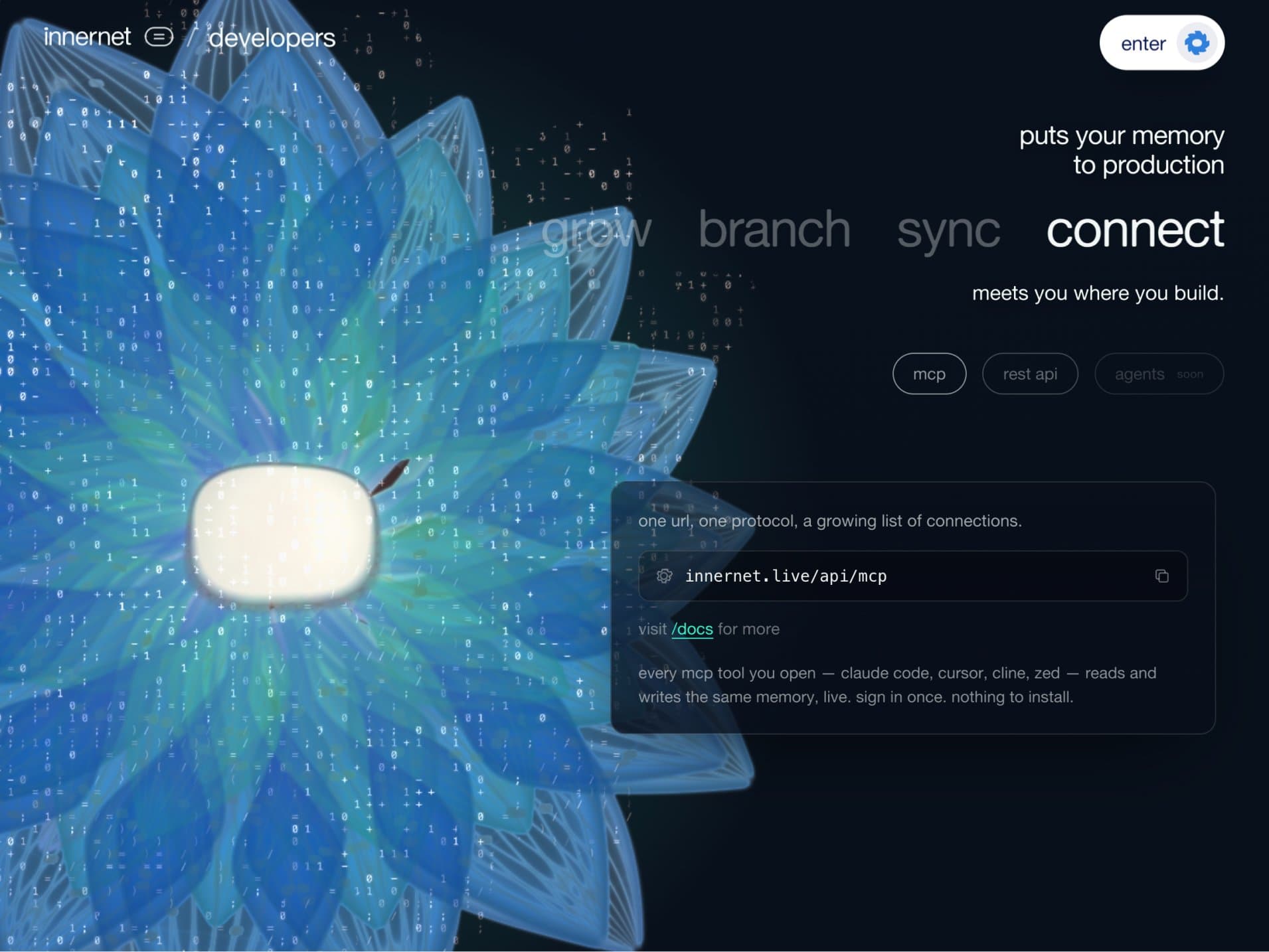
About this app
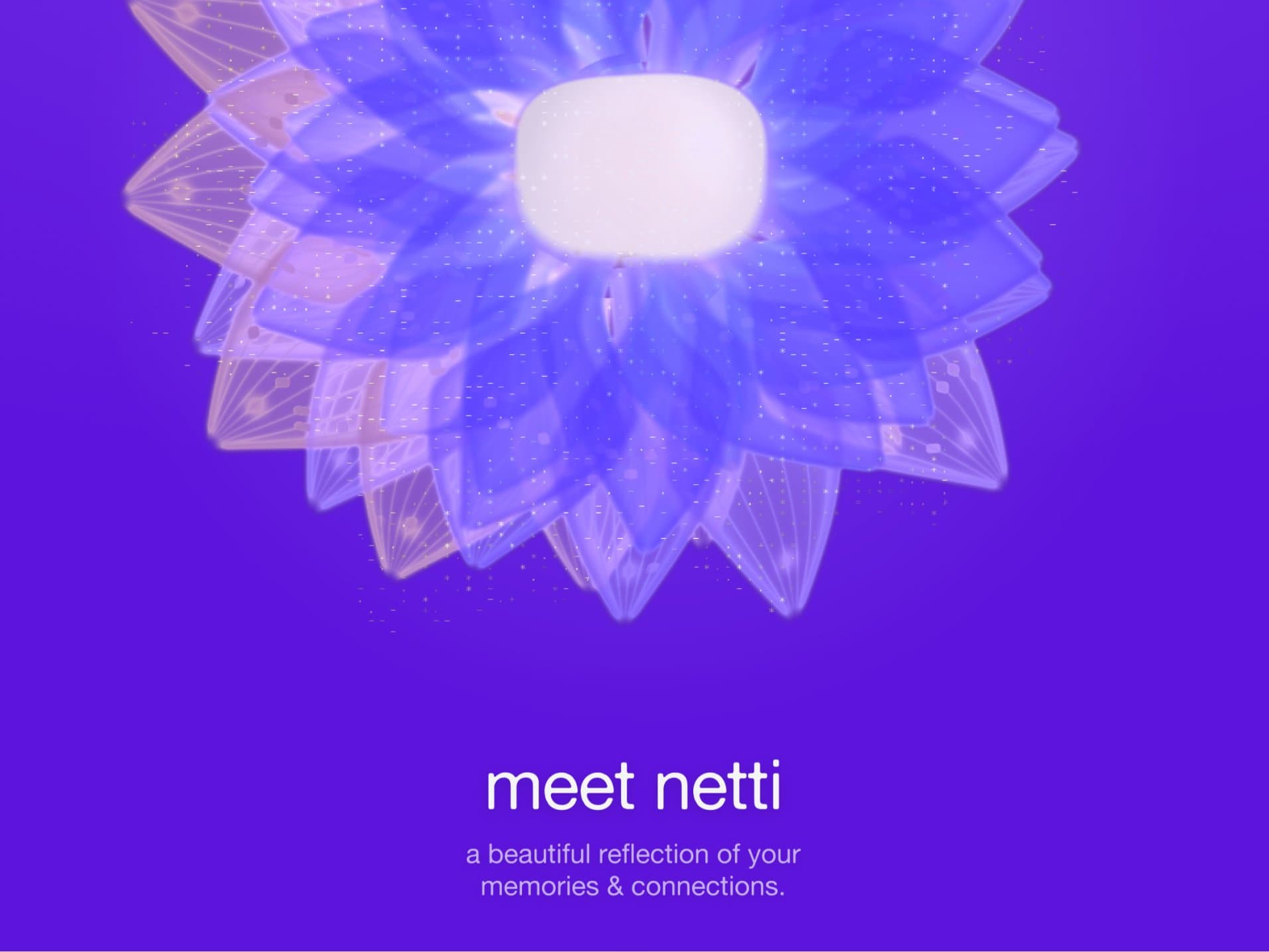
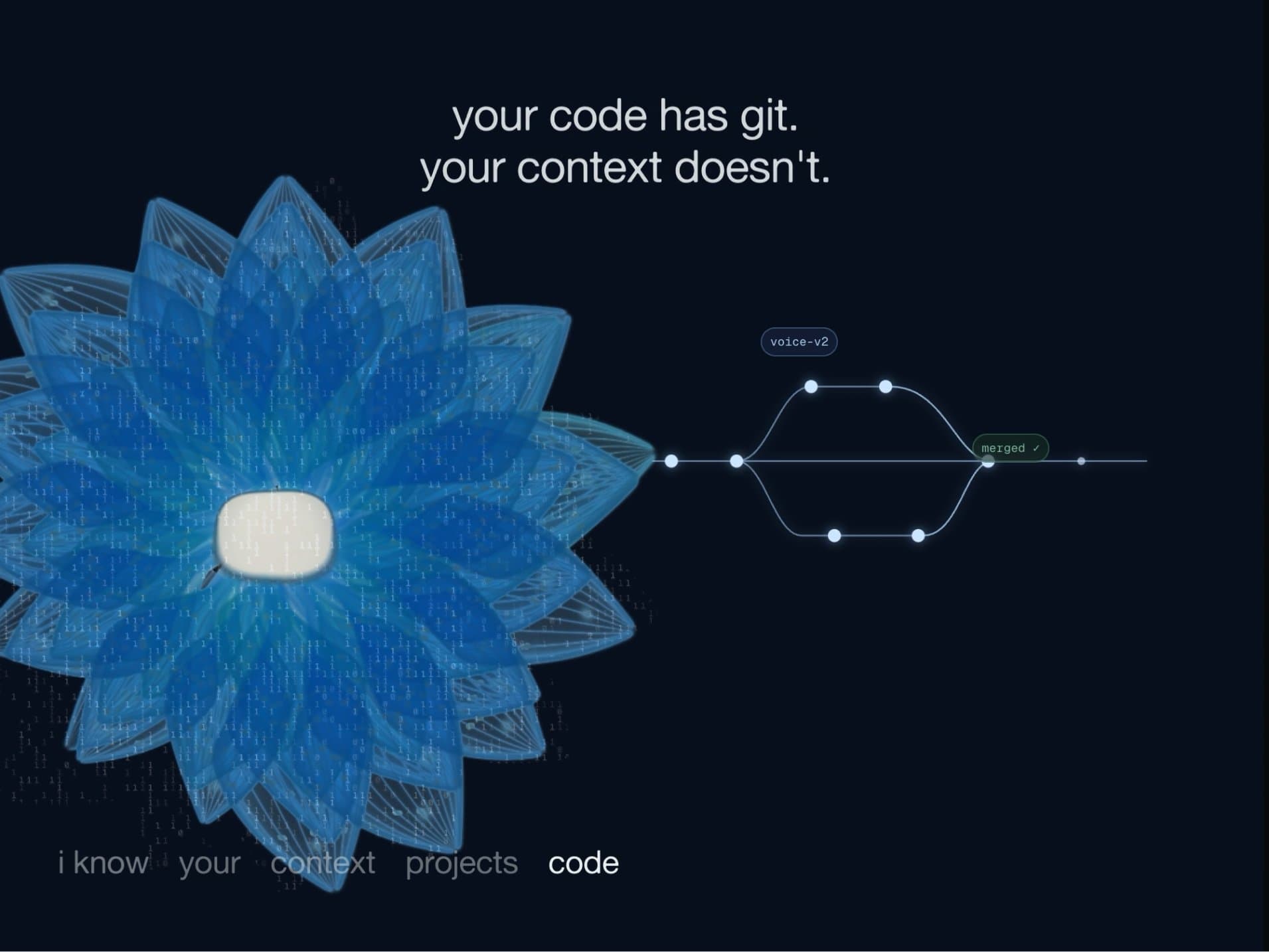
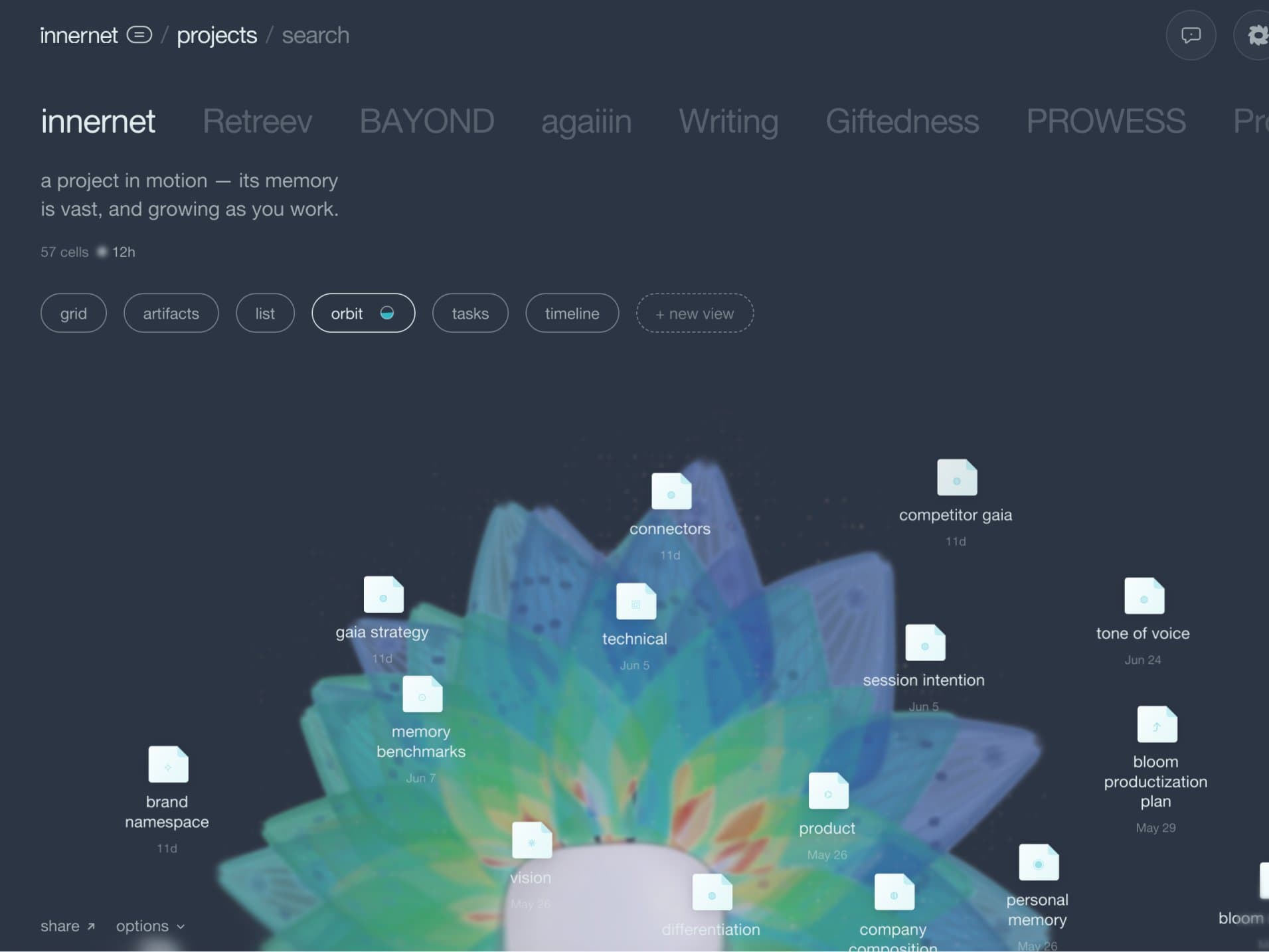
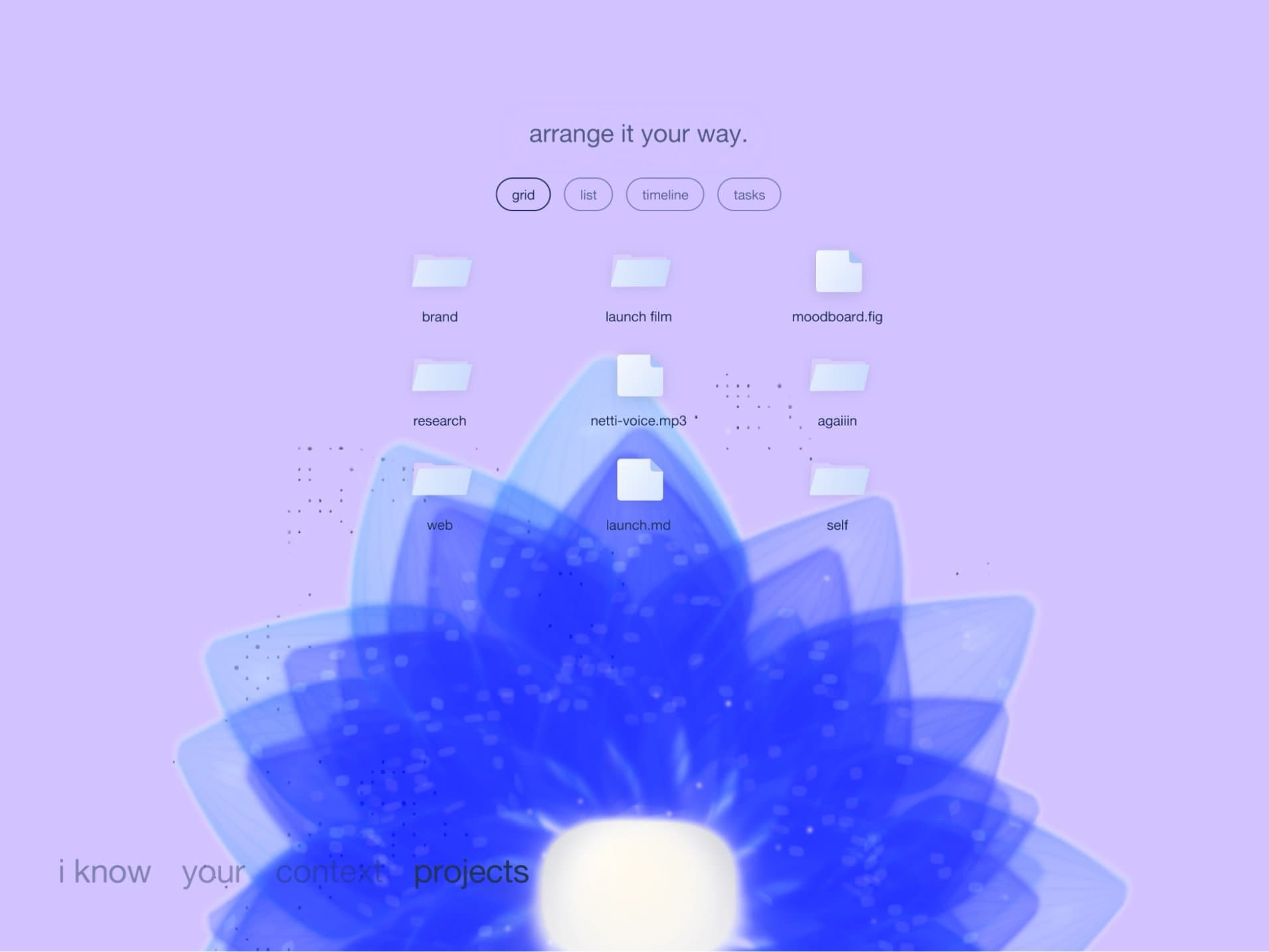
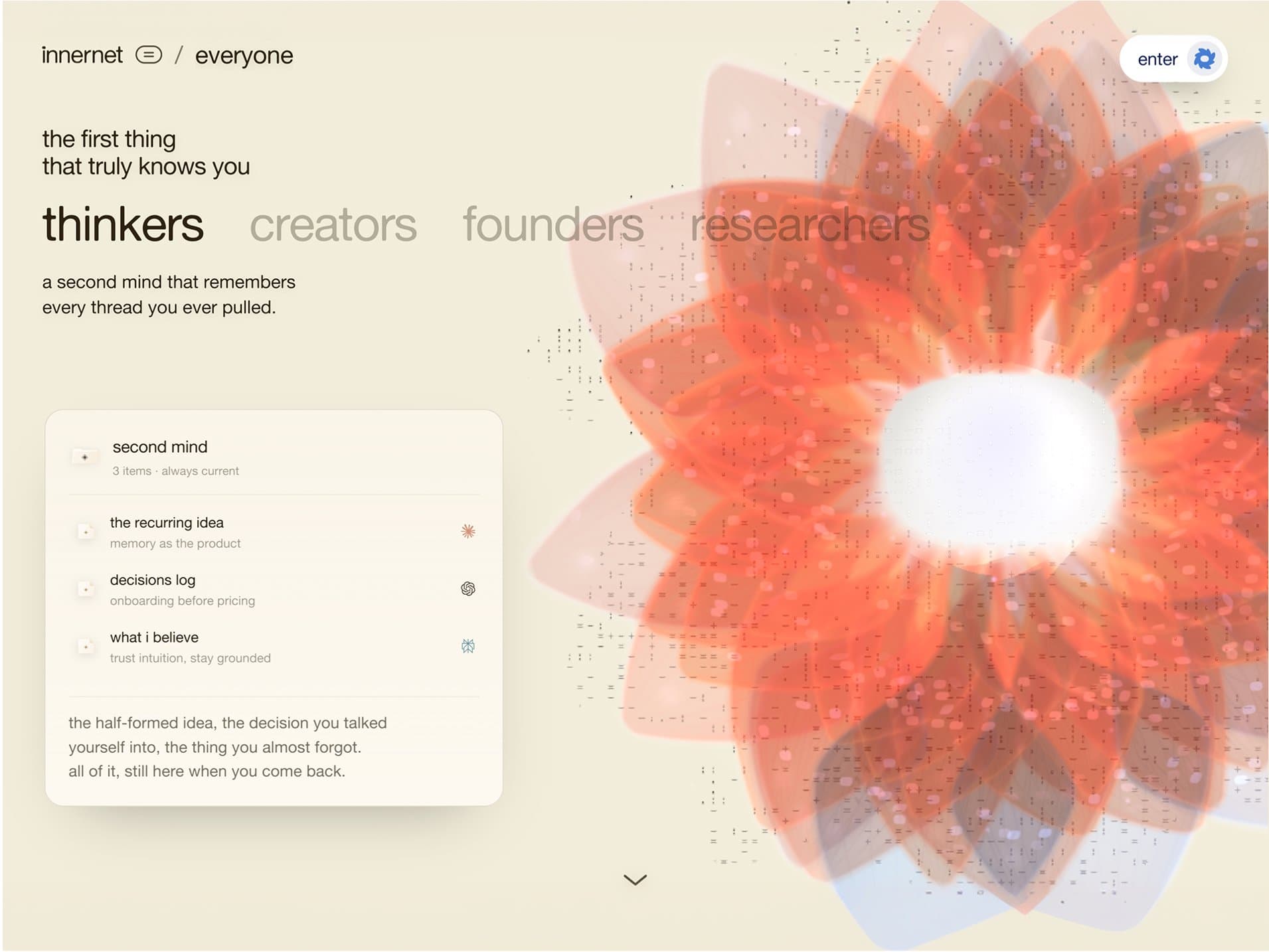
Innernet is a persistent, versioned memory layer for your digital life. It quietly observes your work across AI tools like ChatGPT, Claude, Cursor, and Perplexity, capturing decisions, preferences, and context so that every tool you use stays in sync. Think of it as a searchable, evolving 'second brain' that lives at the center of your workflow. With row-level security, hashed tokens, OAuth 2.1, and optional field-level encryption, your memory stays private and yours. It offers MCP, REST API, and a Git-like anchor for code repos, making it ideal for developers, creators, and researchers who want to stop re-explaining context and just build.
Key features
- 1MCP + REST API for live context sync across ChatGPT, Claude, Cursor, Perplexity and more.
- 2Versioned, branchable memory maps with commit logs and capture protocols per project.
- 3Row-level security, hashed tokens, OAuth 2.1, optional field encryption, GDPR controls.
Target customer profile
Drawn from the product itself, not from a survey.
Demographic
Solo developers and indie hackers
Pain points
Losing context between coding sessions; repeating setup instructions to AI tools
Primary needs
Seamless memory persistence across development tools; minimal setup
Demographic
Content creators and writers
Pain points
Scattered notes and drafts; losing voice and research threads
Primary needs
Centralized, versioned memory for ideas and brand voice; cross-tool sync
Demographic
Researchers and analysts
Pain points
Disconnected sources and synthesis; difficulty tracking evolving findings
Primary needs
Living document that auto-structures research; memory that grows with exploration
Scout Review
Written by AI from measured evidence, scored out of 100.
Innernet offers a compelling vision for a versioned, privacy-first memory layer that syncs context across AI coding and research tools. Its strength lies in thoughtful security details and seamless MCP/REST integrations that directly address the pain of losing context between sessions. The polished site and quick-setup promise make it attractive for solo developers and creators. However, being in early beta with no pricing, demos, or user feedback yet means it remains unproven. It sits ahead of basic note-taking alternatives in AI-tool depth but behind established players in maturity and ecosystem.
Measure by measure
Usability
68Fast MCP setup and clear docs make onboarding sound painless for devs already using supported tools.
Design
72Polished, modern landing with elegant code examples and memory visualizations that feel thoughtful and on-brand.
Speed
55Site feels snappy with lightweight presentation; real-time sync claims untested publicly.
Security
62Strong-sounding claims around row-level security, hashed tokens, and OAuth match the app description exactly.
Accessibility
48Responsive design visible but zero accessibility documentation or standards mentioned anywhere.
Growth
32Extremely early beta with waitlist only; tiny social mentions and no reviews or community yet.
Improvement areas
- Add public pricing page and live demo to reduce friction for early adopters.
- Build community presence (GitHub, Discord) and gather initial user feedback.
- Address accessibility gaps and pursue basic compliance documentation.
Design & Usability
Innernet's landing page nails a clean, developer-friendly aesthetic with well-crafted code snippets and memory timeline visuals that communicate the 'persistent second brain' concept effectively. The design feels modern and consistent, avoiding clutter while highlighting integrations with tools like Claude and Cursor. Usability shines in the promised frictionless MCP connection — sign in once via OAuth and context flows across sessions without extra installs. Documentation at /docs provides clear starting points for developers. However, the absence of a live demo or public pricing page keeps it from feeling fully ready for broad adoption. Overall, it positions well for its target solo devs and researchers who hate re-explaining context.
Speed & Security
The site itself performs smoothly with no noticeable load issues, supporting quick browsing of features. Real-time memory sync via MCP and REST API is central to the pitch, though no independent benchmarks exist yet. Security stands out with concrete, verifiable claims: row-level database enforcement, hashed access tokens, OAuth 2.1, optional field encryption, and GDPR-compliant export/delete controls. These align directly with the product description and privacy section. Still early days mean no third-party audits or SOC 2 reports, which is typical but leaves some uncertainty. For a memory layer handling personal context across AI tools, the transparency on data handling is a solid foundation compared to many indie tools.
Accessibility & Growth
Accessibility receives minimal attention — the responsive layout and readable text are baseline positives, but there's no mention of WCAG compliance, alt text practices, or screen reader support. This is common for very new products but represents a gap versus more mature peers. Growth is the weakest area: as of July 2026 the product is in pre-launch beta with a waitlist, planned launch around early July, and only scattered social mentions on LinkedIn and Reddit. No GitHub activity, review platform presence, or community metrics exist for this specific innernet (distinct from the unrelated 2021 WireGuard project). Trajectory depends entirely on successful beta execution and word-of-mouth among indie hackers.
Conclusion
If you're tired of repeating yourself to every new AI chat, innernet is worth joining the waitlist to test once it opens. Just temper expectations — this is very much a product still finding its footing in a crowded second-brain space.
Suggestions for improvement
- Publish pricing and a live demo to convert waitlist interest faster.
- Add a public changelog and GitHub presence for developer trust.
- Implement basic accessibility audits and document WCAG efforts.
- Secure an independent security review or SOC 2 path as usage grows.
Alternatives comparison
Named competitors, point by point. Nobody paid to appear here or to be left out.
 innernet |  Mem.ai |  Notion AI | Rewind.ai | |
|---|---|---|---|---|
| Live AI tool integration (MCP/REST sync across multiple tools) | Yes - MCP endpoint + REST for ChatGPT, Claude, Cursor, Perplexity etc. | Limited - AI note-taking but no deep multi-tool live sync | Partial - Notion AI workspace but not automatic live memory from external tools | No - Screen/meeting recording, local-only, no developer tool focus |
| Versioned/branchable memory with commit history | Yes - Git-like branches, merges, commit logs on context maps | Basic versioning on notes | Page history but not structured branching for memory | Timeline recording but no versioned branching |
| Privacy & security features (row-level, encryption, OAuth) | Strong claims: row-level security, hashed tokens, OAuth 2.1, opt-in encryption | Standard encryption and privacy controls | Enterprise SSO, encryption, SOC 2 | Local-only storage emphasis |
Mem.ai
An AI note-taking app that aims to capture and retrieve personal knowledge, but lacks deep AI tool integration.
Notion AI
A collaborative workspace with built-in AI, but not designed for live, automatic memory from multiple tools.
Rewind.ai
A personal AI that records screen activity and meetings, but is local-only and less focused on developer workflows.
Comparing options? See innernet alternatives, scored side by side
Sources
What the review was written against. A verdict with no sources is an opinion.
- instagram.com×4
- innernet.live×3
- reddit.com×3
- github.com×2
- youtube.com
- backpackinglight.com
- gracker.ai
- simon-frey.com
- cybersectools.com
- netbird.io
- yelp.com
- linkedin.com
- glassdoor.com
- zoominfo.com
- spectrum.com
- news.ycombinator.com
- att.com
- focusbroadband.com
- dnb.com
- innernet.net
- compareinternet.com
- blog.tonari.no
- archlinux.org
- allconnect.com
- innernetinc.com
More Development & Engineering apps
View all Development & Engineering
CreateMyCoin
92A no-code Solana token creator that deploys SPL tokens in...

Vibe Coding Agent Skills
92A free, open-source platform offering 110 AI agent skills...

CC Switch
91Open-source desktop app for switching AI coding providers...

DemoVexa
90Turn your code into professional product demo videos with AI-generated scripts, animated UI, and natural voiceovers.

TaxID
90Fast EU VAT validation API for developers, covering 27 EU...

Olevx
89112 free client-side web tools plus a private autosaving ...

FontPlop
89Browser-based font viewer & tester for TTF, OTF, WOFF, WO...

deed.page
89Permanent web hosting for AI agents, no human step

Denpex
89AI-powered GPU failure diagnosis for distributed ML training

Webfetch
89Web scraping API that turns any URL into HTML, text, Mark...

BeartIMAGE
88BeartIMAGE is a free, web-based image processing platform engineered for fast, bulk photo editing and conversion directly in your browser.

Claw Messenger
88Claw Messenger is an iMessage API service that gives AI a...


A platform dedicated to providing unbiased reviews of newly launched applications, analyzing everything from their features to their full potential.
info@scoutforge.net© 2026 Scoutforge. All rights reserved.
