Cycling through all six. Tap any point to stop.
Measured on six things
Jev AI turns raw state into structured decisions—fast, ch...
Security
50HTTPS and DMARC/SPF are in place, but zero CSP, HSTS, frame protection, or secure cookies — 4/13 on the header checklist. No published audits found.
Screenshots
1 / 1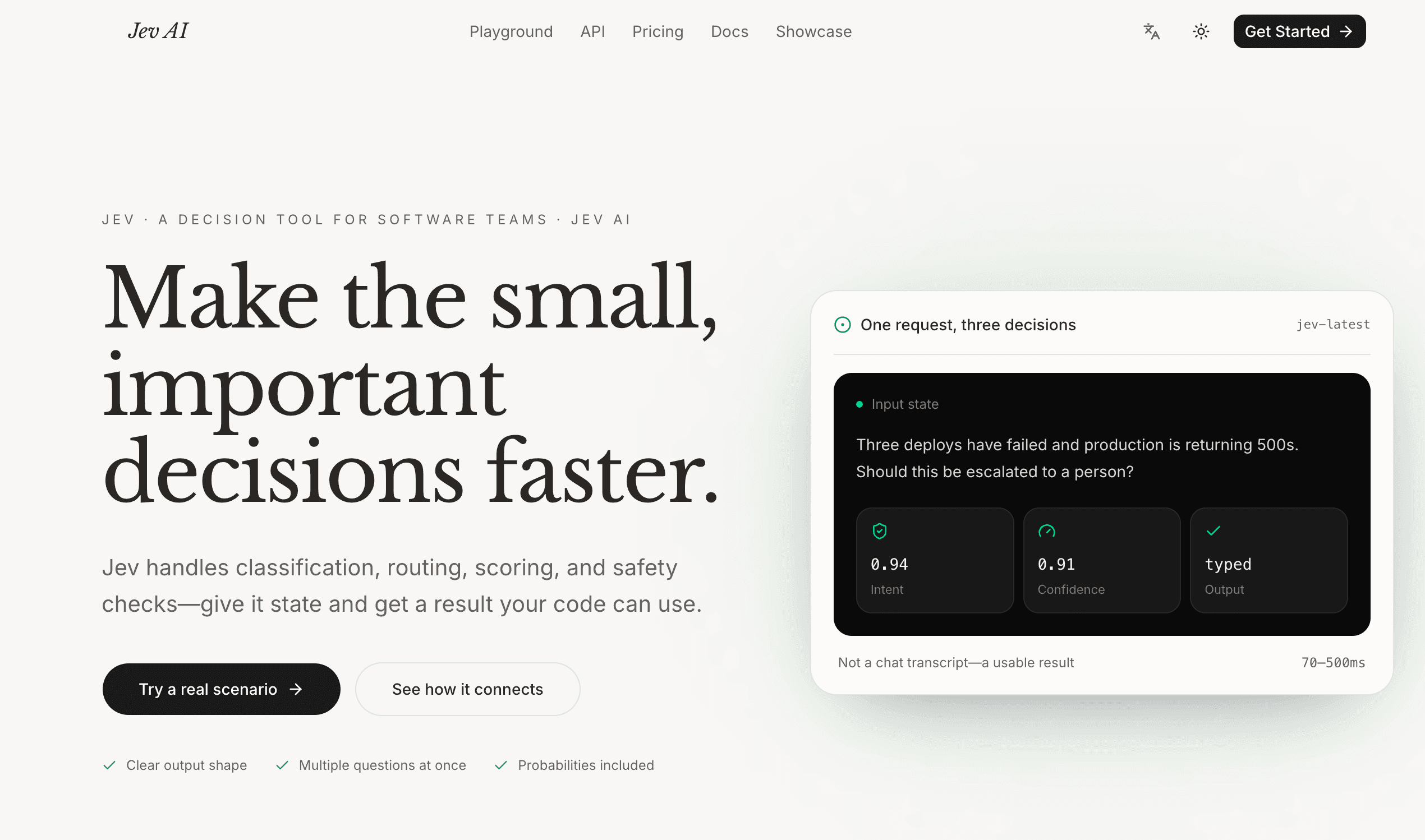
About this app
Jev AI is a fresh take on AI for developers who need to make small decisions at scale. Instead of generating chatty paragraphs, it takes your input state and answers typed questions—choice, score, or noul (yes/no)—with probabilities. That means you can plug the output directly into your code for routing, classification, moderation, or guardrails. The playground is free and runs without a waitlist, so you can try it on real scenarios like ticket triage or content tagging. It supports multiple questions per request and models from various providers including TypeSafe, Cloudflare, Perplexity, and others. Pricing is per credit, no subscription required, and there's a dedicated API endpoint. It's not for generating prose—it's for making reliable, auditable decisions inside your system.
Key features
- 1Typed decision outputs (choice, score, noul) with probabilities and confidence for direct code branching
- 2Free, no-waitlist playground with side-by-side state, questions, and API request preview
- 3Multi-question parallel requests against shared state across a 14-model decision directory
- 4Credit-based one-time pricing ($10/$100/$1,000) with no subscription or expiry
Target customer profile
Drawn from the product itself, not from a survey.
Demographic
Software developers building AI agents
Pain points
Chaining multiple LLM calls for simple decisions, managing async logic, and dealing with unpredictable outputs
Primary needs
Typed, probabilistic outputs that can be used directly in if/switch statements and agent workflows
Demographic
Product teams implementing content moderation or triage
Pain points
Manual review queues, inconsistent classification, and slow routing decisions
Primary needs
Fast, scalable decision-making for support tickets, user-generated content, and safety checks
Demographic
AI engineers evaluating decision models
Pain points
Comparing model performance on specific tasks requires custom scripts and infrastructure
Primary needs
A single playground to test multiple decision models with real data and inspect probabilities
Scout Review
Written by AI from measured evidence, scored out of 100.
Jev AI is a focused, developer-first take on the 'decisions, not prose' idea: send state, ask typed questions, get probabilities your code can branch on. The playground is free and waitlist-free, the docs are clear, and the multi-model directory is a smart hedge against any single provider. Design is clean but marred by a broken hero video and unfinished-looking result states. Speed is fine on desktop, sluggish on mobile. Security is the real gap — a 4/13 header checklist and no published audits for a product that wants to sit in your production decision path. Accessibility is mid: 86/100 with five failing audits and no statement. Growth is promising but unproven against OpenAI and Cloudflare.
Measure by measure
Usability
66Free no-waitlist playground plus a 4-step quickstart gets you from state to API key fast. Side-by-side state/questions/request panel is genuinely well thought out.
Design
68Clean off-white layout, disciplined typography, and a split playground that mirrors the typed-output pitch. Undercut by a broken hero video and thin model-card links.
Speed
58Desktop 85 but mobile 62 with a 5.9s LCP and 3.8s FCP — the hero video that won't even play is likely dragging first paint down.
Security
50HTTPS and DMARC/SPF are in place, but zero CSP, HSTS, frame protection, or secure cookies — 4/13 on the header checklist. No published audits found.
Accessibility
58Lighthouse 86/100 but failing contrast, heading order, missing alt text, unnamed links, and no main landmark. Language switcher is a plus; no a11y statement.
Growth
62Real, specific problem: typed probabilistic decisions for code. Clear wedge vs. OpenAI/Cloudflare, but early (domain 0.1 yrs) and crowded by model providers shipping their own deciders.
Improvement areas
- Security headers are largely absent (4/13 checklist) and no published audits or security page
- Broken hero video and empty playground result states undermine the otherwise clean design
- Five failing accessibility audits with no a11y statement or WCAG claim
- Mobile performance lags desktop (62 vs 85) with a 5.9s LCP
Design & Usability
The homepage is genuinely well-composed: off-white canvas, tight typographic hierarchy, and a playground panel that puts state, typed questions, and the API request side by side so you understand the product in one glance. Scenario cards (flight search, support triage) do the explaining without a scroll. The cracks are real though — the hero video renders a hard playback error instead of a fallback, the results panel sits empty with instructional filler that reads unfinished, and the model directory's 'Playground'/'Model page' links are so small they nearly vanish. Usability is the stronger half: a free, no-waitlist playground plus a four-step quickstart (state → questions → API key → endpoint) gets a developer to first value in minutes, and the docs spell out the choice/score/noul contract clearly. It's a competent, developer-respecting onboarding — just not a polished one.
Speed & Security
Speed is a tale of two devices: desktop Lighthouse lands at 85, but mobile drops to 62 with a 5.9s LCP and 3.8s FCP. The hero video that fails to load is dead weight on first paint, and CLS at 0 shows the layout itself is stable — this is a payload problem, not a jank problem. Security is the weakest dimension. HTTPS is enforced and SPF/DMARC are configured, but the header probe found no HSTS, no CSP, no frame protection, no X-Content-Type-Options, no Referrer-Policy, no Permissions-Policy, and no secure cookies — 4 of 13 checklist points. No SOC 2, ISO, pen-test, or bug bounty page surfaced in the fetched content. For a product asking developers to route production decisions through its API, that's a thin trust story.
Accessibility & Growth
Accessibility scores 86/100 on Lighthouse but fails five concrete audits: insufficient color contrast, non-sequential heading order, images without alt attributes, links without discernible names, and no main landmark. A language switcher exists, which is a real plus, but there's no accessibility statement or WCAG claim. Growth is the interesting one. The problem is real and specific — developers chaining LLM calls for classification, routing, and moderation want typed, probability-backed outputs they can drop into an if/switch. The wedge (choice/score/noul, parallel questions, a 14-model directory) is concrete and the pricing is credit-based with no subscription. But the category is getting crowded: OpenAI and Cloudflare both ship decision layers, and the domain is only 0.1 years old. Room to grow, no proof yet that it will.
Conclusion
If you're building agents and tired of parsing chatty paragraphs into enums, Jev's typed output contract is worth an afternoon in the free playground. Go in with eyes open: the security posture is thin, so don't route anything sensitive through it until they publish headers and an audit. The idea is right, the execution is early, and the next six months will tell you whether this becomes infrastructure or a demo.
Suggestions for improvement
- Replace the broken hero video with a static thumbnail or a working fallback so first paint isn't wasted on a playback error.
- Ship a real security page: HSTS, CSP, frame protection, and a SOC 2 or pen-test summary for teams routing production decisions.
- Fix the five failing accessibility audits — alt text, link names, heading order, contrast, and a main landmark — and publish an a11y statement.
- Give the playground a populated example result on load so the right panel doesn't read as unfinished UI.
Alternatives comparison
Named competitors, point by point. Nobody paid to appear here or to be left out.
 Jev AI |  OpenAI Decisions API |  Cloudflare Clef | |
|---|---|---|---|
| Typed decision output (choice/score/yes-no with probabilities) | Yes — choice, score, noul with probabilities and confidence | Yes — structured outputs for classification and routing | Yes — text and JSON structured decisions |
| Free playground / trial without waitlist | Yes — free online playground, no waitlist | Limited preview, may require waitlist | Available via Cloudflare developer platform |
| Multiple model providers in one interface | Yes — 14 decision models across providers | No — OpenAI models only | No — Cloudflare Clef models only |
| Pricing model | Credit-based one-time plans ($10/$100/$1,000), no subscription | Usage-based API pricing (limited preview) | Usage-based via Cloudflare platform |
| Edge deployment focus | Not emphasized; API endpoint focus | Not emphasized | Yes — designed for edge routing and evaluation |
OpenAI Decisions API
OpenAI's limited-preview decision layer for classification, routing, and agent next steps. It offers structured outputs but may require a waitlist and is tightly integrated with OpenAI models.
Cloudflare Clef
Cloudflare's open structured decision model for routing, evaluation, and agent boundaries, often used at the edge. It focuses on text and JSON decisions with a specific API.
Comparing options? See Jev AI alternatives, scored side by side
More API Service apps
View all API Service
CC Switch
91Open-source desktop app for switching AI coding providers...

TaxID
90Fast EU VAT validation API for developers, covering 27 EU...

SiftingIO - Market Data API
88Real-time & historical market data API for stocks, forex,...

Claw Messenger
88Claw Messenger is an iMessage API service that gives AI a...

OBVELO
88Privacy gateway that masks personal data in LLM traffic

tradutor de mangá com IA
88O tradutor de mangá com IA traduz capítulos em lote, personaliza textos e oferece edição visual para estúdios.

Giftronaut
87.5gift card software, international gift card, international visa gift card, gift card API

QRocodile
87Design And Animate QR Codes People Want to Scan

StockFit API
87A developer-first financial data API providing structured...

Plori
87Cloud AI agents with persistent disk, memory, and real CL...

QVeris AI
86Connect AI agents to 10,000+ real-world tools and APIs

Split Forms
86Free contact form backend for any website


A platform dedicated to providing unbiased reviews of newly launched applications, analyzing everything from their features to their full potential.
info@scoutforge.net© 2026 Scoutforge. All rights reserved.
