Cycling through all six. Tap any point to stop.
Measured on six things
Typed AI decisions as a simple JSON API.
Speed
57Lighthouse mobile 61/100 with a 12.2s LCP — the hero and playground assets are heavy. Desktop 66/100. CLS is excellent (0.001) and FCP is fast (1.2s), so the page paints early then stalls on the big stuff.
Screenshots
1 / 1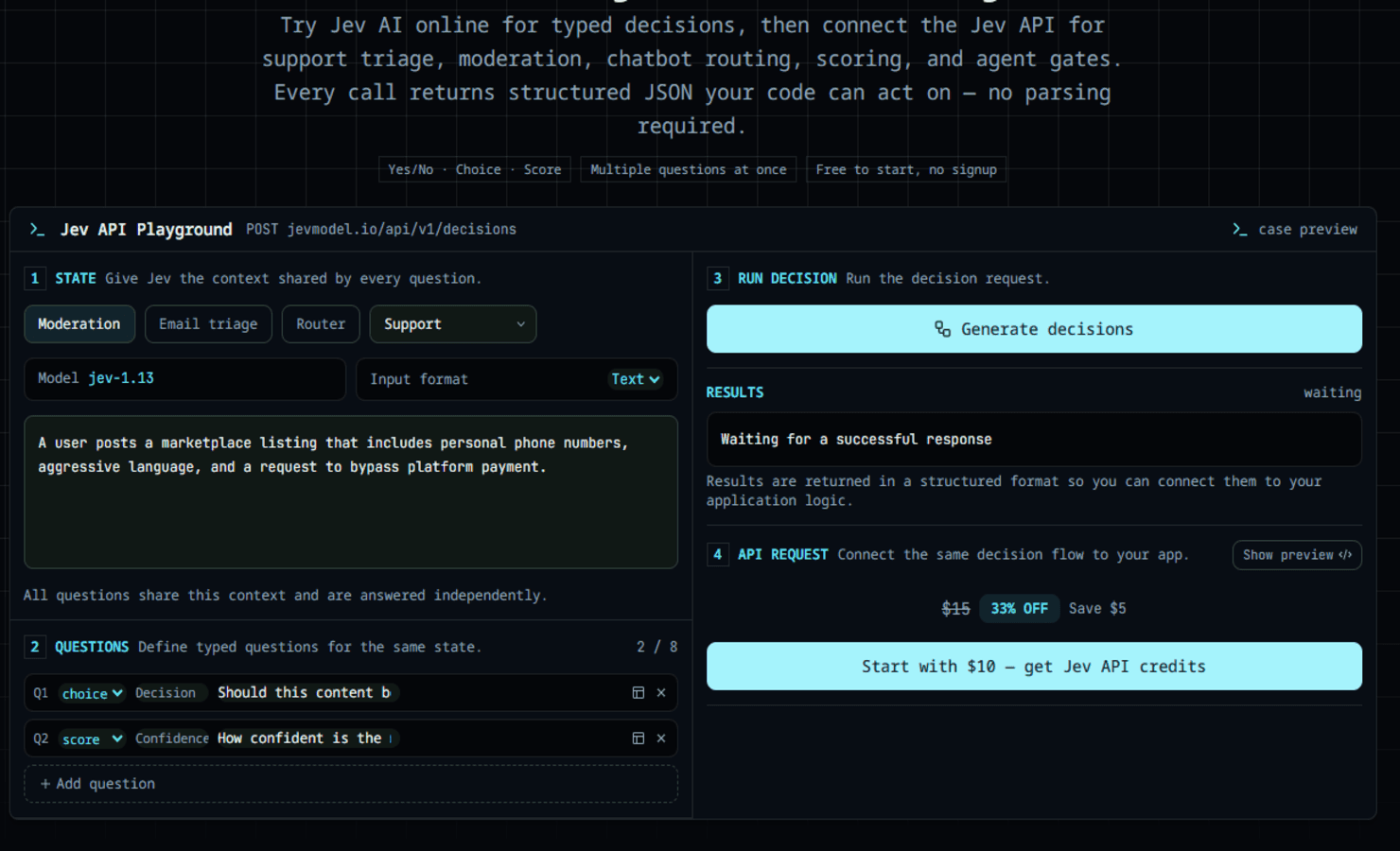
About this app
Let me cut to the chase: Jev Model isn't another chat interface. It's a typed decision layer that returns structured JSON—think { decision: 'route_to_sales', confidence: 0.92, reason: '...' }—so your code can act without parsing paragraphs of text. You define the schema (yes/no, choice, score), give it context, and Jev answers with stable fields. I've seen too many teams duct-tape prompt engineering into their workflows; Jev flips that by giving you a narrow, auditable contract. It's perfect for support triage, content moderation, chatbot routing, lead scoring, or gating agent actions before they touch production systems. The playground is genuinely useful—you can test scenarios and see the JSON response instantly. Pricing is credit-based and straightforward: 100k credits for $10, 1M for $100, and 11M for $1000, with 1,000 free credits daily to kick the tires. Each decision call uses 1 credit, regardless of how many questions you ask, which keeps costs predictable. From a developer'...
Key features
- 1Typed decision schemas (yes/no, choice, score) returning stable JSON with decision, confidence, reason, and route fields.
- 2No-signup playground with 1,000 free daily credits for testing scenarios before buying.
- 3One-time credit packs: $10/100k, $100/1M, $1000/11M, valid 365 days, 1 credit per decision call.
- 4Use cases: support triage, content moderation, chatbot routing, lead scoring, and agent action gating.
Target customer profile
Drawn from the product itself, not from a survey.
Demographic
Backend developers at SaaS startups
Pain points
Wasting time parsing free-text LLM outputs; brittle prompt engineering; inconsistent routing logic.
Primary needs
Stable JSON responses for workflow routing; easy API integration; predictable pricing.
Demographic
Product managers building AI features
Pain points
Unreliable moderation gates; unclear audit trails; slow iteration on decision logic.
Primary needs
Typed decision schemas; confidence scores and reasons; fast playground for testing.
Demographic
AI engineers building agent systems
Pain points
Agents making unsafe tool calls; lack of deterministic gates; complex cost control.
Primary needs
Narrow decision contracts; credit-based metering; stable endpoint for production.
Scout Review
Written by AI from measured evidence, scored out of 100.
Jev Model API is a typed decision layer that returns structured JSON — { decision, confidence, reason } — instead of free-text LLM output. The pitch is sharp and the target is clear: backend devs who are tired of regex-ing JSON out of chat completions. The site backs it up with an inline playground preview, transparent one-time pricing ($10/100k, $100/1M, $1000/11M credits), and 1,000 free daily credits with no signup. Where it stumbles: mobile LCP of 12.2s, accessibility failures on the exact form-heavy UI that is the product, no visible API docs, and a security posture that's header-strong but audit-silent. A competent, clearly-positioned indie API with real upside if the docs and a11y catch up.
Measure by measure
Usability
63No-signup playground with 1,000 free daily credits is a real try-before-buy. Pricing is transparent one-time packs. But there's no visible API reference, SDK, or changelog in the fetched content — devs will want docs before wiring this into production.
Design
58Dense but coherent single-page site with an inline 4-step playground preview that actually shows the product. Branding is thin — 'ToolForX' header and a placeholder-feeling tagline undercut an otherwise competent layout.
Speed
57Lighthouse mobile 61/100 with a 12.2s LCP — the hero and playground assets are heavy. Desktop 66/100. CLS is excellent (0.001) and FCP is fast (1.2s), so the page paints early then stalls on the big stuff.
Security
74Strong header posture: HTTPS, HSTS, CSP, frame protection, X-Content-Type-Options, Referrer-Policy all set (10/12 checklist). Stripe handles checkout. Gaps: no Permissions-Policy, no SPF record, and no SOC 2 / ISO / pen-test claims published.
Accessibility
58Lighthouse 82/100 with real failures: insufficient contrast, unlabeled form elements and selects, color-only link distinction, undersized touch targets. No WCAG statement or a11y page. The playground's form-heavy UI is exactly where these bite.
Growth
62Real, specific wedge: typed JSON decisions for routing, moderation, and agent gates — a genuine pain vs. parsing free-text LLM output. Named segments and clear use cases. Ceiling is the one-time credit model and lack of team/enterprise tier.
Improvement areas
- Mobile performance: 12.2s LCP needs image compression, deferred playground JS, and lazy-loaded sections.
- Accessibility: unlabeled form fields/selects, low contrast, color-only links, and small touch targets in the playground.
- Documentation: no visible API reference, SDK, error codes, or changelog beyond the homepage FAQ.
- Business model: one-time credits with no team/enterprise tier or subscription option limits recurring revenue.
Design & Usability
Jev Model's site is a single dense page that does the job: hero, an inline four-step playground preview, use-case grid, schema examples, pricing, and FAQ. The playground preview is the strongest design decision — it shows the actual request/response flow instead of a stock illustration. Weaknesses: the 'ToolForX' header and 'YOUR AI SYSTEM 1' tagline read like unfilled template slots, and there's no real app screenshot beyond the playground. On usability, the no-signup playground with 1,000 free daily credits is a genuine try-before-buy, and one-time pricing is refreshingly simple. The gap is documentation: no visible API reference, SDK, or changelog in the fetched content, which is a problem for a product whose buyers are backend developers wiring it into production.
Speed & Security
Speed is the weak spot. Lighthouse mobile performance lands at 61/100 with a 12.2s largest contentful paint — the hero and playground assets are heavy enough that mobile users wait a long time for the main content. Desktop is 66/100. The good news: CLS is 0.001 and FCP is 1.2s, so layout is stable and the page paints early. Security is stronger: HTTPS enforced, HSTS, CSP, frame protection, X-Content-Type-Options, and Referrer-Policy all present (10/12 checklist points), and Stripe handles checkout so card data never touches Jev's servers. Gaps: no Permissions-Policy header, no SPF record, and no published SOC 2, ISO, or pen-test claims — enterprise buyers will want more than headers before sending production traffic.
Accessibility & Growth
Accessibility is the weakest measured dimension. Lighthouse scores 82/100 but the failing audits are the ones that matter for a form-heavy playground: insufficient color contrast, form elements and select elements without labels, links distinguishable only by color, and touch targets too small. There's no accessibility statement or WCAG conformance claim on the site. Growth potential is genuinely interesting: the wedge — typed JSON decisions for routing, moderation, lead scoring, and agent gates — addresses a real developer pain (parsing free-text LLM output, brittle prompt engineering) and names specific segments. Compared to OpenAI Function Calling (requires prompt engineering, no metering) and Amazon Comprehend (AWS setup, not a general decision API), Jev's narrow contract plus credit metering is a defensible position. The limit is the business model: one-time credit packs with 365-day validity and no team or enterprise tier cap how far this scales.
Conclusion
If you're a backend dev who has written one too many JSON.parse() calls on an LLM response, Jev is worth the free 1,000 daily credits to test. The playground is real, the pricing is honest, and the use cases (triage, moderation, routing, agent gates) are the ones that actually hurt in production. Before you commit, though: check whether the API reference exists beyond the homepage, verify the response schema handles your edge cases, and don't expect enterprise compliance paperwork yet. It's a promising narrow tool — not a platform.
Suggestions for improvement
- Publish a real API reference with request/response examples, error codes, and rate limits — the playground is not documentation.
- Fix the mobile LCP (12.2s): compress hero images, defer the playground bundle, and lazy-load below-the-fold sections.
- Add labels to every form element and select in the playground, and raise contrast on links — the a11y failures are on your core UI.
- Add a team/enterprise tier or subscription option; one-time credit packs with 365-day expiry cap recurring revenue.
Alternatives comparison
Named competitors, point by point. Nobody paid to appear here or to be left out.
 Jev Model API |  OpenAI Function Calling |  Amazon Comprehend | |
|---|---|---|---|
| Structured JSON output | Native — every call returns typed JSON (decision, confidence, reason, route) by design. | Yes, via function schemas — but requires prompt engineering and schema discipline. | Returns classification labels/scores, not a general-purpose typed decision contract. |
| Built-in credit metering | Yes — 1 credit per decision call, one-time packs from $10 to $1000. | Token-based billing, no per-decision metering. | AWS usage-based pricing per unit processed, no decision-level metering. |
| Free tier / try-before-buy | 1,000 free credits daily, no signup required for the playground. | Pay-per-token from the first call; no free daily allowance. | AWS free tier limited; requires account setup. |
| Setup complexity | Low — define schema, send context, get JSON. No prompt engineering. | Medium — requires prompt design, schema definition, and parsing logic. | Higher — AWS account, IAM, and service configuration for custom schemas. |
| Auditability / reason field | Yes — every response includes a reason string for audit trails. | Depends on prompt; not guaranteed in the schema. | Confidence scores yes; free-text reasoning no. |
OpenAI Function Calling
Allows LLMs to output structured JSON via function schemas, but requires prompt engineering and lacks built-in credit metering or a dedicated decision-focused API.
Amazon Comprehend
AWS NLP service for classification and moderation, but not a general-purpose typed decision API and often requires more setup for custom schemas.
Comparing options? See Jev Model API alternatives, scored side by side
More API Service apps
View all API Service
CC Switch
91Open-source desktop app for switching AI coding providers...

TaxID
90Fast EU VAT validation API for developers, covering 27 EU...

SiftingIO - Market Data API
88Real-time & historical market data API for stocks, forex,...

Claw Messenger
88Claw Messenger is an iMessage API service that gives AI a...

OBVELO
88Privacy gateway that masks personal data in LLM traffic

tradutor de mangá com IA
88O tradutor de mangá com IA traduz capítulos em lote, personaliza textos e oferece edição visual para estúdios.

Giftronaut
87.5gift card software, international gift card, international visa gift card, gift card API

QRocodile
87Design And Animate QR Codes People Want to Scan

StockFit API
87A developer-first financial data API providing structured...

Plori
87Cloud AI agents with persistent disk, memory, and real CL...

QVeris AI
86Connect AI agents to 10,000+ real-world tools and APIs

Split Forms
86Free contact form backend for any website


A platform dedicated to providing unbiased reviews of newly launched applications, analyzing everything from their features to their full potential.
info@scoutforge.net© 2026 Scoutforge. All rights reserved.
