Cycling through all six. Tap any point to stop.
Measured on six things
Open-source AI video generator for native 4K HDR with mul...
Speed
45Lighthouse mobile performance 51/100 with LCP 12.1s, TBT 411ms. Desktop 69/100. Heavy media assets likely cause slow load. No user complaints found.
Screenshots
1 / 1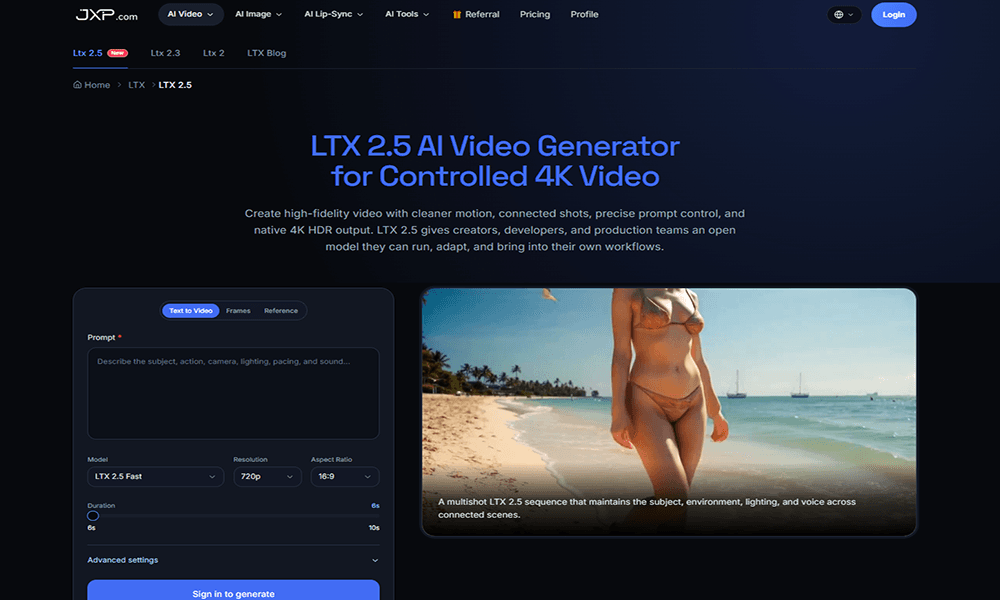
About this app
LTX 2.5 is an open-weight AI video generation model that stands out for its ability to produce native 4K HDR footage, cleaner motion, and connected multishot scenes. It's not just another AI video tool; it's built for creators who need control and want to own their workflow. You can run it locally or in the cloud, fine-tune it on your own data, and integrate it into professional pipelines, whether you're a filmmaker, developer, or researcher. The model uses Diffusion Fidelity Rendering to preserve detail and follows complex prompts with precision. With open weights, you're not locked into a closed ecosystem. I've been experimenting with video AI for a while, and LTX 2.5 feels like a breath of fresh air—practical, powerful, and remarkably flexible.
Key features
- 1Open-weight model with local deployment and fine-tuning capabilities.
- 2Native 4K HDR output with Diffusion Fidelity Rendering for detail preservation.
- 3Native multishot continuity for connected scenes with consistent characters and environments.
Target customer profile
Drawn from the product itself, not from a survey.
Demographic
Filmmakers and video editors (25-50, both genders, creative professionals)
Pain points
Struggle to generate consistent, production-ready footage; limited control over multi-shot scenes; concerns about resolution and color fidelity for professional workflows
Primary needs
Native 4K HDR output, multishot continuity, precise prompt adherence, and ability to integrate into existing post-production pipelines.
Demographic
Developers and ML engineers (20-45, technical background, working in AI or software)
Pain points
Dependency on closed AI services; lack of model transparency; high API costs; inability to customize or fine-tune for specific use cases
Primary needs
Open weights, local deployment options, fine-tuning capability, integration with tools like ComfyUI, and code access for adaptation.
Demographic
Studios and production teams (business, 5-100+ employees, media/entertainment industry)
Pain points
Need for scalable and efficient video generation; costly and inflexible cloud solutions; data privacy concerns when using external services
Primary needs
Private infrastructure execution, fine-tuning on proprietary data, pipeline control, and high-quality output suitable for professional finishing.
Scout Review
Written by AI from measured evidence, scored out of 100.
LTX 2.5 is an open-weight AI video generator with impressive output quality and a clear value proposition for creators who want control and customization. The design is polished, and the app's model-first approach is user-friendly. However, usability is hampered by the sign-in requirement on the homepage, and the app store listing shows a broader JXP app rather than a focused LTX tool. Performance is slow on mobile, and security headers are incomplete. Accessibility is decent but has fixable issues. Growth potential is high due to the open-weight differentiator, but traction is early.
Measure by measure
Usability
58Homepage requires sign-in before any generation, blocking trialability. App store shows broad JXP app, not dedicated LTX interface. Pricing is clear with credit system, but no demo path.
Design
72Strong visual examples and consistent dark theme; app UI is model-first and clear. Red banner clashes with aesthetic, and app screenshots show broader JXP app rather than focused LTX tool.
Speed
45Lighthouse mobile performance 51/100 with LCP 12.1s, TBT 411ms. Desktop 69/100. Heavy media assets likely cause slow load. No user complaints found.
Security
52HTTPS and HSTS present, SPF/DMARC set. Missing key security headers (CSP, frame protection, etc.). No SOC 2 or pen-test reports found. Basic security posture for a SaaS.
Accessibility
70Lighthouse accessibility 88/100. Failing audits: ARIA input names, button names, contrast ratio, visible labels mismatch. No a11y statement found. Site is responsive and keyboard-navigable.
Growth
68Open-weight model with local deployment and fine-tuning is a clear differentiator. Targets multiple segments with visible headroom in AI video. Traction signals are early but domain is old.
Improvement areas
- Homepage requires sign-in before any generation, limiting trialability.
- App store listing shows a broad JXP social app rather than a focused LTX tool.
- Mobile performance is slow with LCP of 12.1s; optimize media assets.
Design & Usability
The design is visually strong with a consistent dark theme and compelling output examples. The app's model-first navigation is intuitive, but the homepage's sign-in requirement before any interaction is a major usability barrier. The app store screenshots reveal a broader JXP social app rather than a dedicated LTX tool, which may confuse users expecting a focused video generation interface. Pricing is transparent with credit-based tiers, but the lack of a demo or guest mode limits trialability.
Speed & Security
Performance is a concern, especially on mobile with a 12-second LCP. The heavy media content likely contributes to slow load times, though desktop performance is better. Security is basic: HTTPS and HSTS are present, but missing CSP and other headers leave room for improvement. No SOC 2 or similar certifications are published, which may be a concern for enterprise users. The site does have SPF and DMARC, which is a positive for email security.
Accessibility & Growth
Accessibility is above average with an 88/100 Lighthouse score, but specific issues like missing button names and contrast problems need fixing. No accessibility statement is available. Growth potential is strong due to the open-weight model with local deployment and fine-tuning, which differentiates it from closed alternatives like Runway and Pika. The target segments are well-defined, and the category has headroom. However, traction is early, and the app's positioning as a broader JXP platform may dilute focus.
Conclusion
LTX 2.5 has the right idea: open weights, local deployment, and fine-tuning for professional workflows. If they can streamline the onboarding experience and focus the app on the LTX tool, they could become a strong alternative to closed platforms. For now, it's a promising but unpolished entry in the AI video space.
Suggestions for improvement
- Add a guest/demo mode on the homepage to allow immediate generation without sign-in.
- Create a dedicated LTX 2.5 app or section within JXP to avoid confusion with the social app.
- Improve mobile performance by optimizing media assets and reducing LCP.
- Publish a security page with details on data handling and any certifications.
Alternatives comparison
Named competitors, point by point. Nobody paid to appear here or to be left out.
 LTX 2.5 |  Runway |  Pika |  Veo (Google DeepMind) | |
|---|---|---|---|---|
| Open weights | Yes | No | No | No |
| Local deployment | Yes | No | No | No |
| Fine-tuning on private data | Yes | No | No | No |
| Native 4K HDR output | Yes | No (up to 4K but not HDR) | No (up to 1080p) | No (up to 1080p) |
| Multishot continuity | Yes | Limited | Limited | Limited |
Runway
A closed-source AI video generation platform that offers intuitive tools and managed infrastructure, but lacks model open weights and local deployment options.
Pika
An AI video generator known for creative control and ease of use, but it's cloud-based and doesn't provide open model access for customization.
Veo (Google DeepMind)
A powerful AI video model available through cloud APIs, offering high quality but with limited control and no open weights for private deployment.
Comparing options? See LTX 2.5 alternatives, scored side by side
More AI Generations apps
View all AI Generations
Uni-1 by Luma AI
92Uni-1 is an advanced multimodal text-to-image AI model th...

LTX 2.3 AI Video Generator
91Fast, open-source AI video generator with 4K support, mul...

IraVoice
88Private on-device dictation for Apple-silicon Macs.

OBVELO
88Privacy gateway that masks personal data in LLM traffic

tradutor de mangá com IA
88O tradutor de mangá com IA traduz capítulos em lote, personaliza textos e oferece edição visual para estúdios.

Pixelimg
88A free online AI-powered tool that instantly converts ima...

HeyVid AI
88HeyVid AI is a free all-in-one AI video and image generat...

RestorePhotosApp
88An AI-powered photo restoration app that brings old, blur...

Mygom SEO
87MygomSEO is an AI marketing agent that audits your site, writes SEO content, publishes to 12+ CMS platforms, posts to social, and monitors rankings 24/7.

pause.do
87A privacy-first browser extension that inserts gentle pau...

DeepSwapAI
87AI face swap online with no subscription, pay per use.

ContentIQ
87AI writer that fact-checks before writing, with real sour...


A platform dedicated to providing unbiased reviews of newly launched applications, analyzing everything from their features to their full potential.
info@scoutforge.net© 2026 Scoutforge. All rights reserved.
