
A platform dedicated to providing unbiased reviews of newly launched applications, analyzing everything from their features to their full potential.
info@scoutforge.net© 2026 Scoutforge. All rights reserved.
A platform dedicated to providing unbiased reviews of newly launched applications, analyzing everything from their features to their full potential.
info@scoutforge.net© 2026 Scoutforge. All rights reserved.
A platform dedicated to providing unbiased reviews of newly launched applications, analyzing everything from their features to their full potential.
info@scoutforge.net© 2026 Scoutforge. All rights reserved.
Cycling through all six. Tap any point to stop.
Measured on six things
AI lecture notes with live transcription, translation, an...
Mobile performance 57/100 with LCP 8.1s — slow for a landing page. Desktop is excellent at 90/100. CLS 0.004 and TBT 212ms are good, but initial load hurts.
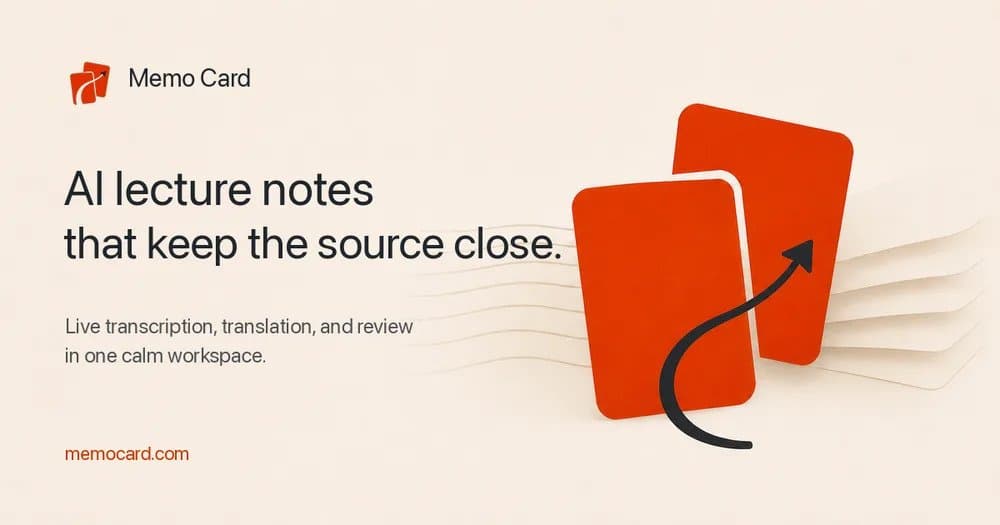
Memo Card transforms live or recorded lectures into an interactive learning experience. As your professor speaks, it provides real-time transcription and translation, then organizes the content into structured notes, summaries, mind maps, quizzes, and an AI tutor that cites timestamps. The platform is designed for students who want to stay engaged in class without frantic typing, and for those who need to revisit key moments later. With its source-linked approach, every piece of generated material is verifiable against the original audio, ensuring accuracy and trust. Whether you're a non-native speaker following lectures in a second language or a student juggling multiple demanding courses, Memo Card streamlines your study workflow, making review efficient and effective. It's a browser-based tool, so no installation is needed, and it prioritizes privacy with clear deletion options for all your data.
Drawn from the product itself, not from a survey.
Demographic
International students studying in non-native languages
Pain points
Struggle to understand fast lectures, accents, and technical vocabulary; note-taking is difficult while trying to comprehend a second language.
Primary needs
Real-time translation, bilingual notes, and accurate transcription to follow along and review.
Demographic
Busy college and university students with heavy course loads
Pain points
Feeling overwhelmed by multiple lectures, missing key points, and spending hours trying to organize notes afterward.
Primary needs
Efficient organization of lecture content into searchable, structured notes with timestamps for quick review and study.
Demographic
Students with learning differences such as ADHD or auditory processing disorders
Pain points
Difficulty sustaining attention during long lectures and retaining information; traditional note-taking is challenging.
Primary needs
Visual aids like mind maps, the ability to replay specific parts, and AI-generated summaries to simplify comprehension.
Demographic
Students who prefer self-paced learning and revisit content
Pain points
In-person lectures are fleeting, and recorded content can be tedious to sift through; finding specific topics takes time.
Primary needs
Recorded audio support, searchable transcripts, and exportable notes for flexible study.
Written by AI from measured evidence, scored out of 100.
Memo Card is a promising early-stage tool with a genuinely differentiated approach: source-linked, verifiable AI lecture notes. The landing page's hero demo is impressive and the design is polished, but below-the-fold emptiness and mobile performance issues (LCP 8.1s) undermine the experience. Security is basic but not alarming, and accessibility is strong at 96/100. The real question is growth — the target audience of international students and those with learning differences is underserved, and the source-linked timestamps are a compelling reason to choose Memo Card over Otter or Notion. However, the lack of visible docs, the 'Early Access' positioning, and the crowded market mean execution will be critical. If the product delivers on its promise of verifiable, bilingual study materials, it could find a loyal niche. For now, it's a solid idea with a decent landing page and room to grow.
Clear workflow from live capture to study materials; demo UI intuitive. But no docs/help center visible, and navigation dropdowns may confuse. Pricing transparent with Stripe checkout.
Polished, card-focused aesthetic with realistic live-transcript demo. Below-the-fold empty gradient and hero overlap issues hold it back. Solid, above-average landing page craft.
Mobile performance 57/100 with LCP 8.1s — slow for a landing page. Desktop is excellent at 90/100. CLS 0.004 and TBT 212ms are good, but initial load hurts.
HTTPS and DMARC/SPF present, Stripe handles payments securely. But zero security headers (HSTS, CSP, etc.) and no SOC 2/ISO evidence. Basic but not egregious for early-stage.
Lighthouse 96/100 is strong; only contrast ratio fails. No WCAG statement or keyboard nav docs, but core site is accessible. Bilingual support is a plus.
Clear wedge: source-linked, verifiable AI notes for international students. Underserved niche with real pain; category has headroom. Execution and traction are the question.
Memo Card's landing page is a mixed bag. The hero demo is genuinely impressive — a realistic live-transcript UI with bilingual captions, timestamps, and speaker labels that feels like actual product footage rather than a static mockup. The card-based aesthetic with rounded corners and soft shadows is cohesive and calming. However, the below-the-fold section renders as a large empty gradient, and the hero card awkwardly overlaps the background curve. Navigation is compact but the '5+' dropdown and 'Workspace' label may confuse first-time visitors. There's no visible docs or help center, which is a miss for a tool that promises to streamline study workflows. The pricing page is clear and transparent, with Stripe handling payments securely. Overall, the design is above average for an early-stage product, but usability would benefit from clearer navigation and a visible support/resources section.
Performance is a tale of two devices. Desktop scores a solid 90/100, but mobile crawls at 57/100 with an 8.1-second LCP — a dealbreaker for students who might access the site on the go. The CLS of 0.004 is excellent, and TBT at 212ms is acceptable, but the initial load is the bottleneck. Security is basic: HTTPS is enforced, and SPF/DMARC are present, but the absence of HSTS, CSP, and other headers leaves room for improvement. The pricing page's transparency about Stripe handling payments (PCI Level 1) is a plus, but there's no evidence of SOC 2 or other certifications. For an early-stage product, this is acceptable but not exceptional. The lack of security headers is a common oversight that should be addressed as the product matures.
Accessibility is a bright spot — Lighthouse scores 96/100, with only a contrast ratio issue flagged. The site is keyboard-navigable and supports bilingual interfaces (English/Chinese), which aligns with its target audience. However, there's no WCAG statement or dedicated accessibility documentation, and the language toggle's small flag icons may pose contrast challenges. Growth potential is promising: the source-linked, verifiable AI notes approach is a genuine differentiator in a crowded market. The target segments — international students, those with ADHD, and self-paced learners — are underserved and have real pain points. The category has headroom, but competition from Otter.ai and Notion AI is fierce. The wedge is clear, but execution and marketing will determine whether Memo Card can carve out a sustainable niche.
Conclusion
Memo Card has the right idea at the right time. The source-linked approach to AI notes is a genuine innovation that addresses real trust issues with AI-generated study materials. The bilingual support and focus on international students is a smart wedge. But the product needs to prove itself: faster mobile load times, visible documentation, and clearer navigation would go a long way. The pricing is reasonable — $299 for a year of unlimited use is competitive. If the team can execute on the product's promise and build a community around it, Memo Card could become a staple for students who need more than just transcription. For now, it's a promising start with a clear vision and a few rough edges to smooth out.
Named competitors, point by point. Nobody paid to appear here or to be left out.
 Memo Card Memo Card |  Otter.ai Otter.ai |  Notion AI Notion AI |  Evernote Evernote | |
|---|---|---|---|---|
| Real-time transcription | Yes, with live bilingual captions | Yes, real-time transcription | No live transcription | Audio recording only, no transcription |
| Translation support | Real-time bilingual translation | No translation | No translation | No translation |
| Source-linked timestamps | Yes, every note/answer cites timestamps | Basic timestamps in transcript | No | No |
| AI study tools (quizzes, mind maps) | Yes, quizzes, mind maps, AI tutor | Summaries only | AI summaries, no quizzes/mind maps | No AI study tools |
| Pricing model | Prepaid credits or $299/year unlimited | Freemium, Pro ~$16.99/month | Freemium, Plus ~$10/month | Freemium, Personal ~$14.99/month |
Otter.ai
An AI meeting and lecture transcription tool that provides real-time notes and summaries, but lacks integrated translation and source-linked study features.
Notion AI
A productivity and note-taking app with AI features that can summarize and organize information, but it doesn't offer live lecture capture or translation.
Evernote
A note-taking app with audio recording and search, but lacks AI-powered transcription, translation, and connected study materials.
Comparing options? See Memo Card alternatives, scored side by side

A weekly newsletter delivering curated tech jobs, intervi...

A unified platform replacing 12-20 disconnected tools for...

A massive collection of free printable coloring pages for...

AI-powered HireVue practice with timed mock interviews, role-specific questions, transcripts, scoring, and actionable feedback.

AI-powered law school study platform with 20,000+ case br...

All-in-one CIRO exam prep for CIRE and 8 other exams, wit...

Free timed practice for SHL, numerical, and logical tests...

Custom illustrated children's books created around your c...

Turn timers into powerful routines with automation, widge...

Turn your content into a branded mobile app with home, co...

Browser extension that translates as you read, building v...

Free 80-item RAADS-R autism self-assessment for adults, with instant total and domain scores, privacy-first access, and clear non-diagnostic guidance.
A platform dedicated to providing unbiased reviews of newly launched applications, analyzing everything from their features to their full potential.
info@scoutforge.net© 2026 Scoutforge. All rights reserved.