Cycling through all six. Tap any point to stop.
Measured on six things
On-demand AI visibility checks and page audits, no subscr...
Growth
62Real problem (AI answer visibility), clear pay-per-use wedge against subscription rivals, and a citability audit. Category has headroom but incumbents are moving fast.
Screenshots
1 / 3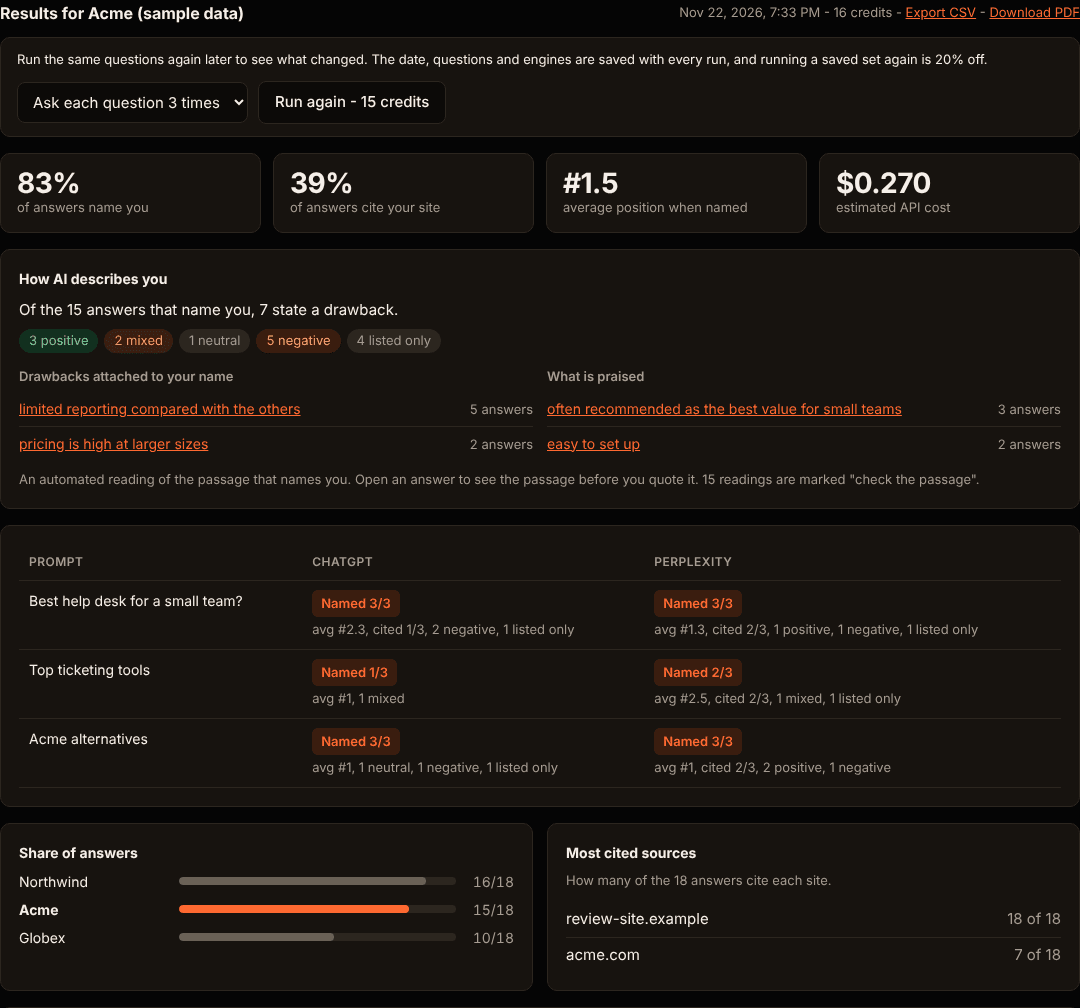
About this app
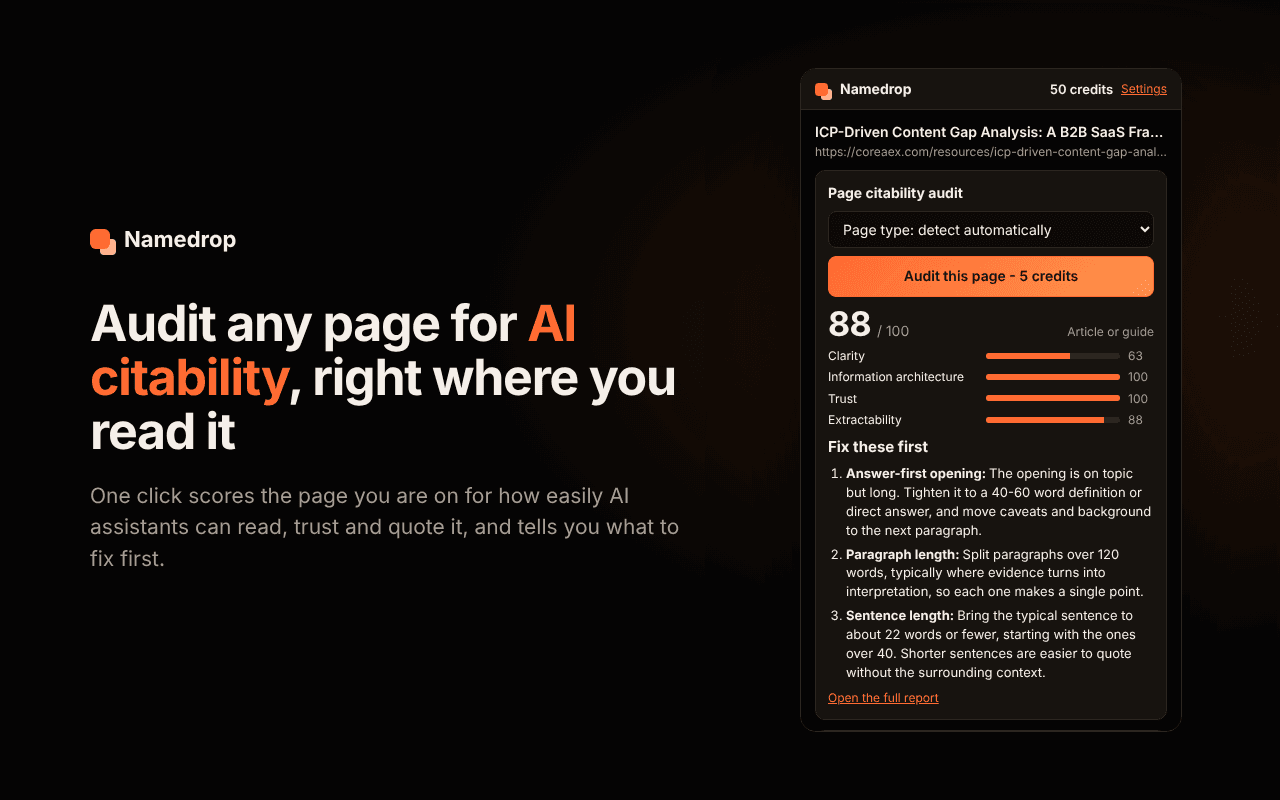
Namedrop is a pay-per-use SEO and content auditing tool from CoreAEX that reveals how often your brand appears in AI-generated answers from ChatGPT, Perplexity, Gemini, and Claude. It asks the engines the questions your buyers actually ask, then shows who gets recommended and which pages get cited—perfect for tracking AI search visibility and competitor share of voice. You can also run a page citability audit that scores any URL on clarity, information architecture, trust, and extractability, with a prioritized fix list. Credits never expire, there's no subscription, and new accounts get 25 free credits, making it a low-risk way to start monitoring your AIO (AI optimization) performance.
Key features
- 1AI answer checker: asks ChatGPT, Perplexity, Gemini, and Claude buyer questions and shows who is named, in what position, and which pages are cited.
- 2Page citability audit: scores any URL on clarity, information architecture, trust, and extractability with a prioritized fix list.
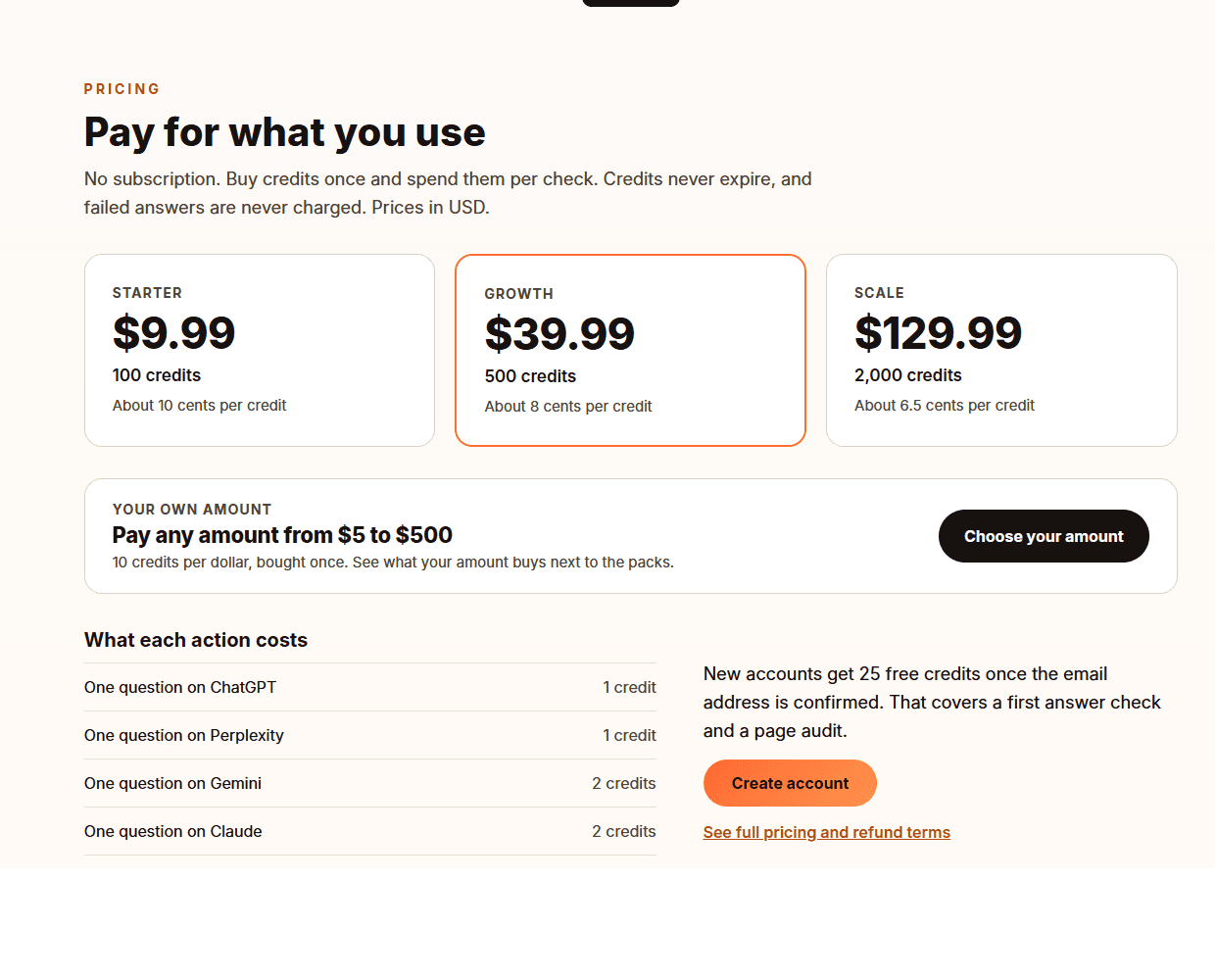
- 3Pay-per-use credits from $9.99 (100 credits), never expiring, with 25 free credits on signup and no subscription.
- 4MCP connector and Chrome extension let you run checks from Claude or the current tab without leaving your workflow.
Target customer profile
Drawn from the product itself, not from a survey.
Demographic
SEO managers and content strategists at B2B SaaS companies
Pain points
Traditional SEO tools ignore AI-generated answers; unsure if brand appears in ChatGPT or Perplexity results.
Primary needs
Monitor AI visibility, track competitor citations, optimize content for AI engines.
Demographic
Digital marketing agencies and freelance SEO consultants
Pain points
Need a scalable, white-label way to audit clients' AI presence without expensive subscriptions.
Primary needs
Run quick audits for multiple clients, export reports, demonstrate ROI to clients.
Demographic
Growth marketers and founders at early-stage startups
Pain points
Limited budget for SEO tools; want to know if AI assistants recommend their product when buyers ask.
Primary needs
Affordable pay-as-you-go checks, actionable insights to improve AI citability, easy setup.
Scout Review
Written by AI from measured evidence, scored out of 100.
Namedrop is a focused, well-executed entry into AI search visibility tracking. It asks ChatGPT, Perplexity, Gemini, and Claude the questions buyers actually ask, then shows who gets named, in what position, and which pages get cited — plus a page citability audit that scores any URL on clarity, architecture, trust, and extractability with a prioritized fix list. The pay-per-use model (credits from $9.99 for 100, never expiring, 25 free to start) is a genuine differentiator against subscription rivals like Profound and Otterly.ai. The site is fast (92 mobile Lighthouse), the onboarding is clear, and the docs are usable. The rough edges are design consistency (the cream pricing band, low-contrast captions, cookie banner overlap) and the absence of published security certifications. For SEO managers and agencies who want to check AI visibility without a monthly commitment, it is a low-risk, competent tool.
Measure by measure
Usability
72Google sign-in above the fold, clear per-action credit costs, and a docs page that actually walks you through the first check. Solid onboarding path.
Design
70Confident orange-on-near-black system with real product UI previews. Cream pricing band breaks the rhythm and low-contrast captions hurt legibility.
Speed
78Lighthouse mobile 92/100 with 2.7s LCP and 8ms TBT; desktop 99/100. Fast, lean, no lag complaints in evidence.
Security
72HTTPS with HSTS, frame protection, SPF and DMARC in place; Paddle handles checkout. Missing CSP and Permissions-Policy; no SOC 2 or audit claims.
Accessibility
80Lighthouse a11y 98/100 with one failing audit (no main landmark). No WCAG statement, but responsive layout and readable contrast in main content.
Growth
62Real problem (AI answer visibility), clear pay-per-use wedge against subscription rivals, and a citability audit. Category has headroom but incumbents are moving fast.
Improvement areas
- Design consistency: the cream pricing band breaks the dark theme, and the cookie banner overlaps the footer/Terms link.
- Accessibility: missing <main> landmark, no WCAG statement, and low-contrast small grey captions.
- Security transparency: no CSP or Permissions-Policy headers, and no published SOC 2, ISO, or pen-test information.
- Growth moat: the pay-per-use model is copyable by subscription incumbents; deeper trend/white-label features would strengthen retention.
Design & Usability
Namedrop's design is a confident, single-accent system: heavy orange display type over near-black, with real product UI previews (an answer table, an 83/100 audit card) instead of abstract illustrations. The hero puts Google sign-in above the fold with 'no card needed' and '25 free credits' stated plainly, which is exactly the right conversion path for a pay-per-use tool. Usability follows through: the pricing page explains what each action costs (1 credit per ChatGPT question, 5 per page audit), and the docs page walks you through your first answer check and page audit step by step. The weak spots are cosmetic but real — the cream pricing band breaks the dark rhythm, the cookie banner overlaps the footer and obscures the Terms link, and several small grey data captions are hard to read at normal size.
Speed & Security
Speed is a genuine strength: Lighthouse mobile performance 92/100 with a 2.7s LCP, 0.043 CLS, and 8ms total blocking time; desktop hits 99/100. That is a lean, snappy site with no evidence of lag complaints. Security is competent but not exceptional: HTTPS is enforced with HSTS, frame protection, X-Content-Type-Options, Referrer-Policy, SPF and DMARC are all present, and checkout is handled by Paddle as merchant of record. What is missing is a Content-Security-Policy and Permissions-Policy, and there are no published SOC 2, ISO, or pen-test claims — normal for an early-stage indie tool, but it keeps the score in the solid-middle band rather than the top.
Accessibility & Growth
Accessibility scores 98/100 on Lighthouse with a single failing audit — the document lacks a main landmark. There is no WCAG or accessibility statement on the site, and some small grey captions are low-contrast, but the responsive layout and main-content contrast are solid. Growth is the more interesting question: Namedrop names a real, current problem (brands have no idea whether ChatGPT or Perplexity recommends them) and differentiates on pay-per-use credits with no subscription, plus a page citability audit with prioritized fixes. Against Profound, Otterly.ai, and Peec AI — all subscription-based AI visibility platforms — the wedge is price and flexibility for agencies and budget-conscious founders. The category has visible headroom as AI search grows, but the incumbents are moving fast and the moat is thin: nothing here gets more valuable as more people adopt it.
Conclusion
If you are an SEO manager or agency wondering whether AI assistants recommend your brand — or your client's — Namedrop is a sensible, low-cost way to find out. The 25 free credits cover a first answer check and a page audit, so you can test the output before spending a dollar. The pay-per-use model suits agencies running occasional client audits better than a $99/month subscription. What it lacks is the depth of a full analytics platform: no trend dashboards at the Starter level, no white-label reporting, and no published compliance certifications. But as a focused, fast, fairly priced tool for a real and growing problem, it earns its place.
Suggestions for improvement
- Fix the cookie-consent banner so it does not overlap the footer and obscure the Terms link.
- Unify the pricing section with the dark theme, or intentionally design a light/dark split that reads as deliberate.
- Increase contrast on small grey data captions ('Not named' pills, 'avg #2.3' labels) to meet WCAG AA.
- Add a Content-Security-Policy and Permissions-Policy header, and publish a security/trust page.
Alternatives comparison
Named competitors, point by point. Nobody paid to appear here or to be left out.
 Namedrop |  Profound |  Otterly.ai |  Peec AI | |
|---|---|---|---|---|
| Pricing model | Pay-per-use credits from $9.99/100; no subscription; credits never expire; 25 free credits | Subscription-based (pricing not verified in collected evidence) | Subscription-based (pricing not verified in collected evidence) | Subscription-based (pricing not verified in collected evidence) |
| AI engines tracked | ChatGPT, Perplexity, Gemini, Claude | AI-generated answers (engines not verified in collected evidence) | ChatGPT, Perplexity and other AI search engines | AI-generated responses (engines not verified in collected evidence) |
| Page citability audit | Yes — scores clarity, information architecture, trust, extractability with prioritized fixes | Not verified in collected evidence | Not verified in collected evidence | Not verified in collected evidence |
| Free tier / trial | 25 free credits on signup, no card needed | Not verified in collected evidence | Not verified in collected evidence | Not verified in collected evidence |
| Workflow integrations | MCP connector for Claude/assistants, Chrome extension (Edge coming soon), CSV export | Not verified in collected evidence | Not verified in collected evidence | Not verified in collected evidence |
Profound
AI visibility analytics platform that tracks how brands appear in AI-generated answers and provides optimization insights.
Otterly.ai
AI search monitoring tool that tracks brand mentions and citations across AI-powered search engines like ChatGPT and Perplexity.
Peec AI
AI search analytics platform that helps brands monitor and improve their visibility in AI-generated responses.
Comparing options? See Namedrop alternatives, scored side by side
More SEO Tools apps
View all SEO Tools
Geogrid
92A UULE-powered local rank tracker for SEO agencies, offer...

Kerbrank
91Local rank tracker for UK businesses with Google Maps heatmaps, ChatGPT visibility checks and a weekly fix list.

BACKLNK
90Backlnk is a free SEO and AI visibility website: 15 website checks, a full audit as a PDF report, and guides to get found in search and AI answers.

CitableReport
89CitableReport is an AI visibility audit:

AuditCloser
89White-label website audits that close deals for digital a...

Lexicon SEO
88Lexicon SEO audits public websites, checks AI-crawler access and gives prioritized fixes. Start free with 1 audit/month for up to 50 pages. Paid plans add weekly monitoring, citation checks and MCP for Claude Code, Cursor and Claude Desktop. Paid citation checks cover Claude, ChatGPT, Gemini and Perplexity.

Cromagnon
88Free, private browser-based PDF, Word, Excel, and study t...

Spek
88Grow your app with self-learning ASO agents

Mover Marketing AI Local SEO
88Specialized SEO services for moving companies to dominate...

named.ae
88named.ae asks ChatGPT, Claude, Gemini, Perplexity and Grok your buyers' questions live, and shows who they name and the pages they read.

Askray
88See who ChatGPT, Gemini & Claude recommend instead of you...

Wajido
88See how your company appears in AI answers


A platform dedicated to providing unbiased reviews of newly launched applications, analyzing everything from their features to their full potential.
info@scoutforge.net© 2026 Scoutforge. All rights reserved.
