Cycling through all six. Tap any point to stop.
Measured on six things
AI SEO article generator that turns keywords into publish...
Growth
58Real problem (AI content chaos, opaque pricing) with a genuine wedge: review-gate-by-default plus transparent per-action credits and refunded failures. Crowded category, but the trust angle is specific.
Screenshots
1 / 3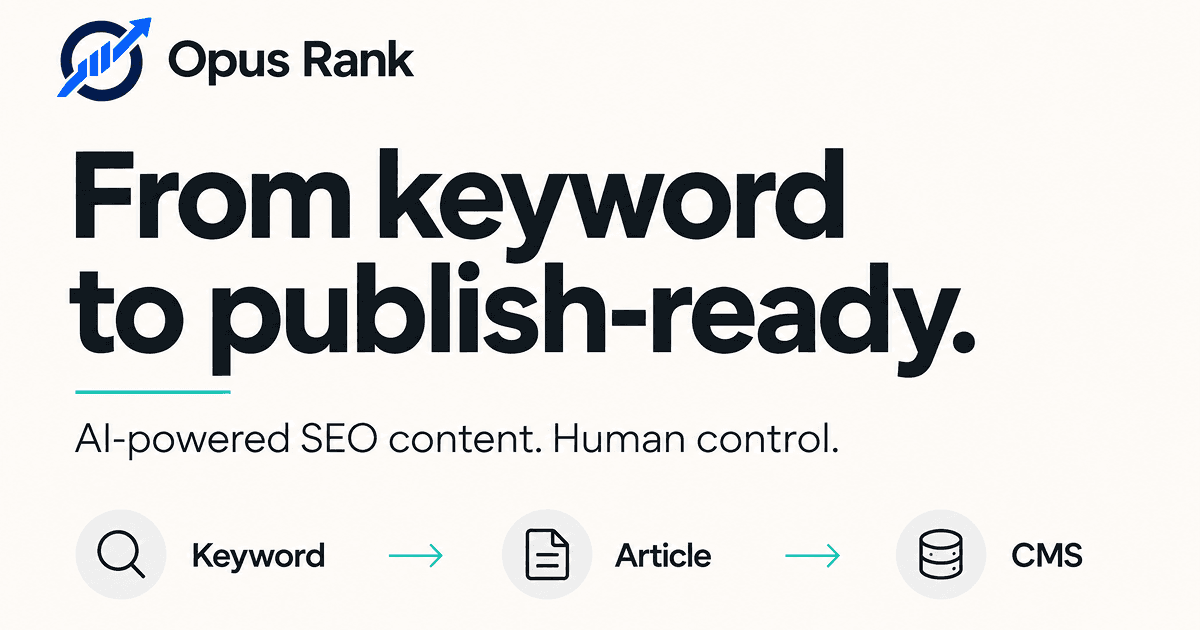
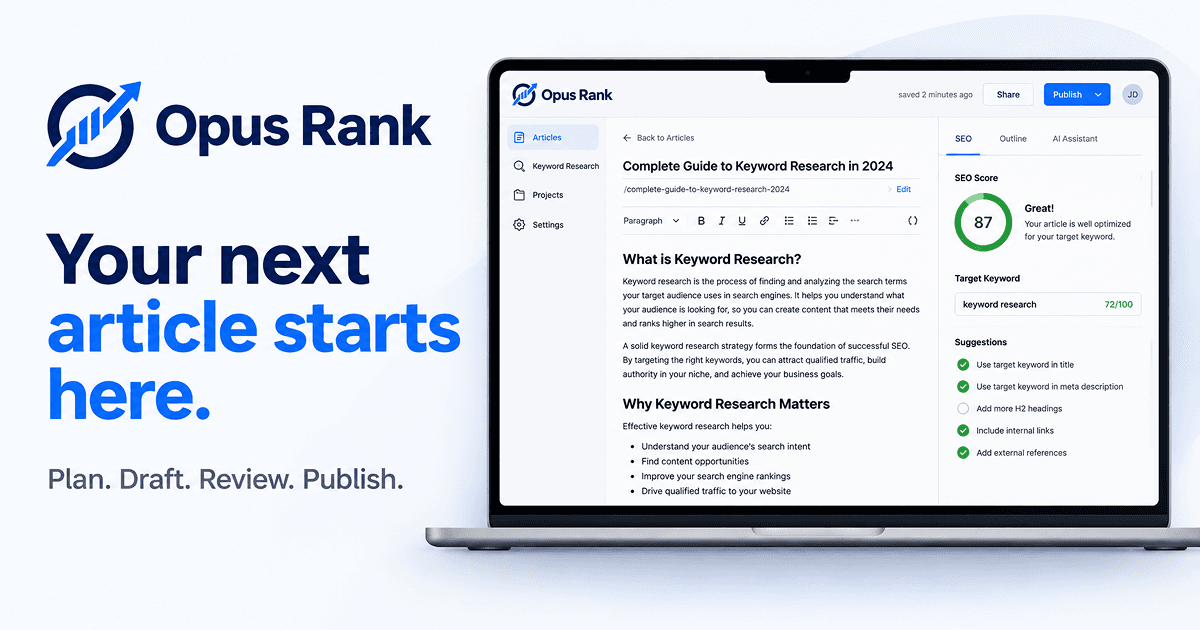
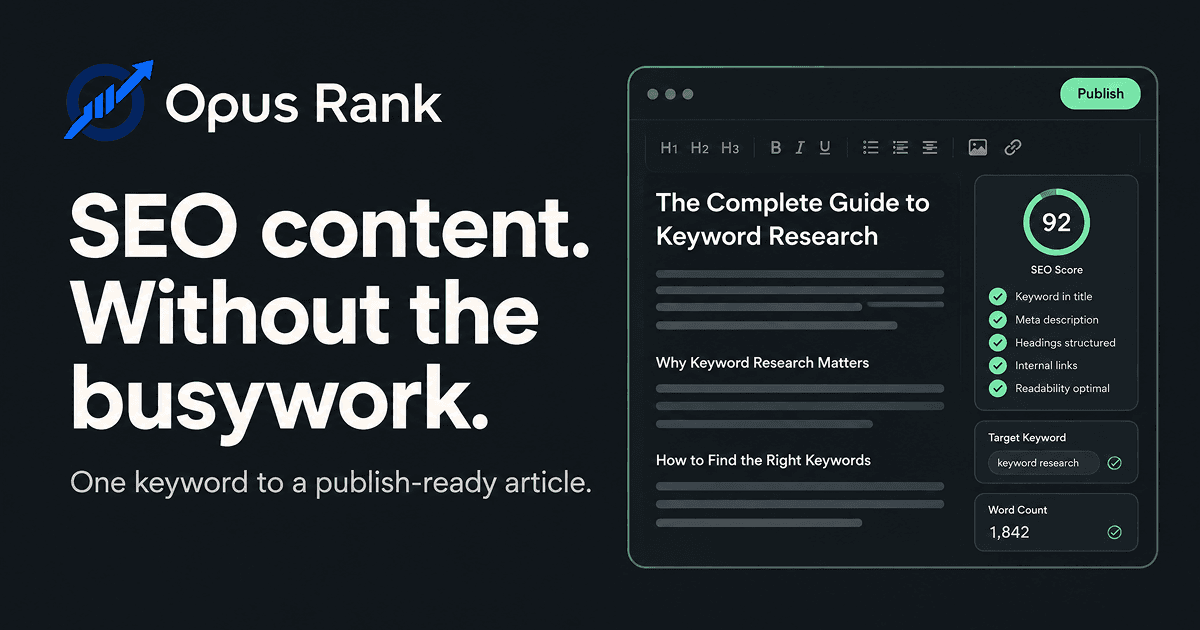
About this app
Opus Rank is an AI-powered SEO content generation platform that transforms a single keyword into a complete, publish-ready article draft. I spent time digging into its workflow, and what stands out is the deliberate emphasis on editorial control: every generation lands in an editor as a draft, and its Autopilot feature ships with a review gate switched on by default, so nothing publishes without your say-so. The pipeline covers topical mapping (pillar and cluster planning), article drafting with SEO title, slug, meta title and description sized to real character limits, an optional FAQ block, internal-link suggestions you approve one at a time, and a featured image generated from context. It connects to WordPress, Webflow, Ghost, and Shopify, with credentials encrypted server-side. Pricing is credit-based and transparent: fixed per-action costs shown before you confirm, failed generations refunded automatically, and an append-only ledger. Plans run from 1,000 credits (Lite) up to 8,...
Key features
- 1Keyword-to-draft pipeline: topical maps, briefs, outlines, full articles with SEO title, slug, meta title/description sized to real character limits.
- 2Editorial control: every generation lands as a draft, Autopilot review gate on by default, per-action credit costs shown before confirm, failed generations refunded.
- 3CMS publishing to WordPress, Webflow, Ghost and Shopify with server-side encrypted credentials, scheduling and version history.
Target customer profile
Drawn from the product itself, not from a survey.
Demographic
In-house content marketers at small-to-mid B2B SaaS or ecommerce brands
Pain points
Publishing cadence slips; writers spend hours on outlines and meta data; fear of AI auto-publishing off-brand content
Primary needs
A repeatable keyword-to-draft pipeline with review control and CMS publishing
Demographic
Freelance SEO writers and solo content consultants managing multiple client sites
Pain points
Repetitive drafting and internal linking eat billable time; opaque AI tool pricing; rework on stale articles
Primary needs
Predictable per-article credit costs, version history, and refresh/rewrite for existing posts
Demographic
Lean marketing teams at agencies or startups without a dedicated SEO specialist
Pain points
No structured topical strategy; scattered publishing across WordPress or Webflow; limited budget
Primary needs
Topical mapping guidance, transparent plans starting low, and direct CMS integrations
Scout Review
Written by AI from measured evidence, scored out of 100.
Opus Rank is a keyword-to-published-article pipeline with an unusually grown-up attitude to control: every generation lands in an editor as a draft, Autopilot's review gate is on by default, and every action shows its credit cost before it runs with failures refunded. The site is fast (97 mobile / 100 desktop Lighthouse), the docs are genuinely deep (25+ task guides), and security basics are in place. Weak spots: a clipped hero headline and unreadable mockups on the landing page, no free trial, no CSP, and no published compliance audits. It's a competent, clearly positioned product in a crowded category, differentiated by transparency rather than raw generation quality.
Measure by measure
Usability
6825+ task-based docs guides, a clear 4-step workflow, and per-action credit costs shown before you confirm. No free trial, so the $17.90 Lite plan is the only way to kick the tires.
Design
71Coherent blue-on-white system with disciplined grids and a consistent numbered-callout language across sections. Undercut by a clipped hero headline and unreadably small mockup type.
Speed
88Lighthouse mobile 97/100 (LCP 1.1s, CLS 0, TBT 186ms) and desktop 100/100. Genuinely fast, lightweight site with no lag complaints in the evidence.
Security
74HTTPS+HSTS, frame protection, Referrer-Policy, Permissions-Policy, SPF and DMARC all set (10/12 checklist). Credentials encrypted server-side per site claims. No CSP header and no SOC 2/ISO/pen-test published.
Accessibility
80Lighthouse accessibility 100/100 on automated checks, with a responsive layout and readable contrast. No WCAG statement or a11y page published, and small grey captions hurt real-world readability.
Growth
58Real problem (AI content chaos, opaque pricing) with a genuine wedge: review-gate-by-default plus transparent per-action credits and refunded failures. Crowded category, but the trust angle is specific.
Improvement areas
- Landing page: clipped hero headline and unreadably small mockup text weaken the first impression and product proof.
- No free trial — the $17.90 Lite plan is the only evaluation path, raising the barrier for new users.
- Security/compliance: no CSP header and no published SOC 2, ISO or pen-test to back the encryption claims.
Design & Usability
The design is disciplined: a restrained blue-on-white palette, consistent numbered callouts, and a scannable four-column 'Built to be checked' grid that reads as one product language. The flaws are first-impression ones — a hero headline clipped at the right edge and mockup text too small to function as proof. Usability is stronger: 25+ task-based docs guides, a clear four-step workflow, and per-action credit costs (100/article, 80/rewrite) shown before you confirm. The gap is the missing free trial — the $17.90 Lite plan is the only way to test it, though credits are kept on cancel.
Speed & Security
Speed is the standout: Lighthouse mobile 97/100 with LCP 1.1s, CLS 0 and TBT 186ms, and desktop a clean 100/100 — a genuinely lightweight site with no lag complaints in the evidence. Security is competent but not certified: HTTPS with HSTS, frame protection, Referrer-Policy, Permissions-Policy, SPF and DMARC all present (10/12), and the site claims CMS credentials are encrypted server-side and never returned to the browser. What's missing is a Content-Security-Policy header and any published SOC 2, ISO or pen-test — fine for the stage, but not yet a trust artifact you can hand to procurement.
Accessibility & Growth
Accessibility scores a perfect 100/100 on Lighthouse's automated axe-core checks, backed by a responsive layout and readable contrast — but automated checks only cover part of WCAG, and there's no accessibility statement or WCAG conformance page, while small grey captions and tiny mockup labels hurt real-world readability. Growth is the interesting one: the problem (AI content chaos, opaque tool pricing, fear of auto-publishing off-brand) is real and the target customer is specific — in-house marketers at small B2B SaaS and freelance SEO writers juggling client sites. The wedge is editorial control: review gate on by default, per-action credit pricing, refunded failures, append-only ledger. Against Surfer, Jasper and Frase that's a trust angle, not a moat — a settings toggle competitors can copy. The category has headroom; the differentiation is real but shallow.
Conclusion
If you're a small content team drowning in outlines and meta data, and you want AI drafting without the 'did it just publish something off-brand?' anxiety, Opus Rank's review-gate-first design and transparent credits are a genuinely sensible fit. If you need enterprise compliance paperwork or a free trial before committing, look elsewhere for now. The idea is sound and the execution is above average; the next 12 months will show whether the trust wedge is enough to win share from Surfer and Jasper.
Suggestions for improvement
- Fix the clipped hero headline and enlarge mockup text so the product screenshots actually prove the product.
- Add a free trial or a small free credit grant — the $17.90 Lite plan is a high wall for first-time evaluation.
- Publish a Content-Security-Policy header and, when ready, a SOC 2 or pen-test summary to back the encryption claims.
- Add an accessibility statement and bump caption/label sizes to match the 100/100 automated score in real use.
Alternatives comparison
Named competitors, point by point. Nobody paid to appear here or to be left out.
 Opus Rank |  Surfer SEO |  Jasper |  Frase | |
|---|---|---|---|---|
| Entry price | $17.90/mo (Lite, 1,000 credits) | Paid plans, typically higher entry | Paid plans, creator tier entry | Paid plans, entry tier |
| Review gate / editorial control before publish | On by default; nothing publishes without approval | Content editor with score; publishing via integrations | Brand voice controls; publishing via integrations | Draft editor; publishing via integrations |
| Transparent per-action credit pricing with refunds | Yes — 100 credits/article, 80/rewrite, failures refunded | Subscription-based, not per-action credits | Seat/word-based subscription tiers | Subscription-based tiers |
| CMS publishing integrations | WordPress, Webflow, Ghost, Shopify with encrypted credentials | WordPress and some CMS integrations | WordPress and marketing integrations | WordPress and CMS integrations |
| Topical mapping / content planning | Pillar/cluster topical maps with publishing order | SERP analysis and content planning tools | Templates and campaign planning, less SEO-specific | Briefs built from top-ranking pages |
| Documentation depth | 25+ task-based guides across 6 topics | Extensive help center and academy | Extensive docs and academy | Help center and guides |
Surfer SEO
Content optimization and SEO writing platform known for data-backed content scores and SERP analysis, often paired with AI drafting.
Jasper
AI marketing content generator with brand voice controls and templates, broader in scope than SEO articles but less focused on CMS publishing workflow.
Frase
SEO content research and AI writing tool that builds briefs from top-ranking pages, comparable on the research-to-draft axis.
Comparing options? See Opus Rank alternatives, scored side by side
More SEO Tools apps
View all SEO Tools
Geogrid
92A UULE-powered local rank tracker for SEO agencies, offer...

Kerbrank
91Local rank tracker for UK businesses with Google Maps heatmaps, ChatGPT visibility checks and a weekly fix list.

BACKLNK
90Backlnk is a free SEO and AI visibility website: 15 website checks, a full audit as a PDF report, and guides to get found in search and AI answers.

CitableReport
89CitableReport is an AI visibility audit:

AuditCloser
89White-label website audits that close deals for digital a...

Lexicon SEO
88Lexicon SEO audits public websites, checks AI-crawler access and gives prioritized fixes. Start free with 1 audit/month for up to 50 pages. Paid plans add weekly monitoring, citation checks and MCP for Claude Code, Cursor and Claude Desktop. Paid citation checks cover Claude, ChatGPT, Gemini and Perplexity.

Cromagnon
88Free, private browser-based PDF, Word, Excel, and study t...

Spek
88Grow your app with self-learning ASO agents

Mover Marketing AI Local SEO
88Specialized SEO services for moving companies to dominate...

named.ae
88named.ae asks ChatGPT, Claude, Gemini, Perplexity and Grok your buyers' questions live, and shows who they name and the pages they read.

Askray
88See who ChatGPT, Gemini & Claude recommend instead of you...

Wajido
88See how your company appears in AI answers


A platform dedicated to providing unbiased reviews of newly launched applications, analyzing everything from their features to their full potential.
info@scoutforge.net© 2026 Scoutforge. All rights reserved.
