Cycling through all six. Tap any point to stop.
Measured on six things
Pageree lets your AI assistant publish landing pages that collect leads, then read how visitors behave and improve each page with you.
Security
62HTTPS enforced with HSTS, SPF and DMARC set, OAuth sign-in for MCP. Missing CSP, frame protection and Permissions-Policy; no SOC 2 or pen-test claims found.
Screenshots
1 / 1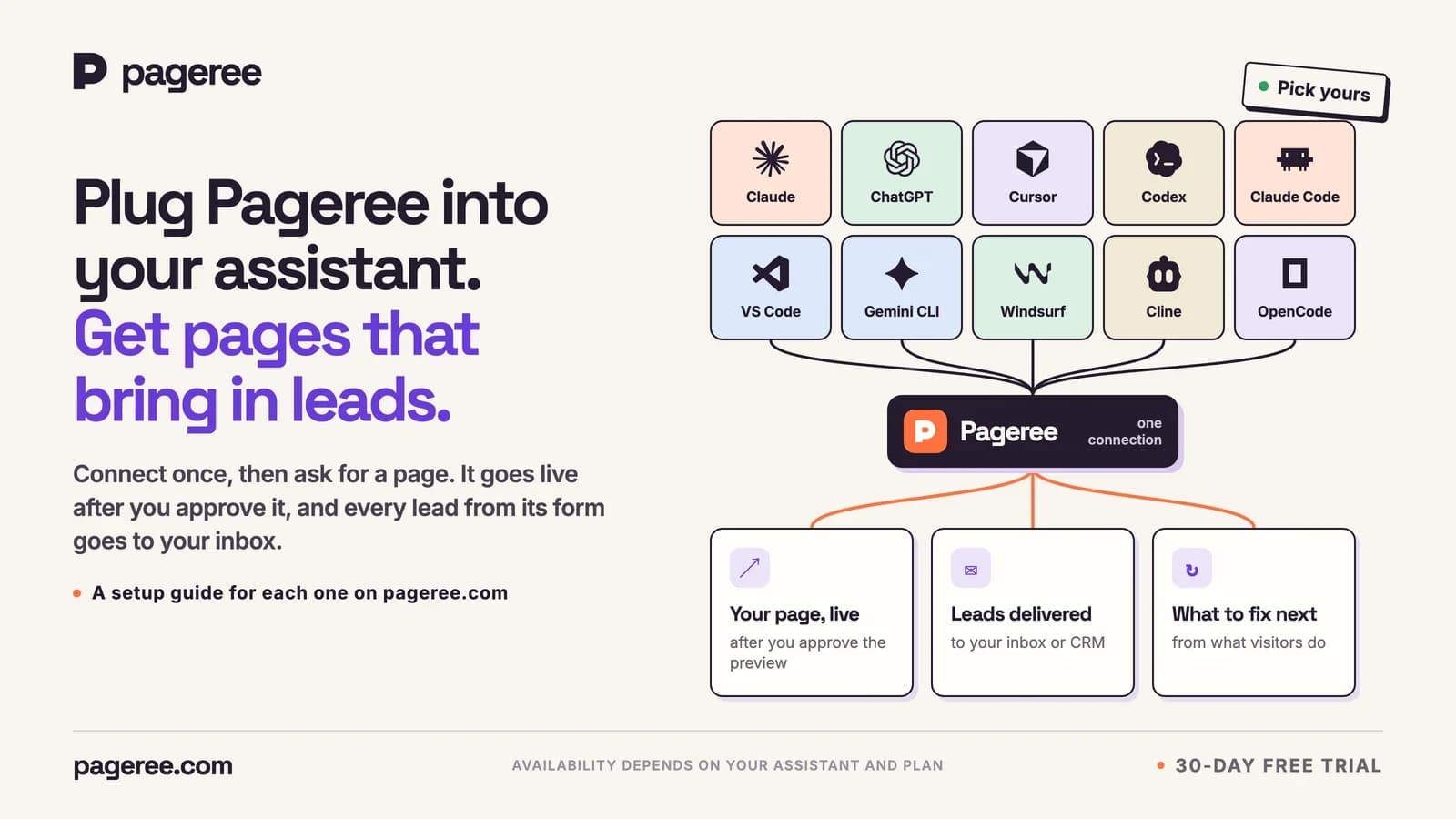
About this app
Your AI assistant can already write a landing page. Pageree gets it live, with forms that deliver leads and analytics that show what to fix, through one connection to the assistant you already use. Publish from chat. Describe the page you need. Your assistant builds it, shows you a private preview, and publishes it once you approve. Collect leads. Every form works. Submissions are checked for bot spam, filtered by your submission rules, and delivered to your email or to your CRM through a webhook. Improve the page. Ask how it is doing. Your assistant reads visits, sources and devices, plus where visitors click, stop and leave, section by section, and proposes one change. Every publish is a version you can restore. Works in ChatGPT, Claude, Cursor, Codex and other assistants. Pages can run on your own domain. Made for small businesses, solo founders, freelancers and agencies who would rather describe a page than build one by hand.
Key features
- 1Hosted MCP server with OAuth — connect Claude, ChatGPT, Cursor, Codex and 13 more via one URL, no API key.
- 2Publish pages from chat with private preview and approval; versioned publishing with restore.
- 3Working lead forms with bot-spam checks, submission rules, and email or webhook/CRM delivery — unlimited submissions on every plan.
Target customer profile
Drawn from the product itself, not from a survey.
Demographic
Solo founders
Pain points
A launch page needs hosting, a working form and somewhere for sign-ups to go
Primary needs
A product waitlist page that sends every sign-up to their email
Demographic
Small businesses
Pain points
Enquiries get lost, and spam fills the inbox
Primary needs
Quote and booking requests for a local service, delivered to email or a CRM
Demographic
Freelancers
Pain points
Little time to build and look after a page
Primary needs
A lead magnet page that collects emails
Demographic
Agencies
Pain points
Every campaign page needs a form, lead delivery and a way to see what visitors do
Primary needs
A demo request page for a B2B product
Scout Review
Written by AI from measured evidence, scored out of 100.
Pageree bets that the hard part of a landing page isn't writing it — your assistant already does that — but hosting it, wiring a form that actually delivers leads, and telling you what to fix. That's a sharper thesis than most page builders have. The execution backs it up: a hosted MCP server with OAuth, 17 client setup guides, a free tier with no card, unlimited form submissions on every plan, and a Lighthouse mobile score of 97. The design is genuinely custom rather than templated, with a coherent illustration system and a submissions panel that shows the product working. Where it falls short is polish and proof: an orphaned grid cell, low-contrast micro-copy, four missing security headers, no published compliance or accessibility statements. None of that is disqualifying at this stage. What matters more is whether the assistants leave room for a middle layer — and right now, they do.
Measure by measure
Usability
68Hosted MCP with OAuth and 17 client setup guides is a real onboarding asset. Free tier needs no card, paid trials are 30 days. Middle sections are long and caption-heavy to skim.
Design
70Confident display type, a coherent custom illustration system and a believable submissions mock-up. Undercut by an orphaned grid cell, tiny low-contrast captions and an uneven logo strip.
Speed
88Lighthouse mobile 97/100 (LCP 1.7s, CLS 0, TBT 53ms) and desktop 100/100. Genuinely fast, no lag complaints in the collected evidence.
Security
62HTTPS enforced with HSTS, SPF and DMARC set, OAuth sign-in for MCP. Missing CSP, frame protection and Permissions-Policy; no SOC 2 or pen-test claims found.
Accessibility
78Lighthouse accessibility 100/100. No published WCAG statement or multi-language support found, and the visual audit flagged small low-contrast grey copy on the homepage.
Growth
62Real problem, specific segments, and a genuine wedge: publish and improve pages through the assistant you already use, with lead capture and analytics baked in. Early stage (domain 0.3 years).
Improvement areas
- Design polish: orphaned grid cell, low-contrast micro-copy, uneven assistant logo strip.
- Security hardening: add CSP, frame protection and Permissions-Policy; publish a security page.
- Trust signals: no accessibility statement, no compliance claims, no third-party reviews to verify.
Design & Usability
Pageree's homepage is a cut above the average indie builder: a custom robot-and-envelope illustration system, a tightly set grotesque headline with the payoff reversed out of an orange block, and a submissions mock-up that shows status pills and held-back reasons — the product's behavior made visible rather than described. The cracks are in the details: a seven-card category grid that leaves an orphaned cell in row two, body copy and micro-labels in light grey on cream that you have to lean in to read, and an assistant logo strip mixing serif and sans wordmarks unevenly. Usability is stronger than the marketing page suggests. The docs ship 17 client setup guides across Claude, ChatGPT, Cursor, Codex and a dozen more, the MCP server is hosted with OAuth so there's no API key to copy, and the free tier needs no card. The cost is scroll: the middle of the homepage is long and caption-heavy, and the three-step walkthrough helps but adds length.
Speed & Security
Speed is the standout. Lighthouse mobile lands at 97/100 with an LCP of 1.7s, CLS of 0 and TBT of 53ms; desktop is a clean 100/100. Whatever stack this is, it's doing the boring things right, and there are no lag complaints in the collected evidence. Security is competent but not exceptional. HTTPS is enforced with HSTS, X-Content-Type-Options and Referrer-Policy are set, and SPF and DMARC are configured — 8 of 12 checklist points. What's missing is the hardening layer: no Content-Security-Policy, no frame protection, no Permissions-Policy. OAuth sign-in for the MCP connection is the right call over API keys. No SOC 2, ISO or pen-test claims appear in the site content, which is normal for a product this young but means there's nothing to verify beyond the headers.
Accessibility & Growth
Accessibility scores 100/100 on the Lighthouse axe-core audit, which is a strong automated result — but automated checks cover maybe a third of WCAG, and there's no published accessibility statement or multi-language support to point at. The visual audit's note about small, low-contrast grey body copy is the kind of thing the automated run won't catch and a screen-reader user might. Growth is the interesting question. The problem is real: a landing page needs hosting, a working form and somewhere for sign-ups to go, and Pageree collapses that into one MCP connection to the assistant you already pay for. The segments are specific — solo founders, local services, freelancers, agencies — and the seven page-type templates map to actual jobs. The wedge is lead capture with submission rules plus first-party analytics plus versioned publishing, which is more than a page generator. The honest limit: the moat is thin. If ChatGPT or Claude ship native hosting, Pageree becomes a plugin. At 0.3 years old with one social profile, it's early — but the idea has room.
Conclusion
If you're a solo founder or a small agency who already lives in Claude or ChatGPT and keeps rebuilding the same lead-capture page by hand, Pageree is worth the free tier. Three pages, working forms, submission rules and analytics, no card — that's a real trial, not a demo. The paid tiers are cheap enough ($5 to $40/month) that the decision is about workflow fit, not budget. Go in knowing what you're buying: a thin, well-executed layer between your assistant and a hosted page, not a platform. If the assistants ever ship native publishing, this category gets squeezed — so enjoy the convenience while the gap is open, and keep your page content portable.
Suggestions for improvement
- Fix the seven-card category grid — either add an eighth card or reflow to a layout that doesn't leave an orphaned cell.
- Raise contrast and size on body copy and micro-labels; light grey on cream fails the squint test even when axe passes.
- Add CSP, frame protection and Permissions-Policy headers — you're four headers from a clean security posture.
- Publish a short accessibility statement and a security page; even 'here's what we do and don't have' beats silence.
Alternatives comparison
Named competitors, point by point. Nobody paid to appear here or to be left out.
 Pageree |  | |
|---|---|---|
| Publish pages directly from an AI assistant via MCP | Yes — hosted MCP with OAuth, 17 client guides | Not applicable — no alternative details provided |
| Lead capture with spam checks and submission rules | Yes — bot checks, rules, email/webhook delivery, unlimited submissions | Not applicable — no alternative details provided |
| First-party analytics with section-level behavior | Yes — visits, sources, devices, click/stop/leave by section | Not applicable — no alternative details provided |
| Free tier and pricing | Free up to 3 pages, no card; paid $5–$40/mo with 30-day trial | Not applicable — no alternative details provided |
Comparing options? See Pageree alternatives, scored side by side
More Marketing & Sales apps
View all Marketing & Sales
Geogrid
92A UULE-powered local rank tracker for SEO agencies, offer...

EmbedMyReviews
92White-label reputation management software for agencies s...

Puzzly – B2B Lead Generation & Sales Intelligence Platform
92Puzzly is an all-in-one B2B lead generation platform that...

Vibe Coding Agent Skills
92A free, open-source platform offering 110 AI agent skills...

QRBliss
91Branded QR codes with AI Brand Sync, 15 free dynamic code...

ThumbnailMaker
90AI YouTube thumbnail maker: paste a video link, get the brief, the thumbnail, and a check at feed size.

WAButton
90WhatsApp website leads, forms and contact routing

PitchWhip
90AI cold call scripts & direct dials from LinkedIn

BACKLNK
90Backlnk is a free SEO and AI visibility website: 15 website checks, a full audit as a PDF report, and guides to get found in search and AI answers.

DemoVexa
90Turn your code into professional product demo videos with AI-generated scripts, animated UI, and natural voiceovers.

Opus Growth
89Opus Growth is a single MCP server for Google Ads, Meta Ads, TikTok Ads, LinkedIn Ads, Microsoft Ads and ChatGPT Ads. ChatGPT, Claude, Codex, Perplexity, Cursor and other assistants connect with the same address.

AuditCloser
89White-label website audits that close deals for digital a...


A platform dedicated to providing unbiased reviews of newly launched applications, analyzing everything from their features to their full potential.
info@scoutforge.net© 2026 Scoutforge. All rights reserved.
