Cycling through all six. Tap any point to stop.
Measured on six things
AI agents attack your web app and APIs every week like real attackers and prove every finding. Free first report.
Security
52HTTPS enforced, HSTS, SPF and DMARC all present, and the site claims EU-only data residency with a kill switch. But no CSP, no frame protection, no X-Content-Type-Options — 6/12 on header hygiene.
Screenshots
1 / 1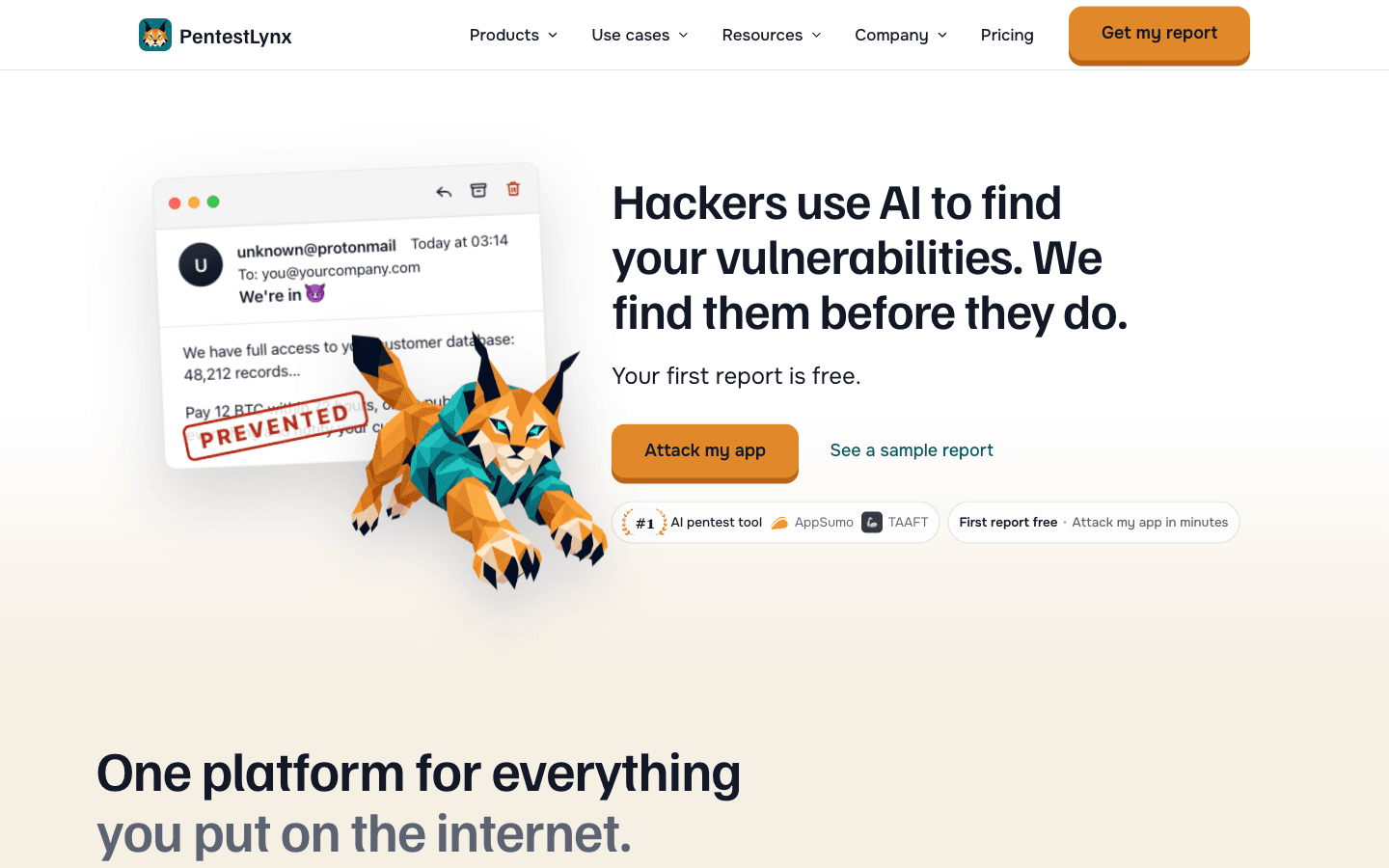
About this app
PentestLynx is an AI penetration testing service for web applications and APIs. AI agents map your attack surface, then try to break in the way a real attacker would: IDOR and BOLA, authentication and session flaws, injection, SSRF, XSS, CSRF, mass assignment and business-logic abuse. Every exploit is replayed to confirm it, so the report contains proven findings rather than scanner noise. Your first report is free. The full report costs $150 one-off, with location, evidence, CVSS score and a code-level fix for every finding, exportable to PDF, JSON, Jira or Linear. Continuous retesting ($990/month, cancel anytime) runs the full AI attack every week and sends an updated list of new, fixed and still-open vulnerabilities. Testing follows OWASP WSTG and the OWASP API Security Top 10, with rate-limited, non-destructive traffic.
Key features
- 1AI agents map attack surface and attempt real exploitation: IDOR/BOLA, auth, injection, SSRF, XSS, CSRF, mass assignment, business logic.
- 2Every exploit is replayed to confirm — reports contain proven findings with request/response evidence, not scanner noise.
- 3Free light pass (TLS, headers, exposed paths, CVEs, DNS/SPF/DMARC, leaked JS secrets); $150 full report with CVSS and code-level fixes.
- 4$990/month continuous retesting: weekly full AI attack with new/fixed/still-open list; export to PDF, JSON, Jira, Linear.
Target customer profile
Drawn from the product itself, not from a survey.
Demographic
Engineering leads and development teams at SaaS or fintech startups
Pain points
Manual pentests are slow and expensive; scanners produce noise; fixes land in PDFs nobody reads
Primary needs
Fast, proven findings with code-level fixes, exportable to Jira or Linear
Demographic
Security and engineering leads at growing SaaS companies
Pain points
Annual manual pentests leave the app untested between releases
Primary needs
Weekly retesting with a list of new, fixed and still-open vulnerabilities
Demographic
Founders and technical leads of AI-built or vibe-coded apps (no dedicated security team)
Pain points
AI coding tools ship apps with missing access controls and leaked keys in frontend bundles
Primary needs
Automated testing of APIs and business logic, with clear fixes that need no security expertise
Scout Review
Written by AI from measured evidence, scored out of 100.
PentestLynx is an AI pentest service that maps your attack surface, attacks it like a person would, and replays every exploit so the report contains proof rather than scanner noise. Pricing is unusually honest for the category: a genuinely free light pass, $150 for a full report with CVSS, evidence and code-level fixes, and $990/month for weekly retesting. The methodology claims are specific — OWASP WSTG, API Top 10, PTES, NIST 800-115, CVSS 3.1 — and the safety story (rate-limited, non-destructive, EU-hosted, kill switch, allowlistable IPs) is the right one. The brand is memorable and the product mockups suggest real depth. What holds it back is craft: a mobile LCP of 7.4s, a security-header set that a pentest vendor should be embarrassed by, and accessibility failures in its own markup.
Measure by measure
Usability
63Free report needs no domain verification, so first value is fast; paid tiers require DNS/file proof and signed authorisation. Pricing comparison table is clear. Six-item nav with four dropdowns is dense.
Design
70Distinctive lynx mascot, 'PREVENTED' hero illustration and a disciplined cream/orange/teal palette give it real identity. Undone by an unreadably small product mockup and an empty band mid-page.
Speed
58Desktop Lighthouse 91/100 but mobile 73/100 with a 7.4s LCP — the hero and mockup assets are heavy on phones. CLS 0 and TBT 27ms show the layout and JS are well-behaved.
Security
52HTTPS enforced, HSTS, SPF and DMARC all present, and the site claims EU-only data residency with a kill switch. But no CSP, no frame protection, no X-Content-Type-Options — 6/12 on header hygiene.
Accessibility
58Lighthouse 86/100 with real failures: broken ARIA role nesting, insufficient color contrast, and list items outside list parents. No accessibility statement or WCAG claim anywhere on the site.
Growth
62Real, growing problem (AI-built apps with broken access control), a specific wedge — replayed proof plus code-level fixes into Jira/Linear at $150 — and a plausible SMB gap between XBOW and Intruder.
Improvement areas
- Security header hygiene: no CSP, frame protection, X-Content-Type-Options, Referrer-Policy or Permissions-Policy (6/12).
- Mobile performance: Lighthouse 73/100 with a 7.4s LCP; desktop is 91/100, so it's an asset-weight problem.
- Accessibility: ARIA role nesting failures, insufficient contrast, list items outside list parents; no a11y statement.
- Design craft: unreadably small product mockup, empty band mid-page, and an unsubstantiated '#1 AI pentest tool' badge.
Design & Usability
PentestLynx has a stronger visual identity than most security startups — the low-poly lynx and the 'PREVENTED' phishing-email hero do more branding work than a thousand stock padlock photos, and the cream/orange/teal palette holds together across the page. The problems are execution details: the flagship 'One platform' mockup is scaled so small its table text is illegible, and a large empty band under the terminal mockup makes the lower page feel unfinished. Usability is decent — the free report needs no domain verification, so time-to-first-value is short, while the paid tiers correctly gate on DNS/file ownership proof and a signed authorisation. The pricing comparison table is genuinely readable. The header is the weak spot: six items with four dropdowns is a lot of surface for a product this young.
Speed & Security
Speed splits cleanly by device: desktop Lighthouse 91/100, mobile 73/100 with a 7.4s LCP. CLS 0 and TBT 27ms mean the layout is stable and the JS is light — the mobile LCP is almost certainly hero imagery and the product mockup, which is fixable with responsive art direction. Security is the interesting one. HTTPS is enforced, HSTS is on, SPF and DMARC are configured, and the site makes specific, checkable claims about EU-only data residency, fixed allowlistable EU IPs and a kill switch. But the header probe scores 6/12: no Content-Security-Policy, no frame protection, no X-Content-Type-Options, no Referrer-Policy, no Permissions-Policy. For a company whose entire product is finding exactly this class of misconfiguration, shipping without them is a credibility problem, not just a checklist miss.
Accessibility & Growth
Accessibility lands at 86/100 on Lighthouse with four real failures: ARIA roles missing required children, roles outside their required parents, insufficient contrast, and list items outside list containers. None are catastrophic, all are fixable in an afternoon, and there's no accessibility statement or WCAG conformance claim to point at. Growth is the strongest dimension. The problem is real and getting worse — AI coding tools ship apps with missing access controls and keys in frontend bundles — and the wedge is specific: proven, replayed findings with code-level fixes exported to Jira and Linear, at $150 versus a slow manual pentest. XBOW targets large estates and security teams; Intruder targets dev teams wanting scanning. That leaves a genuine gap for founders and small engineering teams who want one honest report. The $990/month retesting tier is the real business, and it's a harder sell than the one-off.
Conclusion
The category is crowded and getting more so — XBOW has funding and enterprise reach, Intruder has an established dev-team footprint. PentestLynx's bet is that the long tail of AI-built apps needs a cheap, fast, provable first pentest and a weekly retest subscription after that. That's a defensible position if the reports hold up. The work now is unglamorous: fix the mobile LCP, ship the security headers you'd flag in someone else's app, clean up the ARIA and contrast failures, and replace the '#1 AI pentest tool' badge with an actual customer quote. The idea is good enough that the execution shouldn't be the story.
Suggestions for improvement
- Ship CSP, X-Frame-Options, X-Content-Type-Options, Referrer-Policy and Permissions-Policy — a pentest vendor failing 6/12 header checks is a bad look.
- Fix the 7.4s mobile LCP: serve responsive hero and mockup images, and lazy-load the product screenshots below the fold.
- Replace the '#1 AI pentest tool' badge with a real customer quote or a linked sample report — directory logos aren't proof.
- Add an accessibility statement and fix the ARIA role nesting, contrast and list-markup failures flagged by Lighthouse.
Alternatives comparison
Named competitors, point by point. Nobody paid to appear here or to be left out.
 PentestLynx | XBOW |  Intruder | |
|---|---|---|---|
| Pricing model | Free light pass; $150 one-off full report; $990/mo continuous retesting | Enterprise/quote-based, aimed at large app estates | Subscription tiers for continuous scanning and pentesting |
| Proof of findings | Every exploit replayed to confirm; request/response evidence in report | Proves findings with working exploits | Scanner-led with AI pentesting layer; evidence varies by finding |
| Target customer | SaaS/fintech startups, founders of AI-built apps, small eng teams | Security teams managing large application estates | Developer teams wanting integrated, same-day security scanning |
| Fix delivery / integrations | Code-level fixes, export to PDF, JSON, Jira, Linear | Exploit proof with remediation guidance for security teams | Integrations with dev tooling and ticketing for remediation |
| Continuous retesting | Weekly full AI attack; new/fixed/still-open list; $990/mo | Continuous offensive testing across estate | Continuous scanning with regular re-tests |
| Data residency / safety | EU-hosted, GDPR by design, fixed EU IPs, kill switch, rate-limited | Enterprise deployment options; details not verified here | Cloud-hosted scanner; compliance details not verified here |
XBOW
AI-powered pentesting platform that proves findings with working exploits, focusing on large app estates and security teams.
Intruder
AI pentesting and vulnerability scanning platform with same-day results, aimed at developer teams wanting integrated security.
Comparing options? See PentestLynx alternatives, scored side by side
More Security apps
View all Security
issued.live
89Free certificate transparency search and SSL lookup with ...

OBVELO
88Privacy gateway that masks personal data in LLM traffic

SendVeil
88Send large original files through private, expiring links, with EU storage.

BenchFleet
88Desktop hub to control real Android phones with AI agents...

Vigilance
88Checks code AI tools install and replaces harmful updates.

Postdate
88Share one link now that opens at the time you choose.

Vaultin AI
88Private AI for law, accounting and advisory firms that ke...

kosa8
88Sealed VMs for AI agents with instant rewind, audit trails & zero key exposureSealed VMs for AI agents with instant rewind and audit tr...

Sidenty
87Sidenty is a professional digital identity protection ser...

Tokitool
87Free, private browser tools for images, chats, QR codes, ...

tmps.fyi
87Share text, images, screenshots and files across devices using a free online clipboard.

Magery Forge
87Weekly security audits for vibe-coded sites, explained in...


A platform dedicated to providing unbiased reviews of newly launched applications, analyzing everything from their features to their full potential.
info@scoutforge.net© 2026 Scoutforge. All rights reserved.
