Cycling through all six. Tap any point to stop.
Measured on six things
AI video generator for cinematic 30s 4K videos with audio...
Speed
46Desktop Lighthouse 82 but mobile 55 with a brutal 19.3s LCP and 444ms TBT. The mobile experience is slow enough that many visitors will bounce before the hero even paints.
Screenshots
1 / 1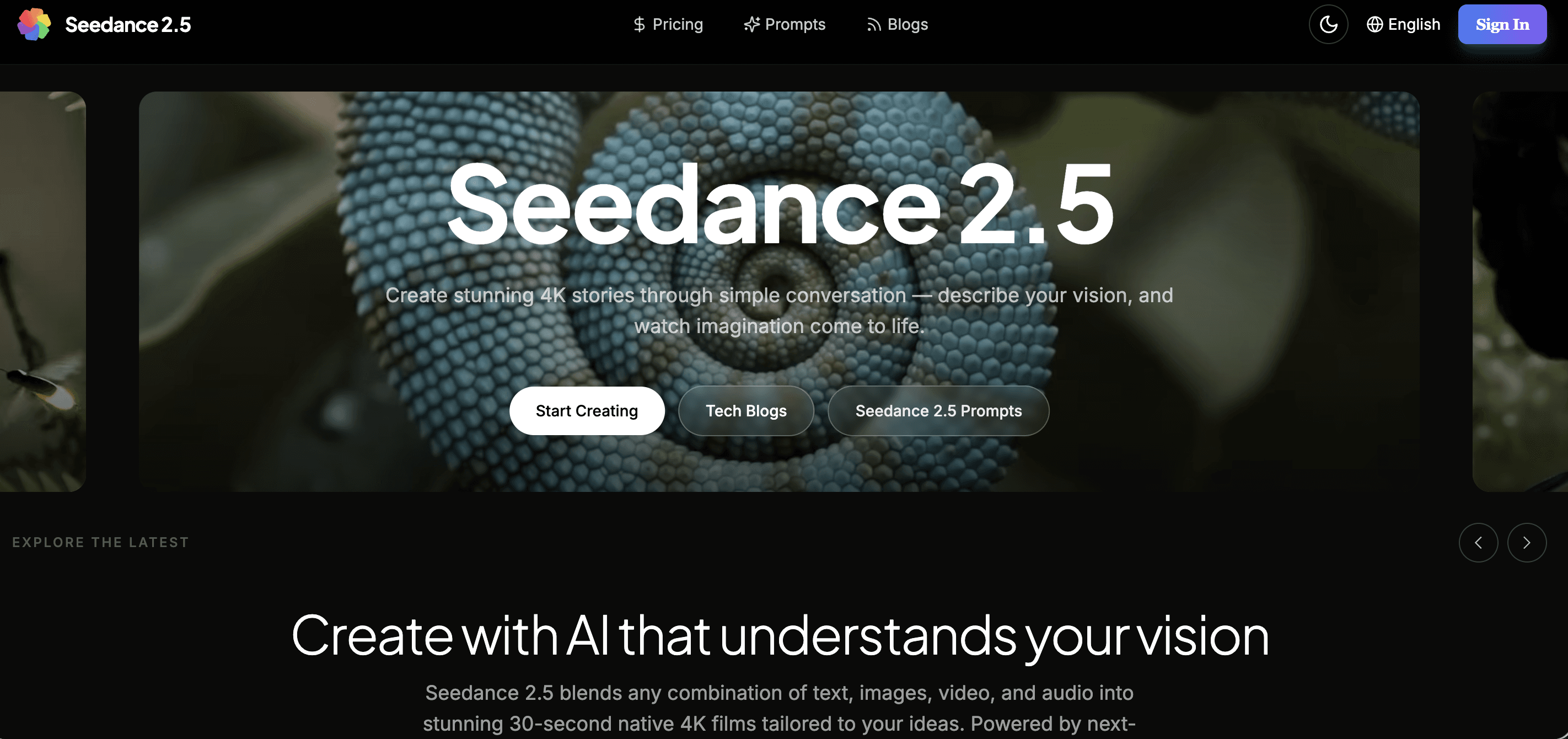
About this app
Seedance 2.5 is a next-generation AI video generation platform developed by ByteDance that enables users to create production-grade 4K videos up to 30 seconds long from a variety of inputs, including text, images, video clips, audio, and 3D models. The platform supports up to 50 multimodal references, allowing for complex creative fusion. Key features include native audio-visual synchronization with phoneme-level lip-sync, local video editing and remixing, 3D pre-visualization, and 20% improved prompt adherence. With an intuitive studio interface, users can generate, edit, and export videos in multiple formats. Seedance 2.5 offers flexible pricing with subscription plans and credit packs, starting with 30 free credits upon sign-up. It is designed for filmmakers, content creators, marketers, and businesses seeking to streamline video production and enhance creative workflows.
Key features
- 130-second native 4K video generation in a single pass with consistent characters, lighting, and spatial relationships
- 2Up to 50 multimodal references (image, video, audio, text, 3D models) fused into one cohesive output
- 3Local video editing and remixing that swaps subjects or backgrounds while preserving original motion and camera work
- 4Native audio-visual synchronization with phoneme-level lip-sync and generated ambient audio in the same latent space
- 53D pre-visualization from white models plus style references for validating camera angles before full rendering
Target customer profile
Drawn from the product itself, not from a survey.
Demographic
Filmmakers and video producers
Pain points
High cost and time for traditional video production; need for realistic motion and audio sync.
Primary needs
Production-grade 4K output, precise camera control, and efficient pre-visualization.
Demographic
Content creators and social media influencers
Pain points
Constant demand for engaging content; limited resources for high-quality video editing.
Primary needs
Quick generation of eye-catching videos, multi-format export, and easy editing.
Demographic
Marketing and advertising professionals
Pain points
Creating multiple campaign variations and localized content quickly.
Primary needs
Rapid iteration, brand consistency, and commercial licensing for client work.
Demographic
E-commerce business owners
Pain points
Need for professional product visuals without expensive equipment or studios.
Primary needs
AI-powered product photography and video creation from simple prompts, with background replacement.
Scout Review
Written by AI from measured evidence, scored out of 100.
Seedance 2.5 is a competent-looking AI video platform with a genuinely interesting feature set and a storefront that undersells all of it. The pitch is strong on paper: 30-second native 4K in a single pass, up to 50 multimodal references, phoneme-level lip-sync, local remixing that preserves camera motion, and 3D pre-visualization. Pricing is transparent and flexible, with a real free tier of 30 credits and credit packs that never expire. But the live homepage shows none of this — no sample video, no frames, no demo — and mobile performance is genuinely poor at a 19.3-second LCP. Security and accessibility are both mid-pack: HTTPS and email auth are configured, but hardening headers and a11y labels are missing. The category is crowded and the product's differentiation is real but thin against Runway, Kling, and Veo. It works, it's priced fairly, and it needs to show its work.
Measure by measure
Usability
5830 free credits, no card required, plus clear monthly/annual and credit-pack pricing with an FAQ. But the homepage never shows what the tool outputs, so onboarding starts blind.
Design
54Dark cinematic theme fits the filmmaking pitch, but the live hero is near-empty black with no product demo, weak hierarchy, and tiny low-contrast nav. No sample 4K frames anywhere above the fold.
Speed
46Desktop Lighthouse 82 but mobile 55 with a brutal 19.3s LCP and 444ms TBT. The mobile experience is slow enough that many visitors will bounce before the hero even paints.
Security
52HTTPS enforced with HSTS, SPF and DMARC in place, but no CSP, frame protection, or other hardening headers — 6/13 checklist points. No published SOC 2, ISO, or bug bounty found.
Accessibility
58Lighthouse a11y 80/100 with five failing audits: unnamed buttons and links, ARIA role violations, low contrast, and unlabeled form fields. Multi-language support is claimed but no WCAG statement exists.
Growth
58Real, growing category with a specific wedge: 30s native 4K single-pass, 50 multimodal refs, and local remix. But it's a reseller-style front end against Runway, Kling, and Veo with no visible moat.
Improvement areas
- Homepage hero shows no generated video, sample frames, or product demo — the core value is invisible above the fold
- Mobile Lighthouse performance 55/100 with a 19.3s LCP; desktop is 82, so the mobile gap is the priority
- Five failing accessibility audits: unnamed buttons/links, ARIA role violations, low contrast, unlabeled form fields
- Security headers stop at HSTS/SPF/DMARC (6/13); no CSP, frame protection, or published compliance documentation
Design & Usability
Seedance 2.5's site commits hard to a dark cinematic aesthetic, and the theme is consistent across the live page and marketing assets. The problem is what's inside the frame: the hero is almost entirely empty black space with no product demonstration, no sample frames, no generated video, and no audio waveform — for a tool whose entire value proposition is producing 4K video, showing zero video above the fold is a strange own-goal. Hierarchy is flat, with the product name, tagline, and CTAs competing at similar weights, and the nav uses small, low-contrast type that disappears into the background. Usability fares better on the commercial side: pricing is unusually transparent, with three subscription tiers, six one-time credit packs, and a FAQ that answers the obvious questions (30 free credits, no card required, credits never expire). But the homepage gives a new visitor no onboarding cues and no example outputs, so the first real look at what the tool produces comes only after signup. The bones are fine; the storefront needs to actually show the goods.
Speed & Security
Speed is a tale of two devices. Desktop Lighthouse performance lands at 82/100, which is respectable, but mobile drops to 55/100 with an LCP of 19.3 seconds and 444ms of total blocking time. CLS is a clean 0 and FCP is 2.6s, so the layout is stable and the first paint is reasonable — it's the main content that takes forever to arrive on mobile. A 19.3s LCP is roughly eight times the 'good' threshold, and for a product competing on creative speed, a slow first impression is a bad look. Security is mid-pack for the stage: HTTPS is enforced with HSTS, and SPF and DMARC are configured, which covers the basics. But the hardening headers are absent — no Content-Security-Policy, no frame protection, no X-Content-Type-Options, no Referrer-Policy, no Permissions-Policy — landing the probe at 6/13 checklist points. No SOC 2, ISO 27001, penetration test summary, or bug bounty program appears in the collected material, which is normal for a young product but leaves enterprise buyers with nothing to point at. Nothing here is broken; plenty here is unfinished.
Accessibility & Growth
Accessibility scores 80/100 on Lighthouse with five failing audits: buttons, links, and menu items without accessible names, ARIA roles missing their required children, insufficient color contrast, and form elements without associated labels. Those are fixable, high-impact issues — an unnamed 'Start Creating' button is invisible to screen readers, and unlabeled form fields break keyboard and assistive flows. The site claims multi-language creation across Chinese, English, and Japanese, which is a genuine plus, but there's no accessibility statement or WCAG conformance claim anywhere in the collected content. On growth, the idea itself holds up: AI video generation is a real, expanding category, and Seedance 2.5 names specific wedges — 30-second native 4K in a single pass, up to 50 multimodal references, local remixing that preserves motion and camera work, and 3D pre-visualization. Those are concrete differentiators, not marketing fog. The catch is positioning: the product is a front end to ByteDance's model competing directly with Runway, Kling, and Google Veo, and nothing in the material explains why a filmmaker picks this reseller over the source or the incumbents. The category has headroom; the moat does not.
Conclusion
If you're evaluating Seedance 2.5, start with the free 30 credits and test the specific claims that matter to you — the 30-second 4K single-pass generation, the 50-reference multimodal fusion, and the local remix workflow that preserves motion. Those are the differentiators, and they're the only things that justify picking this over Runway, Kling, or Veo. The pricing structure is honest and the credit packs don't expire, which lowers the risk of trying it. What the product needs most is not more features but more proof: sample outputs on the homepage, a performance pass on mobile, accessible labels on its own controls, and a security page that gives commercial buyers something to sign off on. The foundation is there. The evidence isn't, yet.
Suggestions for improvement
- Put real generated 4K video and sample frames on the homepage hero — the current empty black field shows nothing the product makes.
- Fix mobile performance: a 19.3s LCP will lose most visitors before the page paints. Compress hero media and defer non-critical scripts.
- Add accessible names to buttons and links, label form fields, and raise contrast — five Lighthouse a11y audits are currently failing.
- Publish a security page with header hardening (CSP, frame protection) and any compliance roadmap to give commercial buyers confidence.
Alternatives comparison
Named competitors, point by point. Nobody paid to appear here or to be left out.
 Seedance 2.5 AI Video |  Runway ML |  Kling AI |  Google Veo | |
|---|---|---|---|---|
| Native 4K video output | Yes — claims 30-second native 4K in a single pass, no stitching | Yes — Gen-series models output up to 4K with upscaling | Yes — up to 1080p native, 4K via upscale on higher tiers | Yes — Veo outputs high-resolution video, 4K on latest models |
| Maximum clip length per generation | 30 seconds native in a single pass | Typically 5-10 seconds per generation, extendable | Up to 10 seconds per generation, extendable | Around 8 seconds per generation |
| Multimodal reference inputs | Up to 50 references: image, video, audio, text, 3D models | Image, video, and text inputs; fewer simultaneous references | Text, image, and video inputs with motion control | Text and image inputs primarily |
| Native audio and lip-sync | Yes — native audio-visual sync with phoneme-level lip-sync | Yes — separate audio tools and lip-sync features | Limited — lip-sync available on select features | Yes — Veo generates native audio with video |
| Free tier / trial | 30 free credits on signup, no credit card required | Free plan with limited credits, paid plans from ~$12/mo | Daily free credits, paid plans available | Access via Google AI plans / Vertex AI, no standalone free tier |
| Entry paid price | $15.92/month Basic; credit packs from $29.90 one-time | Standard plan around $12-15/month | Entry subscription roughly $10/month equivalent | Bundled with Google AI Pro/Ultra subscriptions |
Runway ML
AI-powered creative suite for video editing and generation, offering text-to-video, green screen, and more.
Kling AI
AI video generation platform that creates realistic videos from text prompts, with advanced motion control.
Google Veo
Google's AI video generation model that produces high-quality videos from text, with a focus on realism and physics.
Comparing options? See Seedance 2.5 AI Video alternatives, scored side by side
More AI Generations apps
View all AI Generations
Uni-1 by Luma AI
92Uni-1 is an advanced multimodal text-to-image AI model th...

Gerty
91Private, local AI assistant for Mac that runs offline

LTX 2.3 AI Video Generator
91Fast, open-source AI video generator with 4K support, mul...

DemoVexa
90Turn your code into professional product demo videos with AI-generated scripts, animated UI, and natural voiceovers.

Pixelimg
88A free online AI-powered tool that instantly converts ima...

OBVELO
88Privacy gateway that masks personal data in LLM traffic

HeyVid AI
88HeyVid AI is a free all-in-one AI video and image generat...

RestorePhotosApp
88An AI-powered photo restoration app that brings old, blur...

IraVoice
88Private on-device dictation for Apple-silicon Macs.

tradutor de mangá com IA
88O tradutor de mangá com IA traduz capítulos em lote, personaliza textos e oferece edição visual para estúdios.

Mygom SEO
87MygomSEO is an AI marketing agent that audits your site, writes SEO content, publishes to 12+ CMS platforms, posts to social, and monitors rankings 24/7.

pause.do
87A privacy-first browser extension that inserts gentle pau...


A platform dedicated to providing unbiased reviews of newly launched applications, analyzing everything from their features to their full potential.
info@scoutforge.net© 2026 Scoutforge. All rights reserved.
