Cycling through all six. Tap any point to stop.
Measured on six things
AI text-to-speech platform with director-mode emotion control, 30-second voice cloning and custom voice design. Free to start, paid from $6/mo.
Speed
46Lighthouse mobile performance 55/100 with LCP 20.8s and FCP 18.8s — very slow initial load on mobile; desktop better at 63/100.
Screenshots
1 / 1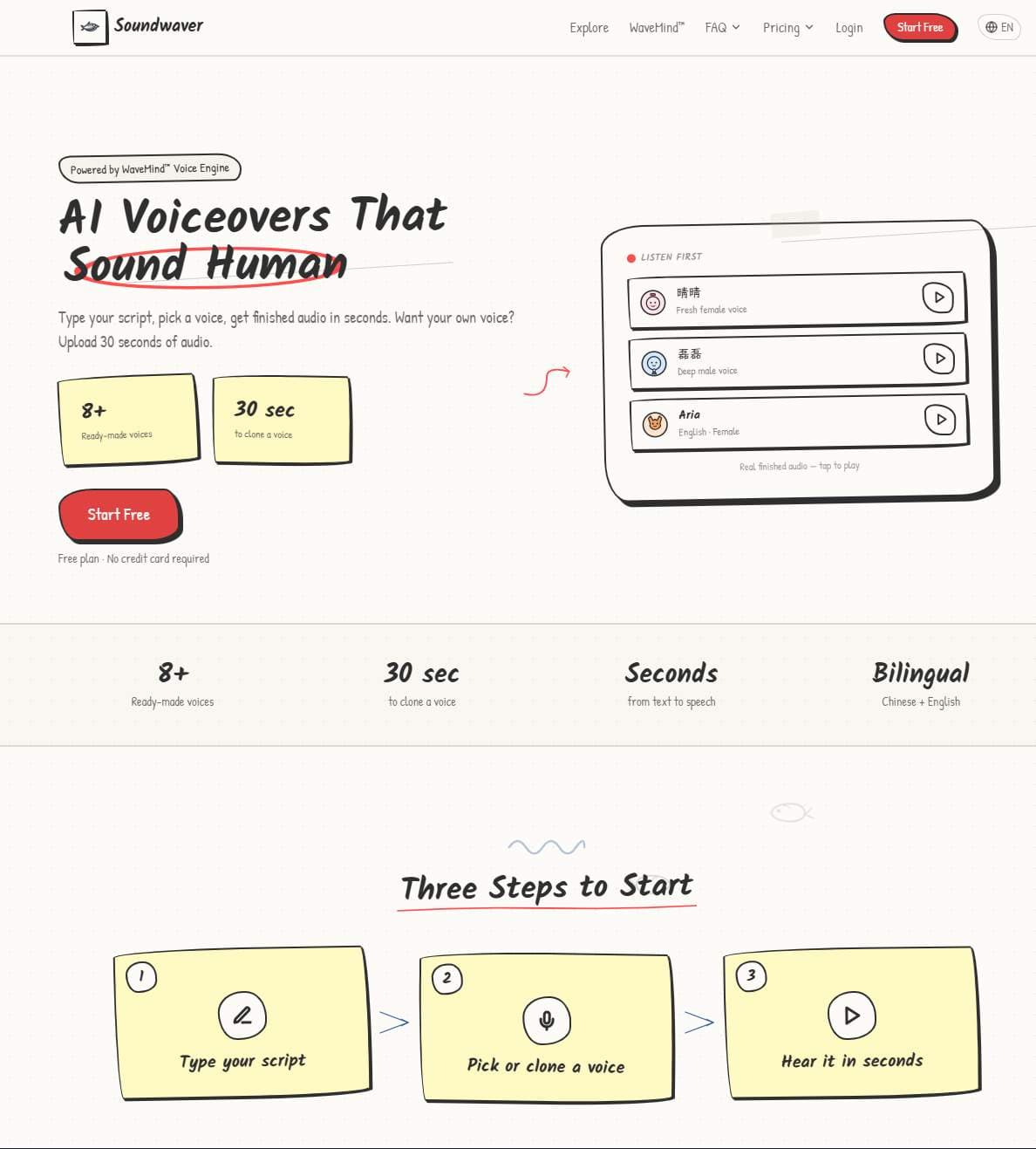
About this app
Soundwaver is an AI text-to-speech platform built on the MiMo-V2.5-TTS model, designed for Chinese-language content creators. Director Mode lets you control delivery with plain-language instructions (e.g. "excited, slightly fast, with a smile") instead of tweaking endless sliders. Clone a voice from a 30-second sample, or design a brand-new voice with WaveMind simply by describing it in words. A community voice library lets creators discover and use voices shared by others. The free plan includes 1,000 credits (approx. 50,000 Chinese characters) with 1 voice slot and 1 clone slot; paid plans start at $6/mo (7,200 credits) with up to 4,000 characters per generation — chapter-length text for audiobooks. Ideal for short-video narration, audiobooks and e-learning. Bilingual Chinese/English interface, secure checkout via Stripe.
Key features
- 1Director Mode: control delivery with plain-language instructions (role, scene, direction) instead of sliders.
- 2Voice cloning from 30-second sample; WaveMind voice design from text description.
- 3Community voice library; bilingual Chinese/English interface; free plan with 1,000 credits.
Target customer profile
Drawn from the product itself, not from a survey.
Demographic
Content creators (YouTubers, short-video makers) aged 18-45, tech-savvy, active on social media
Pain points
Need engaging voiceovers but lack recording equipment or voice-over skills; time-consuming to produce; budget constraints for professional voice actors
Primary needs
Quick, natural-sounding voice generation; easy workflow; affordable pricing; ability to clone own voice for consistent branding
Demographic
Online educators and course creators in Taiwan/Hong Kong or teaching Traditional Chinese
Pain points
Large volume of lecture materials need narration; keeping content up-to-date requires frequent re-recordings; may have non-native accents
Primary needs
Reliable and natural TTS in Traditional Chinese; ability to edit scripts without re-recording entirely; high-quality audio for professional courses; tools to clone their own voice for personal touch
Demographic
Podcasters and audiobook narrators (amateur to professional) focusing on Mandarin/Taiwanese content
Pain points
High production costs for audiobook narration or podcast segments; rigid schedules for studio sessions; need to produce multi-episode content rapidly
Primary needs
High-quality AI voices that maintain emotional nuance; batch processing for series; convenient script-to-speech with fine-tuned control over pacing and tone; commercial rights for paid plans
Demographic
Marketing professionals and business owners in Taiwan or targeting Tang-Min community
Pain points
Need localized ads or product demos without recording studios; limited internal audio production capacity; maintaining consistent brand voice across campaigns
Primary needs
Natural-sounding Taiwanese Mandarin TTS for commercial use; scalable to large volumes; ability to clone and store brand voices; easy integration into workflows
Scout Review
Written by AI from measured evidence, scored out of 100.
Soundwaver is an ambitious AI TTS platform aimed at Traditional Chinese content creators, offering voice cloning, Director Mode, and a community voice library. The design is charming but flawed (red scribbles, dense testimonials), usability is strong with clear onboarding and docs, but speed is a major issue (LCP 20.8s on mobile). Security is decent with HTTPS and consent policies, but lacks CSP and certifications. Accessibility is good but not perfect. Growth potential is high given the underserved niche, but the product is very early-stage. Overall, a promising tool with execution gaps to address.
Measure by measure
Usability
72Clear three-step onboarding, structured docs with interactive tag playground, and free tier without credit card make first-time use approachable.
Design
58Consistent hand-drawn style with yellow accents and clear voice-picker mockup, but red scribbles over hero headlines and dense testimonial card undermine polish.
Speed
46Lighthouse mobile performance 55/100 with LCP 20.8s and FCP 18.8s — very slow initial load on mobile; desktop better at 63/100.
Security
72HTTPS, HSTS, frame protection, and DMARC in place; consent policy for voice cloning is solid. Missing CSP and Permissions-Policy, no published security certifications.
Accessibility
70Lighthouse accessibility 90/100 with minor issues: aria-* mismatches, contrast problems, missing main landmark. Bilingual interface helps non-Chinese speakers.
Growth
68Targets underserved Traditional Chinese TTS niche with clear differentiators (Director Mode, voice cloning, community library) — real headroom if execution holds.
Improvement areas
- Mobile performance: LCP 20.8s is unacceptable; optimize assets and use CDN.
- Design polish: remove red scribbles from hero, improve testimonial layout spacing.
- Security transparency: publish security page, add CSP and Permissions-Policy headers.
Design & Usability
Soundwaver's design is a mixed bag: consistent hand-drawn style and yellow accents give it a friendly, approachable feel, and the voice-picker mockup is clear. However, red scribbles over the hero headlines (both Chinese and English) look like an editing mistake, and the dense testimonial card hurts readability. Usability is stronger: the three-step onboarding is intuitive, the docs are structured like a game manual with interactive tag playground, and the free tier requires no credit card. The bilingual interface is a plus, though the docs are only in Traditional Chinese.
Speed & Security
Performance is a weak point: Lighthouse mobile scores 55/100 with LCP at 20.8s, which is painfully slow for a landing page. Desktop is better at 63/100 but still not great. Security is more solid: HTTPS, HSTS, frame protection, and DMARC are in place, and the FAQ clearly states voice cloning requires consent. However, missing CSP and Permissions-Policy headers, and no published security certifications (SOC 2, ISO) leave room for improvement. The consent policy is a good ethical touch.
Accessibility & Growth
Accessibility is decent: Lighthouse scores 90/100, but there are real issues like aria-* mismatches, insufficient color contrast, and a missing main landmark. The bilingual interface helps, but no WCAG statement is published. Growth potential is promising: Soundwaver targets Traditional Chinese content creators, a niche underserved by ElevenLabs and Google TTS. Its differentiators—Director Mode, voice cloning from 30-second samples, and a community voice library—are concrete. The domain is only 0 years old, so traction is unproven, but the idea has clear headroom if execution improves.
Conclusion
Soundwaver has the right idea for a niche market, but it needs to polish its design, fix the hero scribbles, and dramatically improve mobile load times. The docs and free tier are great for onboarding, and the consent policy is a good ethical foundation. If the team can address speed and accessibility issues, and build community traction, it could become a go-to for Traditional Chinese TTS. For now, it's a promising early-stage product worth watching.
Suggestions for improvement
- Remove the red scribbles from hero headlines; they look like a design error.
- Improve mobile performance: optimize images, lazy-load, and consider a CDN to cut LCP below 3s.
- Add a proper security page with details on data handling and any certifications (SOC 2, ISO).
- Publish an accessibility statement and fix contrast and landmark issues flagged by Lighthouse.
Alternatives comparison
Named competitors, point by point. Nobody paid to appear here or to be left out.
 Soundwaver |  ElevenLabs |  Microsoft Edge |  Google Cloud Text-to-Speech | |
|---|---|---|---|---|
| Traditional Chinese voice quality | Specialized in Traditional Chinese with local accents (Taiwanese, etc.) | Multilingual but less natural Mandarin/Taiwanese accents | Built-in TTS with multiple voices but limited customization | Robust API but not optimized for Traditional Chinese |
| Voice cloning | Clone from 30-second sample; included in free plan (1 clone) | Voice cloning available but requires paid plan | No voice cloning | Custom voices via API but requires technical setup |
| Emotional control | Director Mode with plain-language instructions and emotion tags | Limited emotional control; mainly via voice settings | No emotional control | Limited; requires SSML for some effects |
| Pricing (entry level) | Free plan with 1,000 credits; paid from $5/mo | Free tier with limited characters; paid from $5/mo | Free (built-in) | Pay-as-you-go, no free tier for TTS |
| Target audience | Traditional Chinese content creators (Taiwan/HK) | Global creators, multilingual | General users needing basic TTS | Developers and enterprises |
ElevenLabs
Powerful AI voice generator with multilingual support, but often has less natural Mandarin/Taiwanese accents and lacks specialized Traditional Chinese features.
Microsoft Edge
Built-in TTS offers multiple voices, but limited customization and lacks voice cloning or advanced emotional controls.
Google Cloud Text-to-Speech
Robust API with diverse voices, but not optimized for Traditional Chinese (focused on simplified) and requires technical integration.
Comparing options? See Soundwaver alternatives, scored side by side
More AI Generations apps
View all AI Generations
Uni-1 by Luma AI
92Uni-1 is an advanced multimodal text-to-image AI model th...

LTX 2.3 AI Video Generator
91Fast, open-source AI video generator with 4K support, mul...

IraVoice
88Private on-device dictation for Apple-silicon Macs.

OBVELO
88Privacy gateway that masks personal data in LLM traffic

tradutor de mangá com IA
88O tradutor de mangá com IA traduz capítulos em lote, personaliza textos e oferece edição visual para estúdios.

Pixelimg
88A free online AI-powered tool that instantly converts ima...

HeyVid AI
88HeyVid AI is a free all-in-one AI video and image generat...

RestorePhotosApp
88An AI-powered photo restoration app that brings old, blur...

Mygom SEO
87MygomSEO is an AI marketing agent that audits your site, writes SEO content, publishes to 12+ CMS platforms, posts to social, and monitors rankings 24/7.

pause.do
87A privacy-first browser extension that inserts gentle pau...

DeepSwapAI
87AI face swap online with no subscription, pay per use.

ContentIQ
87AI writer that fact-checks before writing, with real sour...


A platform dedicated to providing unbiased reviews of newly launched applications, analyzing everything from their features to their full potential.
info@scoutforge.net© 2026 Scoutforge. All rights reserved.
