Cycling through all six. Tap any point to stop.
Measured on six things
Marketing stats checked, graded, and searchable by reliab...
Design
56Restrained navy/orange/teal palette and clean finding-page hierarchy are undermined by a full-viewport gradient hero that pushes the headline below the fold and a nav that scatters five accent colors across its icons.
Screenshots
1 / 3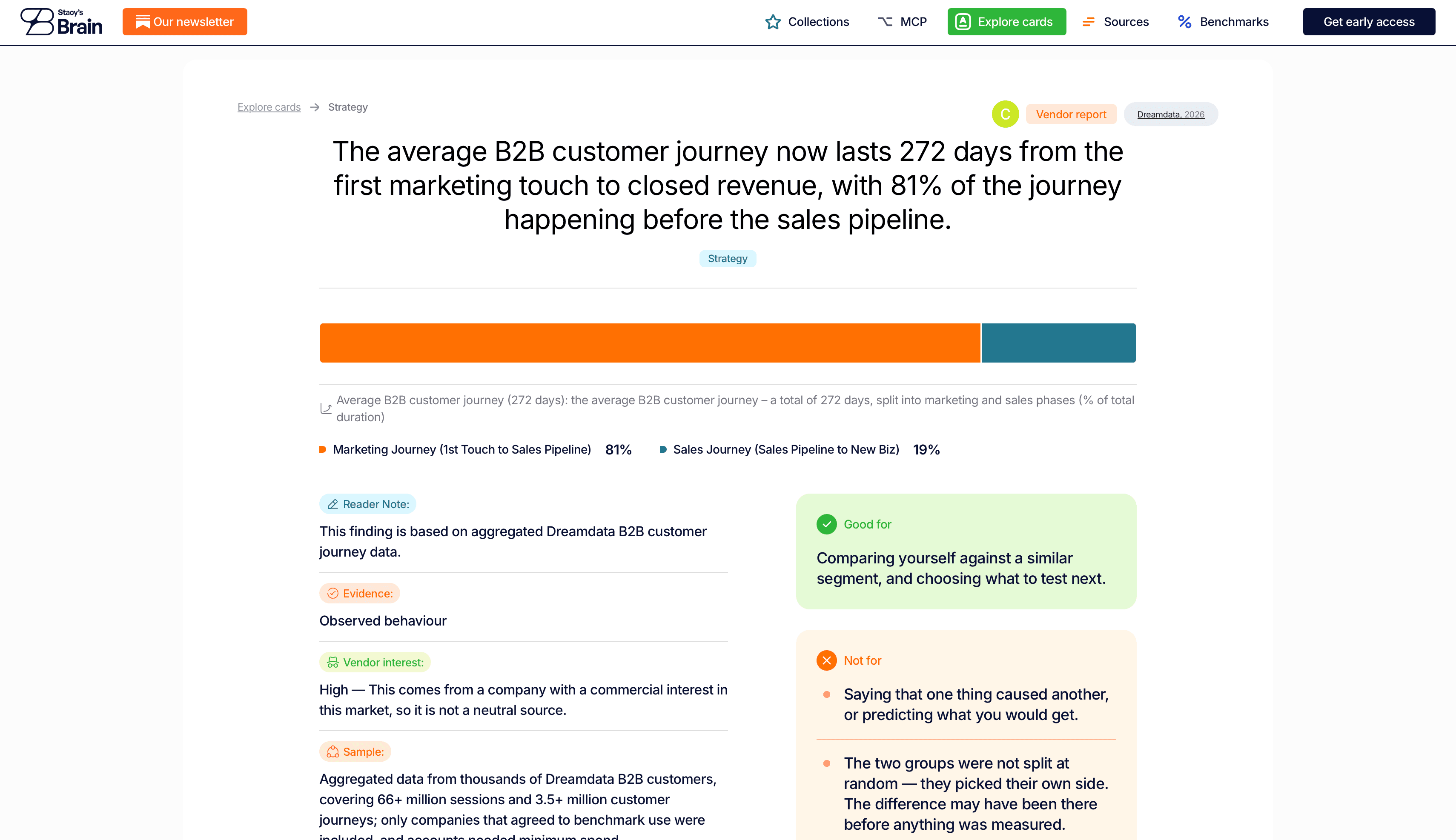
About this app
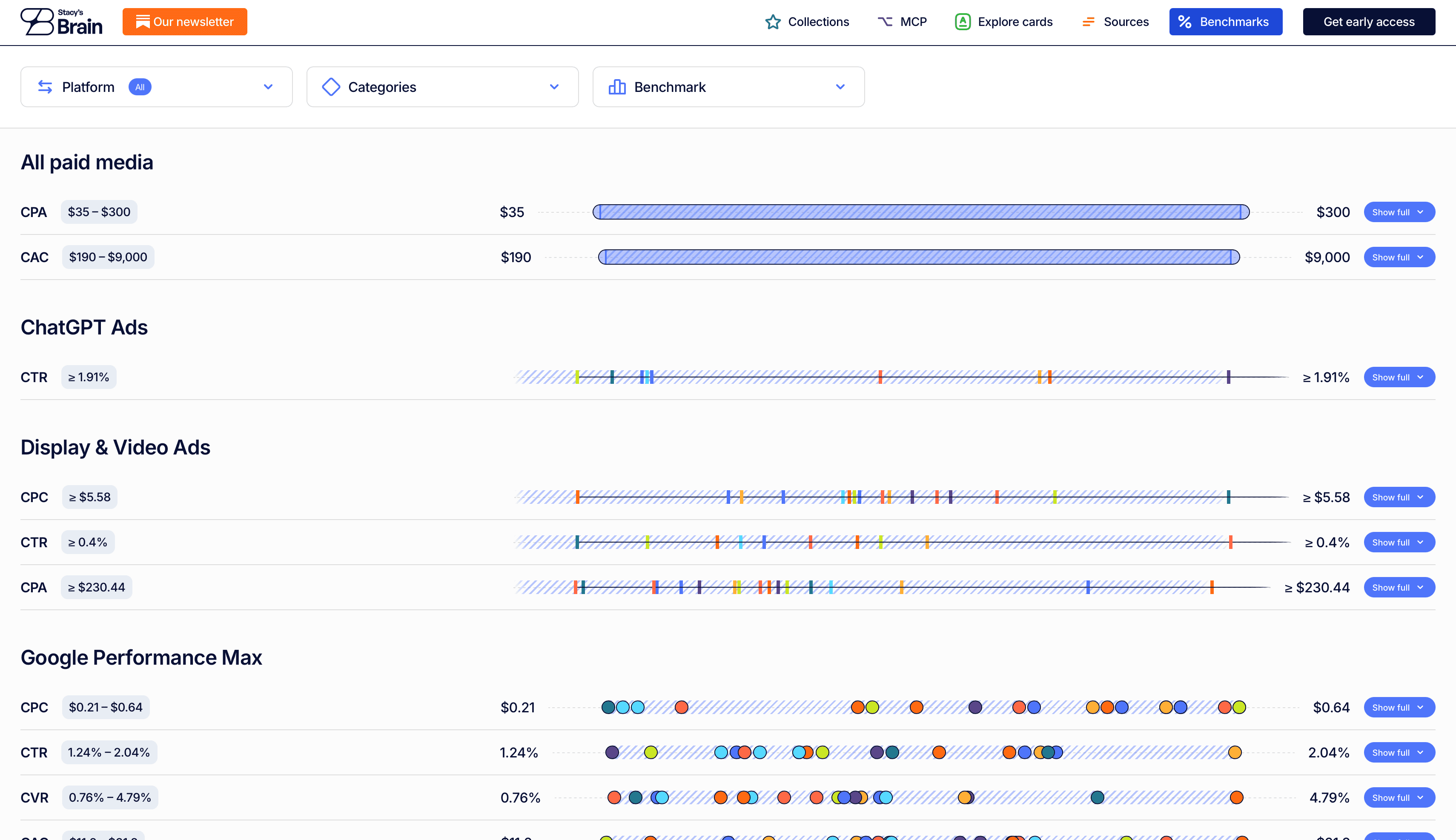
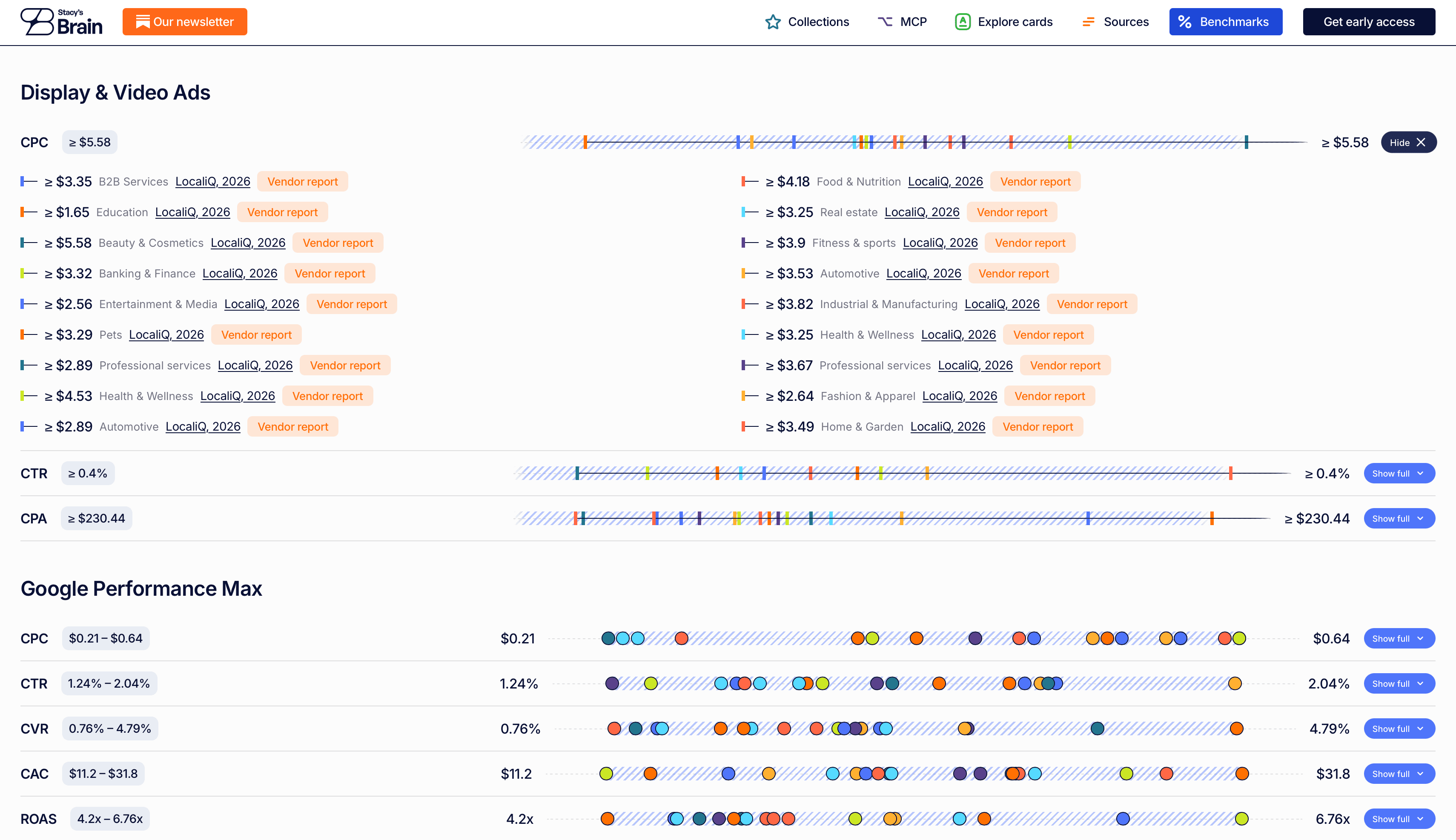
Stacy's Brain bills itself as "marketing's collective memory"—and honestly, that phrase sums it up better than any pitch deck could. The idea is simple but sorely needed: every marketing statistic, benchmark, and research finding floating around the internet gets checked, graded with a reliability tier, and stored in a searchable database so you can see whether that headline number is peer-reviewed gold or a vendor's self-serving survey from two years ago. The site currently hosts 883 cards, each tagged with a tier that runs from peer-reviewed experiments and meta-analyses at the top down to opinions, forecasts, and anything that hides its sample at the bottom. You can browse curated collections like "How to earn AI search citations" or "Increasing creator marketing efficiency in 2027," bookmark insights into personal folders, add notes, and even make those folders public for your team. There's also a Claude integration that returns reliability tiers and study context alongside any ...
Key features
- 1883 marketing insights, each graded with a reliability tier from peer-reviewed experiments down to opinions and forecasts.
- 2Searchable database with bookmarking, personal notes, and shareable public collections for teams.
- 3Claude integration that returns reliability tiers and study context alongside any marketing number.
Target customer profile
Drawn from the product itself, not from a survey.
Demographic
Content marketers and SEO specialists at B2B SaaS companies
Pain points
Constantly citing unverified stats; fear of using outdated or vendor-biased data in blog posts and decks
Primary needs
Quick access to graded, citable statistics with source context and reliability tiers
Demographic
Marketing managers and growth leads in agencies or in-house teams
Pain points
Budget decisions based on shaky vendor reports; hard to defend strategy choices to leadership
Primary needs
Defensible evidence for campaign planning and stakeholder presentations
Demographic
Marketing researchers, analysts, and academics
Pain points
Manual vetting of studies and reports is time-consuming; no central place to compare evidence quality
Primary needs
A structured, tiered research database with bookmarking, notes, and shareable collections
Scout Review
Written by AI from measured evidence, scored out of 100.
Stacy's Brain is a genuinely useful idea executed with real care: 883 graded marketing insights, reliability tiers from peer-reviewed down to opinion, bookmarking, notes, shareable collections, and a Claude integration that returns source context alongside any number. The engineering fundamentals are strong — 98/100 mobile Lighthouse, a full 12/12 security header checklist, 96/100 accessibility. The weak spots are the marketing surface and the maturity: the homepage buries its pitch below a full-viewport gradient, several collections are 'Coming soon', and there's no published compliance program. For content marketers and SEO teams tired of citing vendor surveys as if they were facts, it's a credible, fast, well-built tool that just needs to grow its library and fix its front door.
Measure by measure
Usability
62Clear 'Explore' CTA, labelled context rows, and a 'Good for / Not for' split on findings help users judge evidence fast. But the headline sits far below the fold, delaying the value proposition, and several collections are still 'Coming soon'.
Design
56Restrained navy/orange/teal palette and clean finding-page hierarchy are undermined by a full-viewport gradient hero that pushes the headline below the fold and a nav that scatters five accent colors across its icons.
Speed
88Lighthouse mobile 98/100 and desktop 99/100, with LCP 2.3s, CLS 0.002, and FCP 911ms. A lightweight content app that loads fast on both form factors — no lag complaints found.
Security
74Full 12/12 header checklist: HTTPS enforced, HSTS, CSP, frame protection, Referrer-Policy, Permissions-Policy, plus SPF and DMARC. No published SOC 2, ISO, or bug bounty program found, which is typical for an early-stage product.
Accessibility
80Lighthouse accessibility 96/100 with only one failing audit: insufficient color contrast. No WCAG statement or multi-language support found, but the automated baseline is strong for an early-stage product.
Growth
64A real, specific pain — marketing stats quoted with equal confidence regardless of source — with a genuine wedge: graded reliability tiers plus a Claude integration. Early-stage (domain ~0.2 years), but the idea has room.
Improvement areas
- Homepage hero buries the headline and value proposition below the fold in a full-viewport gradient.
- Several curated collections are marked 'Coming soon', limiting the library's usefulness at launch.
- No published compliance program (SOC 2, ISO, bug bounty) despite strong security headers.
- Single failing accessibility audit (contrast) and no WCAG conformance statement.
Design & Usability
Stacy's Brain has a coherent visual identity — navy primary, orange accent, teal for data — and its finding pages are genuinely well-structured, with labelled source metadata and a 'Good for / Not for' split that suits a trust-focused product. The problem is the front door: the homepage hero is a full-viewport gradient with the headline pushed roughly three-quarters down, so the value proposition is invisible until you scroll. The nav also scatters five accent colors across its icons, adding noise to an otherwise minimal bar. Usability is solid once you're inside — clear 'Explore' CTA, single-row benchmark filters, scannable context rows — but several collections are still 'Coming soon', and the delayed headline costs first-impression clarity.
Speed & Security
Speed is the standout: Lighthouse mobile 98/100 and desktop 99/100, with LCP 2.3s, CLS 0.002, and FCP 911ms. For a content-and-database app, that's excellent and there are no lag complaints to undercut it. Security is strong on the fundamentals — the HTTP probe returned a full 12/12 checklist with HTTPS enforced, HSTS, CSP, frame protection, Referrer-Policy, Permissions-Policy, plus SPF and DMARC. What's missing is the compliance layer: no published SOC 2, ISO 27001, pen-test summary, or bug bounty program. For an early-stage product that's normal, but it caps the score below what the header hygiene alone would earn.
Accessibility & Growth
Accessibility scores 96/100 on the Lighthouse axe-core audit, with a single failing item: insufficient background/foreground contrast. There's no WCAG conformance statement or multi-language support, but the automated baseline is strong. Growth is the more interesting question. The problem Stacy's Brain names is real and specific — marketing statistics get quoted with equal confidence whether they come from a peer-reviewed experiment or a vendor's self-serving survey — and the graded reliability tier is a genuine differentiator against Statista and eMarketer, neither of which grades source quality this way. The Claude integration is the sharpest wedge: put the grading inside the assistant people already use and the value compounds. The limit is adoption — 883 cards is a start, but the database only becomes indispensable once it's the default place to check a number.
Conclusion
If you've ever shipped a blog post citing a two-year-old vendor survey and quietly hoped nobody checked the sample size, Stacy's Brain is aimed squarely at you. The tier system is the kind of thing that should exist and mostly doesn't, and the Claude integration makes it usable in the flow where the bad citations actually happen. It's early — 883 cards, a domain registered months ago, collections still marked 'Coming soon' — so treat it as a promising tool to bookmark rather than a finished research platform. The fundamentals are there; the library depth and the homepage are what to watch.
Suggestions for improvement
- Move the headline and subline up into the first viewport so the value proposition is visible without scrolling.
- Ship the 'Coming soon' collections or hide them until they're ready — empty promises undercut a trust-focused brand.
- Add a WCAG conformance statement and fix the one contrast failure flagged by Lighthouse.
- Publish a security/compliance page (even a plain 'how we handle data' note) to back up the strong header hygiene.
Alternatives comparison
Named competitors, point by point. Nobody paid to appear here or to be left out.
 Stacy's Brain |  Statista | eMarketer | |
|---|---|---|---|
| Source reliability grading | Yes — every insight tagged with a tier from peer-reviewed to opinion/forecast | No — provides charts and market data without reliability tiers | No — formal reports, but no evidence-tier transparency |
| Pricing model | Free to browse, save, and share; waitlist for early access | Subscription tiers for full data access | Subscription-based research reports |
| AI assistant integration | Yes — Claude integration returns tiers and study context with any number | Not a core offering | Not a core offering |
| Bookmarking and shareable collections | Yes — personal folders, notes, and public team collections | Limited — saved charts within account | Limited — report access within subscription |
| Breadth of data coverage | 883 curated marketing insights at launch | Millions of statistics across all industries | Deep digital marketing and benchmark reports |
Statista
A broad statistics portal with charts and market data across industries, though it doesn't grade source reliability the way Stacy's Brain does.
eMarketer
Subscription-based market research and benchmark reports for digital marketing, more formal but less focused on evidence-tier transparency.
Comparing options? See Stacy's Brain alternatives, scored side by side
More Marketing & Sales apps
View all Marketing & Sales
EmbedMyReviews
92White-label reputation management software for agencies s...

Puzzly – B2B Lead Generation & Sales Intelligence Platform
92Puzzly is an all-in-one B2B lead generation platform that...

Geogrid
92A UULE-powered local rank tracker for SEO agencies, offer...

Vibe Coding Agent Skills
92A free, open-source platform offering 110 AI agent skills...

QRBliss
91Branded QR codes with AI Brand Sync, 15 free dynamic code...

ThumbnailMaker
90AI YouTube thumbnail maker: paste a video link, get the brief, the thumbnail, and a check at feed size.

WAButton
90WhatsApp website leads, forms and contact routing

PitchWhip
90AI cold call scripts & direct dials from LinkedIn

BACKLNK
90Backlnk is a free SEO and AI visibility website: 15 website checks, a full audit as a PDF report, and guides to get found in search and AI answers.

DemoVexa
90Turn your code into professional product demo videos with AI-generated scripts, animated UI, and natural voiceovers.

Opus Growth
89Opus Growth is a single MCP server for Google Ads, Meta Ads, TikTok Ads, LinkedIn Ads, Microsoft Ads and ChatGPT Ads. ChatGPT, Claude, Codex, Perplexity, Cursor and other assistants connect with the same address.

AuditCloser
89White-label website audits that close deals for digital a...


A platform dedicated to providing unbiased reviews of newly launched applications, analyzing everything from their features to their full potential.
info@scoutforge.net© 2026 Scoutforge. All rights reserved.
