Cycling through all six. Tap any point to stop.
Measured on six things
Find U.S. startups that reported financing in SEC Form D filings.
Security
52HTTPS + HSTS, SPF and DMARC in place, but no CSP, frame protection, Referrer-Policy or Permissions-Policy — 6/12 on headers. No SOC 2, pen-test or security page found.
Screenshots
1 / 1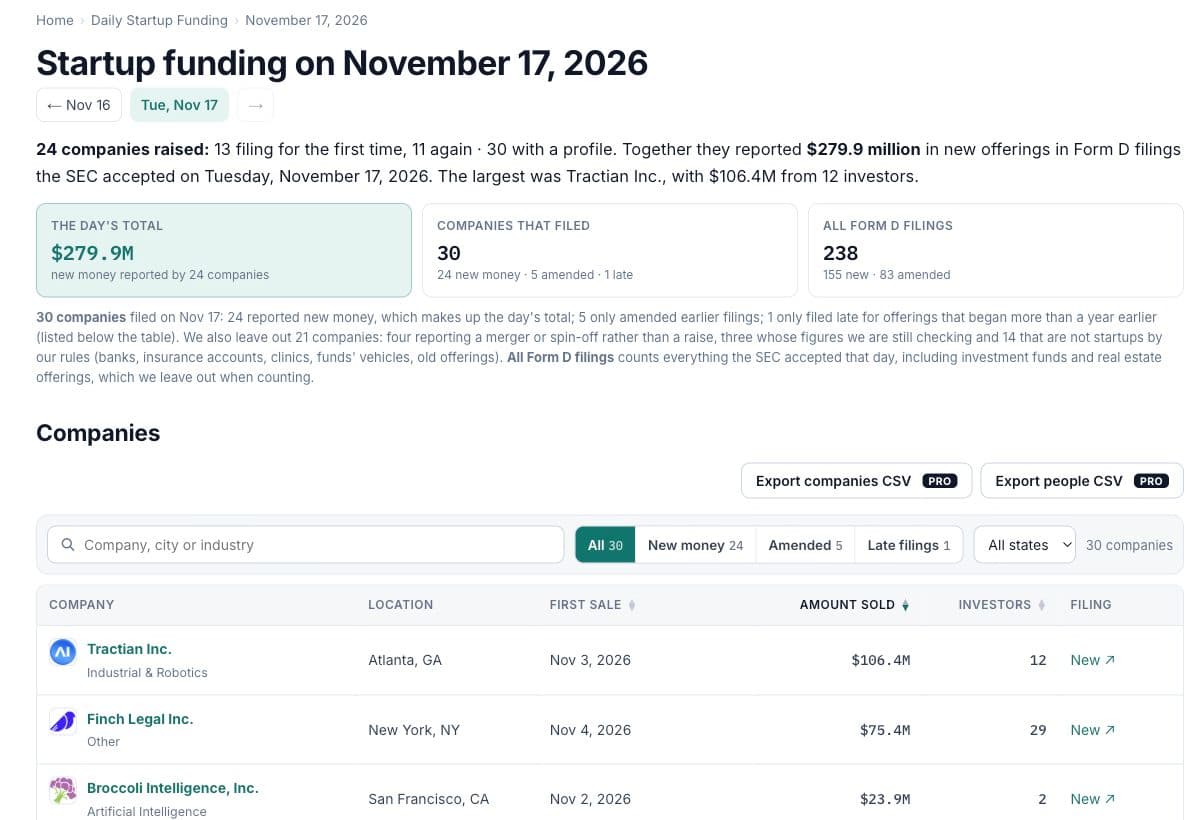
About this app
Startup Funding Tracker helps B2B sales teams, recruiters, investors, and advisers find U.S. startups that recently reported financing. It organizes SEC Form D notices and amendments into a daily feed and groups filings into company profiles. Users can filter by industry, location, and reported financing, then open the original SEC record to verify the amount sold and filing date. Saved searches and email alerts help teams follow a market over time. CSV exports let teams work with shortlists in a spreadsheet. Company profiles are free to browse.
Key features
- 1Daily Form D ingestion from SEC EDGAR, filtered to startups (funds and real estate dropped), delivered same evening or next morning.
- 2Search and filter by industry, state, city, round size and date, with saved searches and email alerts.
- 3Every company and person page free, with website, LinkedIn, phone and a direct link to the original SEC filing for verification.
- 4CSV export of companies and people (17 columns) for Pro and Max tiers, loadable into Excel, Sheets or a CRM.
Target customer profile
Drawn from the product itself, not from a survey.
Demographic
B2B sales and business development teams
Pain points
Finding recently financed prospects in a target market takes time.
Primary needs
A searchable list and original filings for verification before outreach.
Demographic
Recruiters and staffing agencies
Pain points
It is hard to tell which startups have recently reported financing.
Primary needs
A way to identify and research relevant companies before contacting them.
Demographic
Banks, law firms, agencies, and advisers
Pain points
Funding disclosures are scattered across SEC filings.
Primary needs
A repeatable way to monitor a market and build a research shortlist.
Demographic
Investors and market researchers
Pain points
Announcements alone can leave gaps in a company’s financing history.
Primary needs
Searchable filing histories and links to filings for source checks.
Scout Review
Written by AI from measured evidence, scored out of 100.
Startup Funding Tracker does one thing and does it well: read the day's Form D filings, drop the funds and real estate, and hand sales, recruiting and advisory teams a clean list of who raised, how much, and who signed the filing — the same evening or next morning. The pitch is honest about its source (SEC EDGAR), the free tier is genuinely usable (every company and person page, first 25 search results, follow 3 companies), and Pro at $49/mo or $39/mo yearly is priced for a working SDR rather than an enterprise data team. The site is fast (97 mobile Lighthouse), the design is coherent, and the 'From the SEC filing to your inbox' walkthrough is the rare landing-page section that actually explains the product. The gaps are the ones you'd expect at this stage: no security page or SOC 2, weak HTTP headers, a data table that fails accessibility on headers, and an FAQ standing in for documentation. None of those are dealbreakers for a solo researcher; several will be for a bank or law firm.
Measure by measure
Usability
68Two clear hero paths, explicit free-tier limits, and a scannable search page with filters and status tabs. FAQ-only help and no docs or API reference hold it back.
Design
70Coherent teal system, real Form D artifacts instead of stock illustrations, and a clean data table. Stat row and drifting CTA labels keep it from feeling finished.
Speed
88Lighthouse 97 mobile / 100 desktop, LCP 1.5s, CLS 0, TBT 0ms. Server-rendered data pages that load like static ones — genuinely fast.
Security
52HTTPS + HSTS, SPF and DMARC in place, but no CSP, frame protection, Referrer-Policy or Permissions-Policy — 6/12 on headers. No SOC 2, pen-test or security page found.
Accessibility
78Lighthouse 96/100, but three real failures: contrast, heading order, and unlabeled <td> cells in the main data table. No a11y statement or multi-language support.
Growth
62Real problem, specific buyer, and a same-evening Form D wedge none of the listed alternatives optimize for. Headroom is real but the moat is thin.
Improvement areas
- No security page, SOC 2, pen-test summary or bug bounty; HTTP headers score 6/12 (no CSP, frame protection, Referrer-Policy, Permissions-Policy).
- Data table fails accessibility on <td> headers, plus contrast and heading-order issues; no WCAG statement or multi-language support.
- FAQ accordion stands in for documentation; no help center, API reference or onboarding guide despite a Team plan promising an API.
- CTA labels drift across hero and pricing; stat row typography breaks the numeric pattern; CSV preview truncates key columns.
Design & Usability
The homepage is unusually honest for a data product: instead of abstract illustrations it shows a real Form D record, the company card it produces, and the alert email that lands in your inbox. That three-column walkthrough is the best thing on the site and does more selling than the three generic 'Built for timely outreach' cards above it. The teal accent is used consistently across eyebrows, CTAs, the Pro tier and table highlights, so the brand reads as one system rather than a template with a color swap. The search page is information-dense but scannable — sortable headers, a date switcher, a filter row and status tabs (All, New money, Amended, Late filings) — which is exactly what a sales researcher wants. Where it slips: the stat row sets 'Same evening or next morning' at heading scale next to numeric stats, CTA labels drift between 'See Pro', 'Start 7-day free trial' and 'Start free', and the CSV preview truncates URL and LinkedIn columns right where the proof should be. Usability-wise the two hero paths (email signup and 'See today's list') are the right call, and the free tier's limits are stated plainly on pricing. The gap is help: an eight-question FAQ accordion is not documentation, and there is no API reference despite a 'Team plan coming soon' that promises one.
Speed & Security
Speed is the standout. Lighthouse mobile 97/100 with LCP 1.5s, CLS 0 and TBT 0ms; desktop 100/100. For a product that renders a filtered table of thousands of Form D rows, that is genuinely well-engineered — server-rendered pages that load like static ones. Security is the weaker half. HTTPS is enforced with HSTS, and SPF and DMARC are configured, which is more than many indie SaaS products manage. But the header probe scores 6/12: no Content-Security-Policy, no frame protection, no X-Content-Type-Options, no Referrer-Policy, no Permissions-Policy. There is no SOC 2, ISO 27001, pen-test summary or bug bounty mentioned anywhere in the fetched site content, and no dedicated security page. For a product that aggregates public SEC filings and exec names this is not a crisis — the data is public — but a B2B buyer's security questionnaire will ask about headers and a security page, and right now the answer is 'no' on both.
Accessibility & Growth
Accessibility scores 96/100 on Lighthouse, but the three failing audits are not cosmetic: insufficient color contrast, non-sequential heading order, and — most damaging — <td> elements in a large table without table headers. That last one hits the core data page, where a screen reader user gets a wall of numbers with no column context. There is no WCAG statement and no multi-language support. On growth: the idea is well-aimed. Form D filings are public, but raw EDGAR XML is unusable for a sales rep, Crunchbase lags and gates timely data behind higher tiers, and Dealroom is built for investors doing market maps rather than SDRs building a daily call list. The wedge — same-evening/next-morning ingestion, filter by industry/state/round size, link back to the original SEC record for verification — is specific and defensible on quality, not on data exclusivity. The honest limit: the moat is a cron job and a scraper, and any competitor with a weekend and an EDGAR client can copy the core loop. The Team plan (Slack, webhooks, Google Sheets, API) is the right direction — that is where switching costs actually accrue.
Conclusion
If you are an SDR, recruiter or adviser who currently pays for Crunchbase and still finds out about raises a week late, this is worth a free account today — the 'See today's list' link lets you check the data quality before you commit an email. If you are a bank, law firm or anyone whose procurement team runs a security questionnaire, wait for the security page, the headers and the Team plan with API. The product is real and the data is verifiable against SEC records, which is more than most 'startup intelligence' tools can say. The next 12 months decide whether this becomes the default daily feed for outreach teams or gets absorbed into a bigger platform that adds Form D ingestion as a feature.
Suggestions for improvement
- Add a security page with your header posture, data handling, and a contact for questionnaires — B2B buyers will ask.
- Fix the data table: add <th> scope attributes and a caption so screen readers get column context on the core page.
- Ship a real help center and API docs before the Team plan launches; the FAQ accordion will not scale to paying teams.
- Standardize CTA labels across hero and pricing ('Start free' vs 'See Pro' vs 'Start 7-day free trial') and fix the stat row typography.
Alternatives comparison
Named competitors, point by point. Nobody paid to appear here or to be left out.
 Startup Funding Tracker |  Crunchbase |  SEC EDGAR |  Dealroom | |
|---|---|---|---|---|
| Data source and freshness | SEC Form D filings read each business day, delivered same evening or next morning. | Curated startup database; funding rounds often lag SEC filings and timely data sits behind higher tiers. | Raw SEC EDGAR source of truth; real-time but unfiltered XML with no enrichment. | Curated ecosystem intelligence; funding data oriented to investors and market maps, not daily outreach. |
| Filtering and search | Filter by industry, state, city, round size, date, first-time vs repeat; saved searches and alerts. | Deep filters across funding, investors, people; advanced filters gated to higher tiers. | Basic full-text and form-type search; no industry, round-size or location filters. | Strong filters for ecosystem analysis and market maps; less tuned to daily sales lists. |
| Verification to source | Every company page links directly to the original SEC Form D record for amount and filing date. | Round data with sources, but not always a direct link to the underlying Form D. | Is the source — every record is the original filing, but with no enrichment or context. | Curated funding data with some sourcing; not a direct Form D verification workflow. |
| Export and CRM workflow | CSV export of companies and people (17 columns) on Pro (3,000 rows/mo) and Max (7,000 rows/mo). | CSV export and API available on higher-tier plans. | No native CSV export; raw XML downloads only. | Export and API on paid plans; oriented to investor workflows. |
| Pricing and free access | Free tier (all company pages, first 25 results, follow 3); Pro $49/mo or $39/mo yearly; Max $99/mo or $79/mo yearly. | Free browsing limited; paid plans significantly higher, timely data behind top tiers. | Free, public, no account required. | Free limited access; paid plans priced for investors and ecosystem teams. |
Crunchbase
Large startup database covering funding rounds, investors and company profiles, but updates often lag behind SEC filings and the most timely data sits behind higher-tier plans.
SEC EDGAR
The free source of truth for Form D filings, but raw XML documents with no filtering, enrichment, or people/company context — essentially what Startup Funding Tracker automates.
Dealroom
Startup and ecosystem intelligence platform with funding data and market maps, oriented toward investors and ecosystem analysis rather than daily sales outreach lists.
Comparing options? See Startup Funding Tracker alternatives, scored side by side
More Marketing & Sales apps
View all Marketing & Sales
EmbedMyReviews
92White-label reputation management software for agencies s...

Puzzly – B2B Lead Generation & Sales Intelligence Platform
92Puzzly is an all-in-one B2B lead generation platform that...

Geogrid
92A UULE-powered local rank tracker for SEO agencies, offer...

Vibe Coding Agent Skills
92A free, open-source platform offering 110 AI agent skills...

QRBliss
91Branded QR codes with AI Brand Sync, 15 free dynamic code...

ThumbnailMaker
90AI YouTube thumbnail maker: paste a video link, get the brief, the thumbnail, and a check at feed size.

WAButton
90WhatsApp website leads, forms and contact routing

PitchWhip
90AI cold call scripts & direct dials from LinkedIn

BACKLNK
90Backlnk is a free SEO and AI visibility website: 15 website checks, a full audit as a PDF report, and guides to get found in search and AI answers.

DemoVexa
90Turn your code into professional product demo videos with AI-generated scripts, animated UI, and natural voiceovers.

Opus Growth
89Opus Growth is a single MCP server for Google Ads, Meta Ads, TikTok Ads, LinkedIn Ads, Microsoft Ads and ChatGPT Ads. ChatGPT, Claude, Codex, Perplexity, Cursor and other assistants connect with the same address.

AuditCloser
89White-label website audits that close deals for digital a...


A platform dedicated to providing unbiased reviews of newly launched applications, analyzing everything from their features to their full potential.
info@scoutforge.net© 2026 Scoutforge. All rights reserved.
