Cycling through all six. Tap any point to stop.
Measured on six things
Free online I Ching. Throw three coins six times to build your hexagram, then read its judgment, Image and every moving line against the classical Zhouyi text — written for your exact question. No signup.
Growth
62A real, specific problem (your own cast, not a random generator) with a genuine wedge: Legge 1899 source text, moving lines, free full 64-hexagram library. Niche but clearly positioned.
Screenshots
1 / 4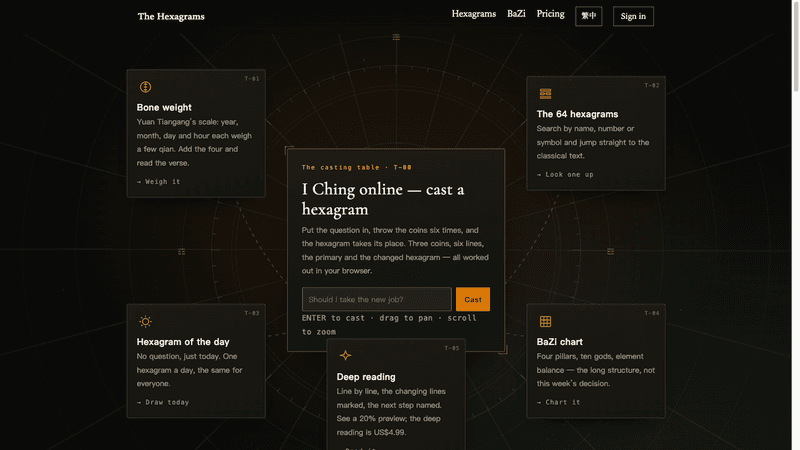
About this app
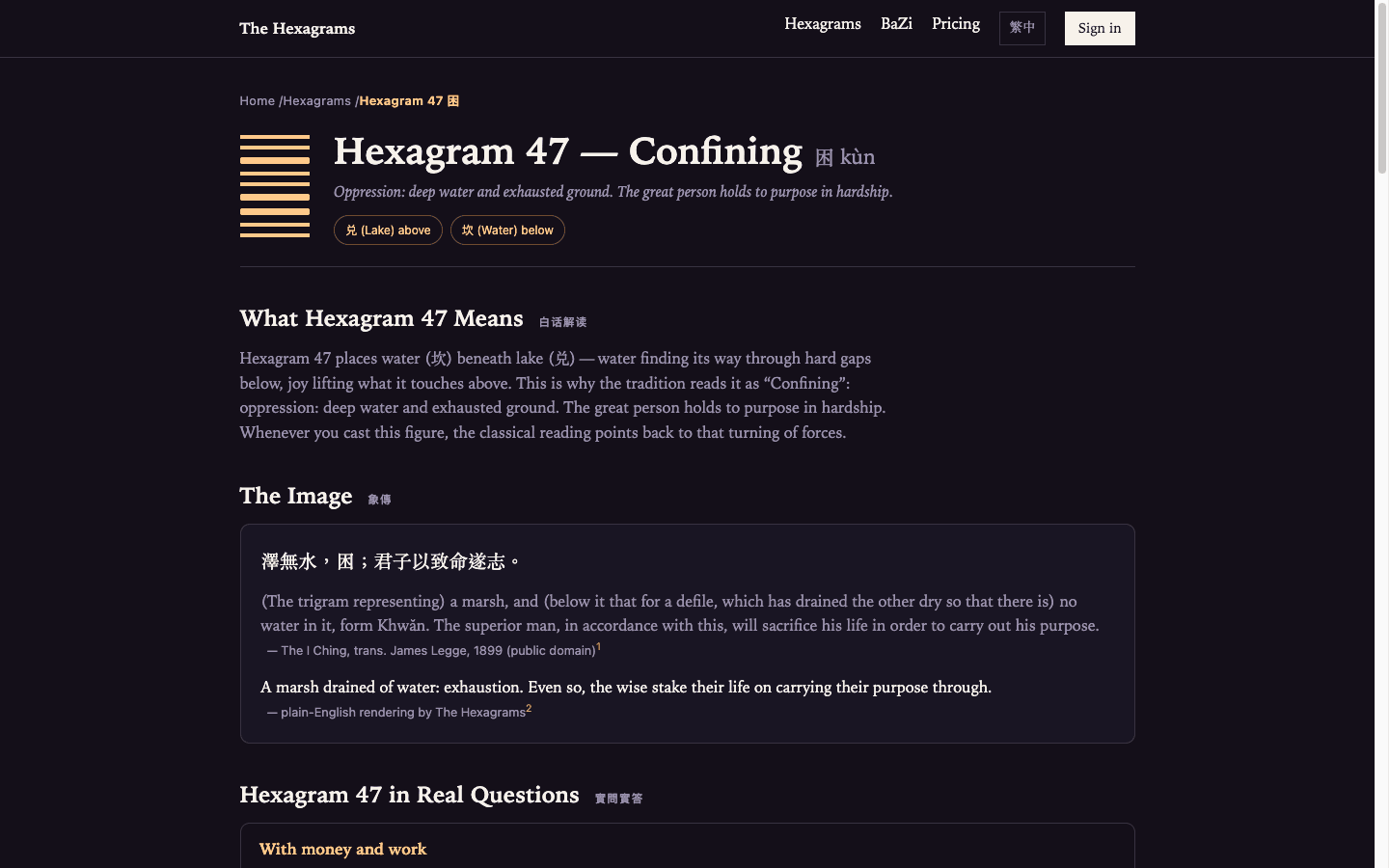
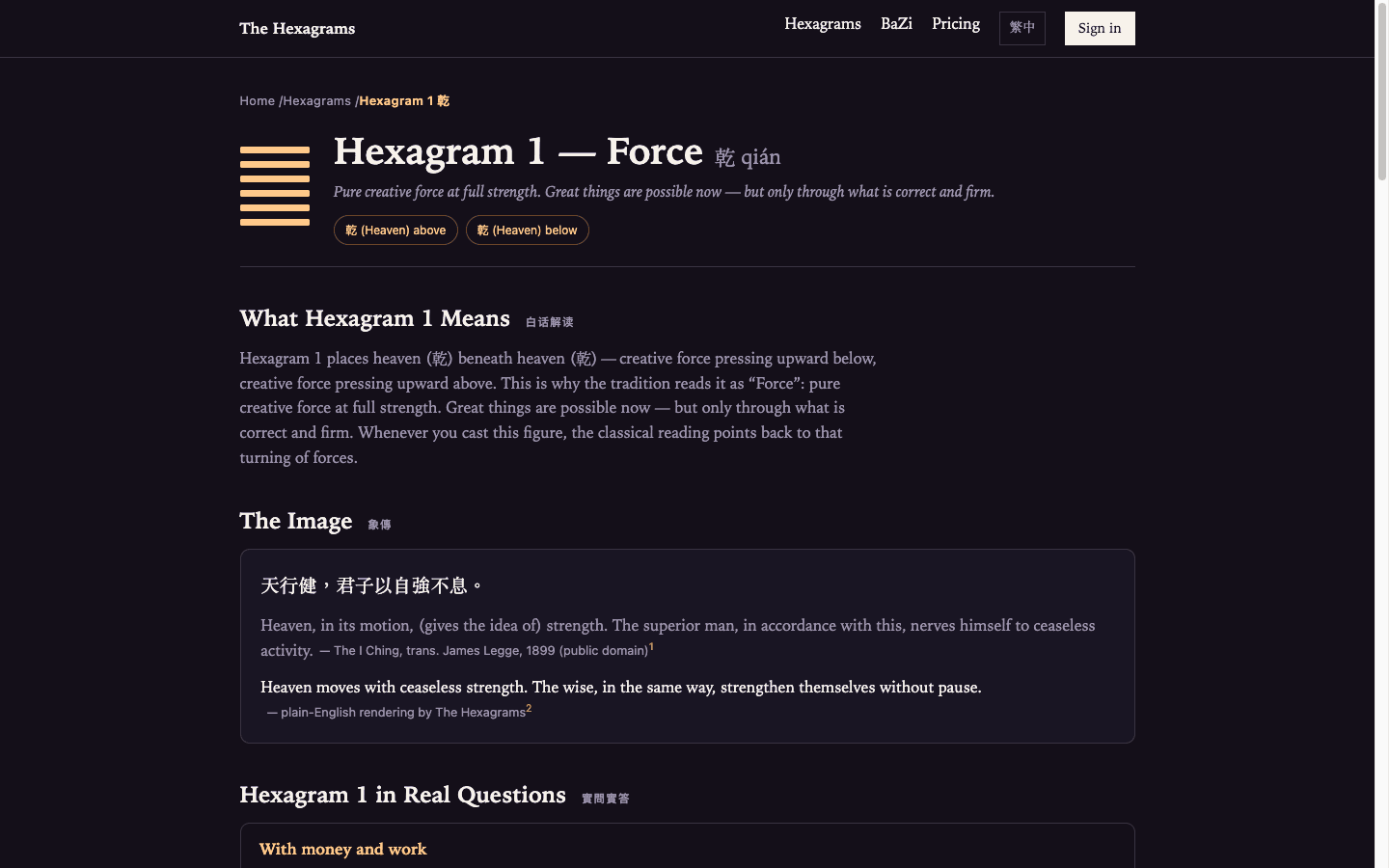
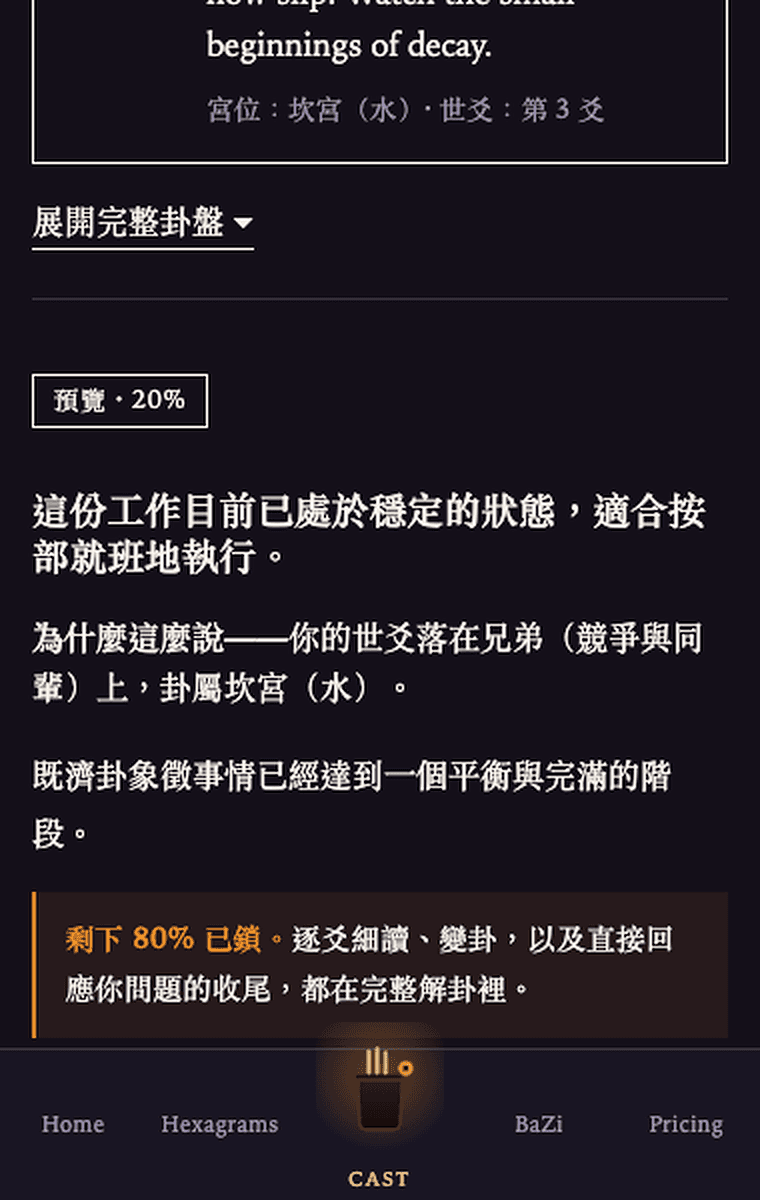
The Hexagrams is an online I Ching reading tool. You hold one question, throw three coins six times, and the site builds your hexagram line by line from the bottom up — then reads it back to you: the judgment, the Image, and every moving line, grounded in the public-domain James Legge (1899) translation rather than keyword summaries. The first 20% of that reading is free; the full line-by-line reading is a one-time $4.99. Unlike a random hexagram generator, a reading here always begins from your own cast, and moving lines show where the situation is heading, not just where it stands. Casting is free and the classical text of all 64 hexagrams is free to read in full. Beyond the I Ching it also offers BaZi four-pillars charts and traditional bone-weight readings. Everything runs in the browser. No account needed to cast, nothing to install. Paid readings are one-time purchases: a deep line-by-line reading is $4.99, the full BaZi chart is $29.99.
Key features
- 1Three-coin I Ching casting in the browser, building the hexagram bottom-up with primary and changed hexagrams.
- 2Line-by-line readings grounded in the public-domain James Legge (1899) translation, with moving lines highlighted.
- 3All 64 hexagram classical texts free to read; casting free with no account required.
- 4One-time pricing: $4.99 I Ching deep reading, $4.99 per BaZi card, $29.99 all-access; 14-day refund, no subscription.
Target customer profile
Drawn from the product itself, not from a survey.
Scout Review
Written by AI from measured evidence, scored out of 100.
The Hexagrams is a browser-based I Ching tool that takes the casting seriously: you hold a question, throw three coins six times, and the site assembles the hexagram bottom-up, then reads back the judgment, the Image and every moving line from the James Legge 1899 translation. Casting is free, all 64 hexagram texts are free, and the full line-by-line reading is a one-time $4.99 with a 20% preview and a 14-day refund. BaZi charts and bone-weight readings extend the offering. Technically it is fast (Lighthouse 99 mobile / 100 desktop) and well-secured (11/12 header checks, DMARC the gap). The weak points are presentational and accessibility: a near-empty first viewport that buries the Cast button, a dim unfinished second section, tiny low-contrast mono labels, and three real a11y failures behind the 95 score.
Measure by measure
Usability
63Free casting with no account, all 64 texts free, transparent one-time pricing and a 20% preview are real strengths. But canvas pan/zoom is explained only in tiny grey text, and the core action hides below the fold.
Design
70Coherent type system (serif display, sans body, mono labels) with one disciplined amber accent. Undone by a near-empty first viewport, the core cast card ~1,200px down, and a dim, clipped second section.
Speed
88Lighthouse mobile 99/100 (LCP 1.7s, CLS 0, TBT 31ms) and desktop 100/100. Casting and hexagram math run locally in the browser, so the app stays light by design.
Security
74Strong header hygiene: HTTPS enforced, HSTS, CSP, frame protection, Referrer and Permissions policies, SPF — 11/12 on the probe. DMARC is the one gap; no SOC 2 or audit claims published.
Accessibility
79Lighthouse a11y 95/100, but three real fails: insufficient contrast, non-sequential headings, and visible labels not matching accessible names. The tiny low-contrast mono labels are the visible culprit.
Growth
62A real, specific problem (your own cast, not a random generator) with a genuine wedge: Legge 1899 source text, moving lines, free full 64-hexagram library. Niche but clearly positioned.
Improvement areas
- Homepage buries the core casting card ~1,200px down behind a near-empty first viewport.
- Three real accessibility failures: contrast, heading order, and label/accessible-name mismatch.
- Missing DMARC record; no published security audit or accessibility statement.
- Canvas pan/zoom controls documented only in tiny low-contrast monospace text.
Design & Usability
The Hexagrams has a genuinely considered visual identity: a serif display face, sans body, monospace labels and a single amber accent applied consistently across the Cast button, icons and hexagram glyphs. The reading page treats the classical text with visible respect. The problem is composition — the homepage opens on a near-empty black viewport and the actual casting card sits roughly 1,200px down, while the second section is a dim, clipped canvas that looks unfinished. Usability is stronger than the layout suggests: casting is free with no account, all 64 hexagram texts are free to read, pricing is transparent one-time ($4.99 reading, $29.99 BaZi all-access) with a stated 14-day refund, and a 20% preview precedes the unlock. The canvas pan/zoom controls, though, are explained only in tiny grey text along the bottom edge.
Speed & Security
Speed is the standout. Lighthouse measured mobile performance at 99/100 (LCP 1.7s, CLS 0, TBT 31ms) and desktop at 100/100, and the site's own claim that casting and hexagram computation happen locally in the browser is consistent with that profile — there is no heavy server round-trip to wait on. Security is solid but not exceptional: the HTTP probe found HTTPS enforced with HSTS, a Content-Security-Policy, frame protection, X-Content-Type-Options, Referrer-Policy, Permissions-Policy and SPF, for 11 of 12 checklist points. The single gap is DMARC, which leaves email spoofing of the domain unguarded. There are no published SOC 2, ISO or pen-test claims, and no third-party security reputation could be verified — normal for a product at this stage, but it caps the score below the top band.
Accessibility & Growth
Accessibility scores 95/100 on Lighthouse but carries three concrete failures: insufficient background/foreground contrast, headings that are not in sequential order, and visible text labels that do not match their accessible names. The visual audit independently flags the same contrast problem in the tiny monospace micro-labels, so this is a real, fixable issue rather than a false positive. No accessibility statement or WCAG claim was found. On growth, the idea holds up: the product names a specific problem — a reading that begins from your own cast rather than a random generator — and backs it with the public-domain James Legge (1899) translation, moving lines that show where a situation is heading, and the full classical text of all 64 hexagrams free. Against Online Clarity and I Ching Online, that source-text fidelity plus the adjacent BaZi and bone-weight tools is a real wedge. The category is niche and the domain is only months old, so the ceiling is modest, but the positioning is clear.
Conclusion
If you already use the I Ching and want the actual classical text rather than a keyword summary, this is a credible, honestly priced option — free to cast, free to read all 64, $4.99 only when you want the full line-by-line reading. The one-time model with no subscription and a stated refund policy is refreshing. Before recommending it broadly, the site needs to move the casting card into the first viewport, fix the contrast and heading-order failures, and add DMARC. None of those are hard; all of them are the difference between a tool that looks unfinished and one that earns trust on first click.
Suggestions for improvement
- Move the casting card into the first viewport — 1,200px of black before the core action costs you first-time visitors.
- Fix the three Lighthouse a11y fails: raise contrast on mono micro-labels, order headings sequentially, align visible labels with accessible names.
- Publish a DMARC record to close the one missing security header and protect the domain from email spoofing.
- Add a short accessibility statement and surface the canvas pan/zoom controls in readable text, not 9px grey mono.
Alternatives comparison
Named competitors, point by point. Nobody paid to appear here or to be left out.
 The Hexagrams | Online Clarity (I Ching with Clarity) | I Ching Online |  | |
|---|---|---|---|---|
| Reading source text | James Legge (1899) public-domain translation, line by line | Hilary Barrett's own commentary and consultation | Classical hexagram texts with online casting | - |
| Casting method | Three-coin, six throws, computed locally in browser | Online consultation with a cast | Online three-coin casting | - |
| Pricing model | Free cast + free 64 texts; $4.99 one-time deep reading; $29.99 BaZi all-access | Consultation-based; pricing not verified in collected evidence | Free online casting; pricing not verified in collected evidence | - |
| Account required | No — account optional, casting works without one | Not verified in collected evidence | Not verified in collected evidence | - |
| Extra divination tools | BaZi four-pillars charts and Yuan Tiangang bone-weight readings | I Ching consultation focus | I Ching casting and texts | - |
Online Clarity (I Ching with Clarity)
Hilary Barrett's I Ching reading site with online consultation.
I Ching Online
Online three-coin I Ching casting with the hexagram texts.
Comparing options? See The Hexagrams alternatives, scored side by side
More Lifestyle & Entertainment apps
View all Lifestyle & Entertainment
Factory Direct Mattress Overland Park
92A locally-owned mattress store in Overland Park, KS offer...

RoomCreator
92An AI-powered interior and exterior design tool that tran...

Seating Chart Generator
90Free seating chart maker for weddings and events

SheetScroll
90> You play; SheetScroll turns the page. It listens through the microphone or a MIDI piano and holds the page until it's sure where you are.

Hireci
89Save every recipe. Plan every meal.

TUNL - Cave Flyer
89A hold-to-thrust cave flyer with a new daily level, ghost races, and a global leaderboard.

Portrait Gift
88AI-powered personalized face swap art platform creating c...

NOSTRES
88Free step-by-step guides for moving to Berlin: documents,...

Random Movie Generator
88Free random movie picker from 142k+ films—no sign-up.

TranscriptYou
88Free YouTube transcript generator with timestamps and AI ...

Roami eSIM
88A global travel eSIM app offering instant activation, no ...

SeatCanvas
87Drag-and-drop seating charts for weddings, quinceañeras and events. Import your guest list from Excel, export print-ready PDFs. Free up to 40 guests, no signup.


A platform dedicated to providing unbiased reviews of newly launched applications, analyzing everything from their features to their full potential.
info@scoutforge.net© 2026 Scoutforge. All rights reserved.
