

A platform dedicated to providing unbiased reviews of newly launched applications, analyzing everything from their features to their full potential.
info@scoutforge.net© 2026 Scoutforge. All rights reserved.
A platform dedicated to providing unbiased reviews of newly launched applications, analyzing everything from their features to their full potential.
info@scoutforge.net© 2026 Scoutforge. All rights reserved.
A platform dedicated to providing unbiased reviews of newly launched applications, analyzing everything from their features to their full potential.
info@scoutforge.net© 2026 Scoutforge. All rights reserved.
Cycling through all six. Tap any point to stop.
Measured on six things
Your Social Media Content Engine That Drives Revenue
Lighthouse mobile 62/100 with a brutal 16.3s LCP and 3.9s FCP; desktop is a healthier 79/100. CLS is 0 and TBT is only 52ms, so the layout is stable and the main thread is fine — the hero is just heavy. Mobile is the weak spot.
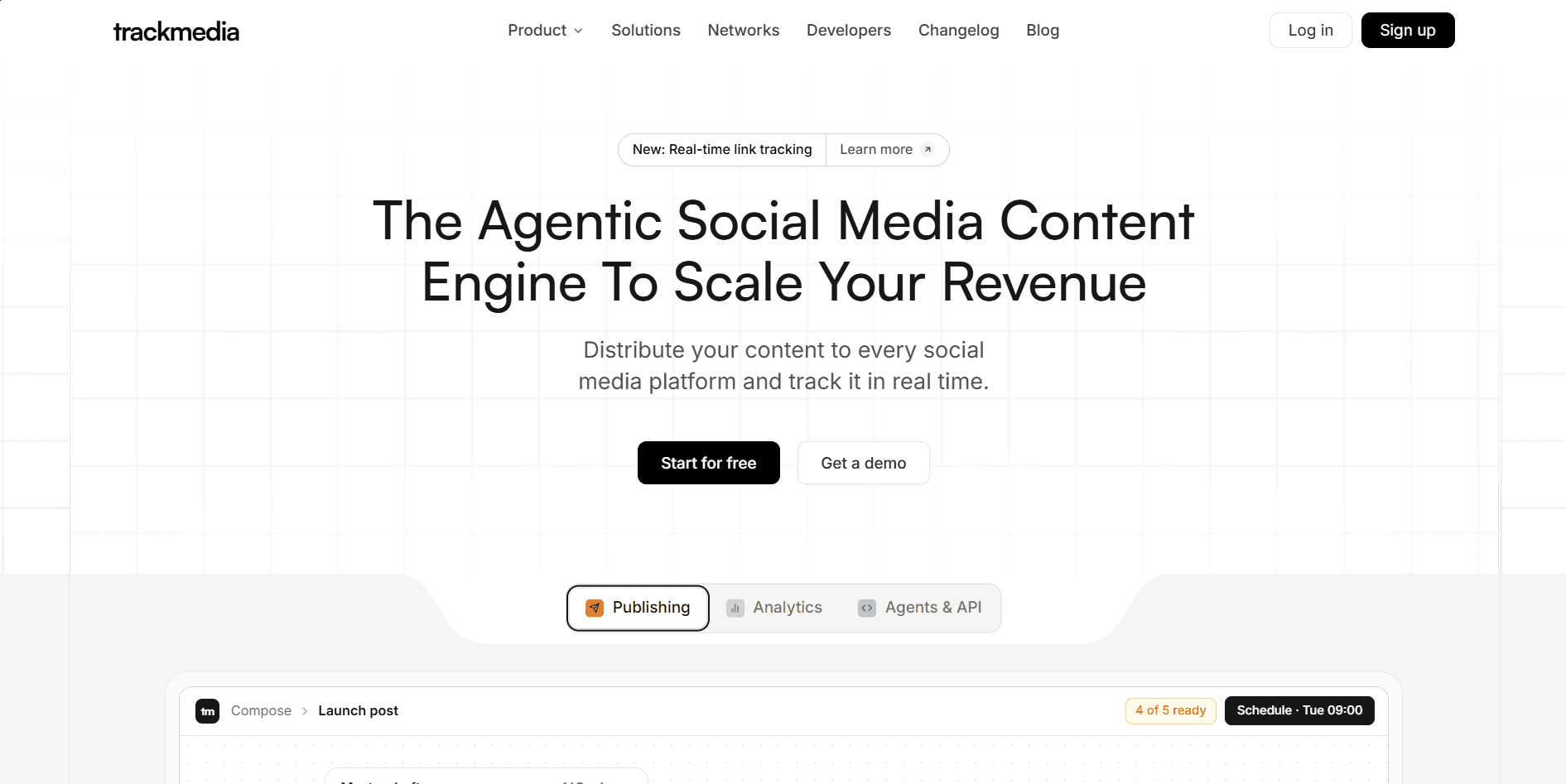
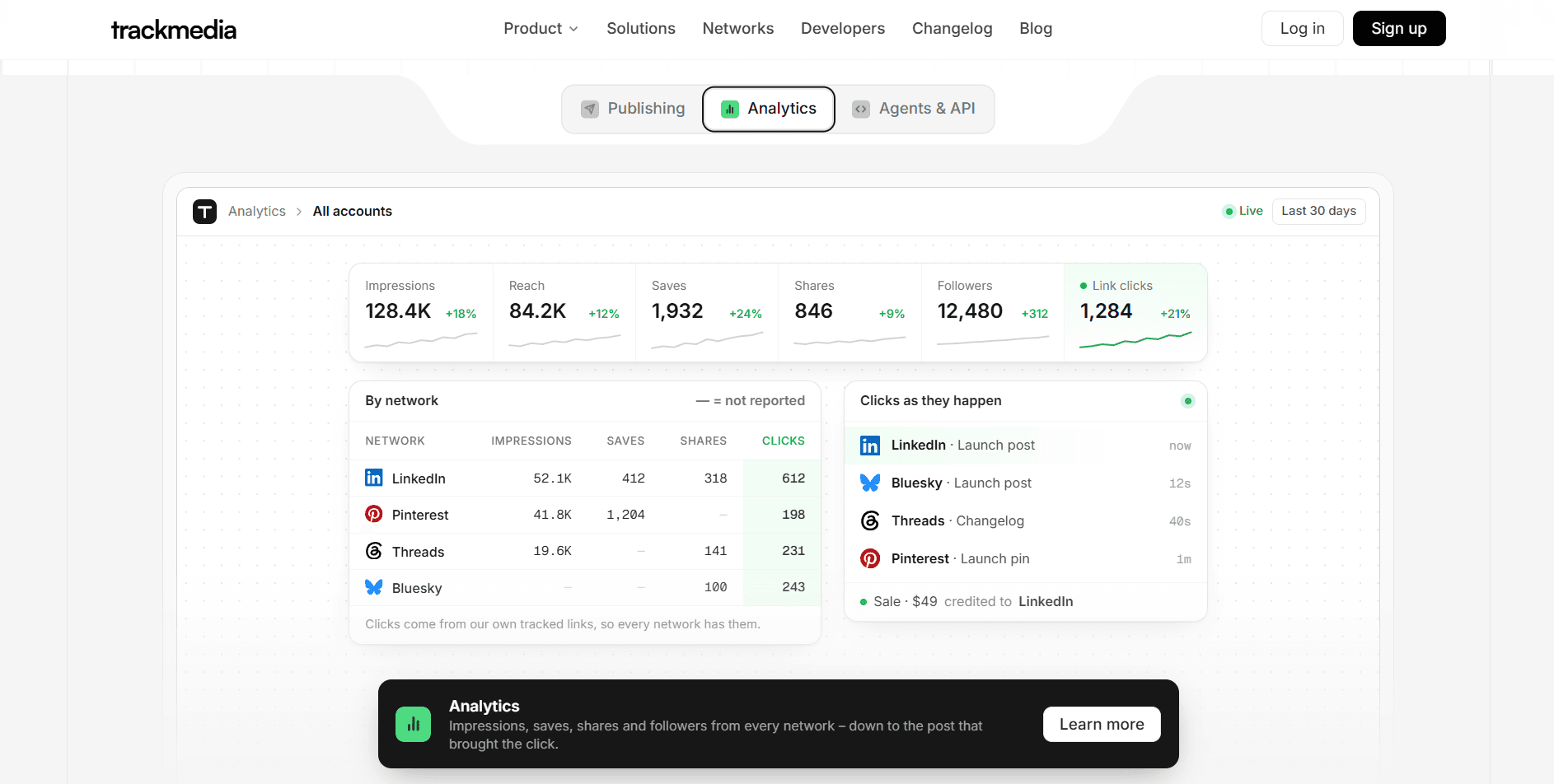
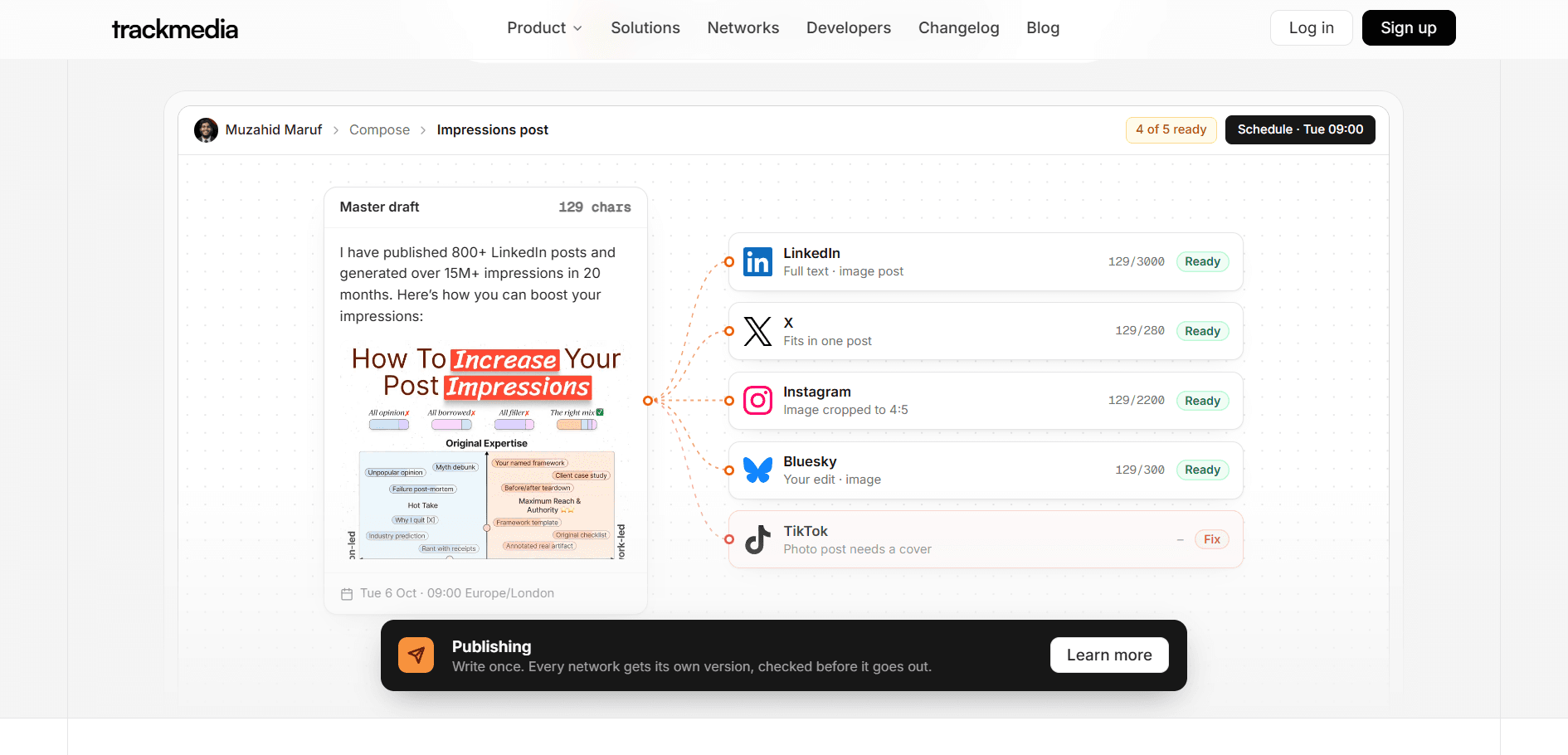
TrackMedia is the agentic social media content engine that helps you scale your revenue. Distribute your content to every social media platform, track it in real time, and use AI agents to run it. 1. Write once, publish everywhere: compose a post one time and distribute it to every social platform. 2. Track every click: every published link gets UTM tagging, so you see which posts drive traffic and revenue in real time. 3. 20 networks, one composer: manage all your channels from a single place instead of switching tabs. 4. Repost without copy-paste: reuse winning content across networks in a click. 5. Built for humans and agents: a full API, SDK, CLI, webhooks and an MCP server let AI agents run your content engine.
Drawn from the product itself, not from a survey.
Demographic
Content creators and solopreneurs
Pain points
Managing multiple social accounts, manually reformatting content, and not knowing which posts drive sales.
Primary needs
Efficient cross-posting, real-time analytics, and a way to monetize content.
Demographic
In-house marketing teams
Pain points
Juggling multiple brand channels, inconsistent posting, and difficulty proving ROI.
Primary needs
Centralized scheduling, comprehensive analytics, and reliable failure notifications.
Demographic
Digital marketing agencies
Pain points
Scaling across many clients, proving value with accurate reporting, and managing permissions.
Primary needs
Multi-workspace management, white-label reporting, and cost-effective per-client pricing.
Demographic
Developers and AI agents
Pain points
Integrating social posting into applications, ensuring idempotent operations, and handling platform limits.
Primary needs
A well-documented API, SDK, CLI, and MCP server for autonomous publishing.
Written by AI from measured evidence, scored out of 100.
TrackMedia is an agentic social media content engine aimed at creators, in-house marketing teams and agencies who are tired of reformatting one post for five networks and guessing which one drove the sale. The pitch is coherent: write once, fan out per-network versions with preflight checks, tag every link with UTM so clicks map to revenue, and let AI agents run the pipeline through an MCP server, API, SDK, CLI and webhooks — with scoped keys and human approval so an agent can prepare but not publish. The landing page sells this well, with real product mockups rather than stock art. The measured reality is more mixed. Mobile performance is 62/100 with a 16.3s LCP, security headers are 7/12 with no CSP and no SPF/DMARC, and accessibility is 93/100 but fails on contrast and touch targets. The domain is brand new and the only listed social profile is a Twitter account, so third-party reputation is essentially unassessed. The idea is differentiated; the execution is early.
Clear three-pillar structure (Publishing, Analytics, Agents & API), free tier plus demo CTA, and a genuinely deep developer surface: API, SDK, CLI, webhooks, MCP server with 17 tools, changelog and blog. Onboarding depth beyond the landing page is unverified.
Polished, modern landing page with real product mockups: per-network previews, character counters, crop notes and an agent-approval panel. Branding is consistent and the UI screenshots do the selling. Above-average craft for an early-stage tool.
Lighthouse mobile 62/100 with a brutal 16.3s LCP and 3.9s FCP; desktop is a healthier 79/100. CLS is 0 and TBT is only 52ms, so the layout is stable and the main thread is fine — the hero is just heavy. Mobile is the weak spot.
HTTPS enforced with HSTS, frame protection, X-Content-Type-Options and Referrer-Policy all present — 7/12 header checklist points. Missing CSP and Permissions-Policy, and no SPF/DMARC on the domain. No SOC 2, ISO or pen-test claims found. Solid basics, unverified depth.
Lighthouse accessibility 93/100 — strong automated baseline. Two real failures: insufficient color contrast and undersized/too-close touch targets. No WCAG statement or a11y page found. Good automated score, but the contrast and touch-target issues are user-facing, not theoretical.
Real problem (cross-posting plus attribution), specific wedge (agent-native publishing via MCP/API/CLI with human-approval scopes), and three named segments. Differentiated against Buffer/Hootsuite/Later, but the agent angle is copyable and the category is crowded.
The landing page is the strongest part of TrackMedia. It leads with a working-looking mockup of the actual product: a master draft fanning out to LinkedIn, X, Instagram, Bluesky and TikTok with per-network character counts, crop notes and a 'Fix' flag on the one that doesn't fit. That's a real product screenshot doing real work, not a stock illustration. The three-pillar structure — Publishing, Analytics, Agents & API — is legible in one scroll, and the free tier plus demo CTA covers both self-serve and sales-led buyers. The developer surface is unusually deep for a product this young: API, SDK, CLI, webhooks, and an MCP server with 17 tools, plus a changelog and blog. What I can't verify from the collected evidence is the onboarding flow itself — how long it takes to connect a first account and publish a first post. The marketing promises 'write once, publish everywhere' with preflight checks; whether the app delivers that without friction is the open question. Design and structure are ahead of the typical early-stage tool; the proof of usability lives behind the signup wall.
Speed is a split verdict. Desktop Lighthouse lands at 79/100, which is fine. Mobile lands at 62/100 with a 16.3-second largest contentful paint and 3.9-second first contentful paint — that's a heavy hero on a phone connection, and it's the number most visitors will actually experience. The mitigating signals are real: CLS is 0, so nothing jumps around, and TBT is only 52ms, so the page isn't choking the main thread. This is a weight problem, not an architecture problem. Security sits in the same 'basics done, depth unproven' zone. HTTPS is enforced with HSTS, and frame protection, X-Content-Type-Options and Referrer-Policy are all present — 7 of 12 checklist points. Missing: a Content-Security-Policy, a Permissions-Policy, and both SPF and DMARC records on the domain, which matters for a product that will send notification and approval emails. No SOC 2, ISO 27001 or pen-test claims appear in the collected material, and no breach history was found. For an early-stage tool handling social account OAuth tokens, the header hygiene is competent but the compliance story is still a blank page.
Accessibility scores 93/100 on the automated Lighthouse audit, which is a genuinely good baseline — most of the structural work is done. But two audits fail and both are user-facing: background/foreground contrast is insufficient in places, and touch targets are too small or too tightly spaced. Those aren't theoretical WCAG nitpicks; they're the two things that make a scheduling app painful on a phone, which is where a lot of social posting happens. No accessibility statement or WCAG conformance claim was found, so there's no published commitment to fix them. On growth: the problem TrackMedia names is real and expensive — creators and marketing teams lose hours reformatting one post for five networks and still can't prove which post drove revenue. The wedge is specific: agent-native publishing through an MCP server, API, SDK and CLI, with scoped keys and human-approval gates so an AI agent can prepare but not publish. That's a sharper position than 'another scheduler.' The limit is that Buffer, Hootsuite and Later already own the category, and the agent layer is a feature they can copy. The idea has room; the moat is thin.
Conclusion
TrackMedia is worth a look if you're already comfortable with developer tooling and want an agent to handle the mechanical part of cross-posting. The per-network versioning, preflight checks and click-to-revenue attribution are the right features, and the MCP server is a genuine differentiator against Buffer, Hootsuite and Later — for now. What holds it back is the unglamorous stuff: a mobile page that takes 16 seconds to paint, missing security headers and email authentication records, and two accessibility failures that hit phone users hardest. None of these are hard to fix, and none of them are fatal. But they're the difference between a product that demos well and one that a marketing team can hand to an agency without a follow-up email. Fix the LCP, add the CSP and DMARC records, bump the contrast and touch targets, and publish a security page. Then the agent story is the only thing left to argue about.
Named competitors, point by point. Nobody paid to appear here or to be left out.
 TrackMedia TrackMedia |  Buffer Buffer |  Hootsuite Hootsuite |  Later Later | |
|---|---|---|---|---|
| Free tier available | Yes — 'Start for free' CTA on homepage | Yes — free plan for up to 3 channels | No — free trial only, paid plans required | Yes — limited free plan |
| Number of supported networks | 20 networks from one composer | ~10 networks including Instagram, X, LinkedIn, TikTok | ~8 major networks plus monitoring streams | ~7 networks, Instagram-first |
| Click and revenue attribution | Automatic UTM tagging with per-post click and sale attribution | Basic link click analytics; no revenue attribution | Link click analytics and reporting; no built-in revenue attribution | Click analytics on paid plans; no revenue attribution |
| Developer and AI agent access | API, SDK, CLI, webhooks and MCP server with 17 tools | Public API on paid plans; no MCP server or CLI | Enterprise API access; no MCP server or CLI | Limited API access; no MCP server or CLI |
| Multi-workspace and agency support | Multi-workspace management with white-label reporting and per-client pricing | Team plans with multiple channels; limited white-label | Strong agency tooling, permissions and white-label reporting | Agency plans with client workspaces; no full white-label |
Buffer
A social media management platform for scheduling posts, analyzing performance, and engaging with audiences.
Hootsuite
A comprehensive social media management tool for scheduling, monitoring, and analyzing across multiple networks.
Later
A visual social media scheduler focused on Instagram, with features for planning and analyzing posts.
Comparing options? See TrackMedia alternatives, scored side by side

Puzzly is an all-in-one B2B lead generation platform that...

White-label reputation management software for agencies s...

A UULE-powered local rank tracker for SEO agencies, offer...

A free, open-source platform offering 110 AI agent skills...

White-label website audits that close deals for digital a...

Frame-perfect video-to-GIF maker that runs entirely in yo...

A top-rated virtual assistant agency that matches busines...

A unified platform replacing 12-20 disconnected tools for...

An all-in-one platform for creators to sell digital produ...

An AI-enhanced executive search firm delivering pre-mappe...

Specialized SEO services for moving companies to dominate...

Analyze your landing page and get a score, teardown, and ...
A platform dedicated to providing unbiased reviews of newly launched applications, analyzing everything from their features to their full potential.
info@scoutforge.net© 2026 Scoutforge. All rights reserved.