Cycling through all six. Tap any point to stop.
Measured on six things
1Alexander AI Visibility Tracker checks the questions buyers ask AI and shows whether your brand is named, cited, or absent. The free plan tracks 6 prompts weekly on ChatGPT, Gemini, and Perplexity.
Security
52HTTPS with HSTS plus SPF/DMARC is solid table stakes, but the probe found no CSP, frame protection, or Referrer-Policy, and there's no SOC 2, pen-test, or security page. Standard for an early-stage tool, not a differentiator.
Screenshots
1 / 1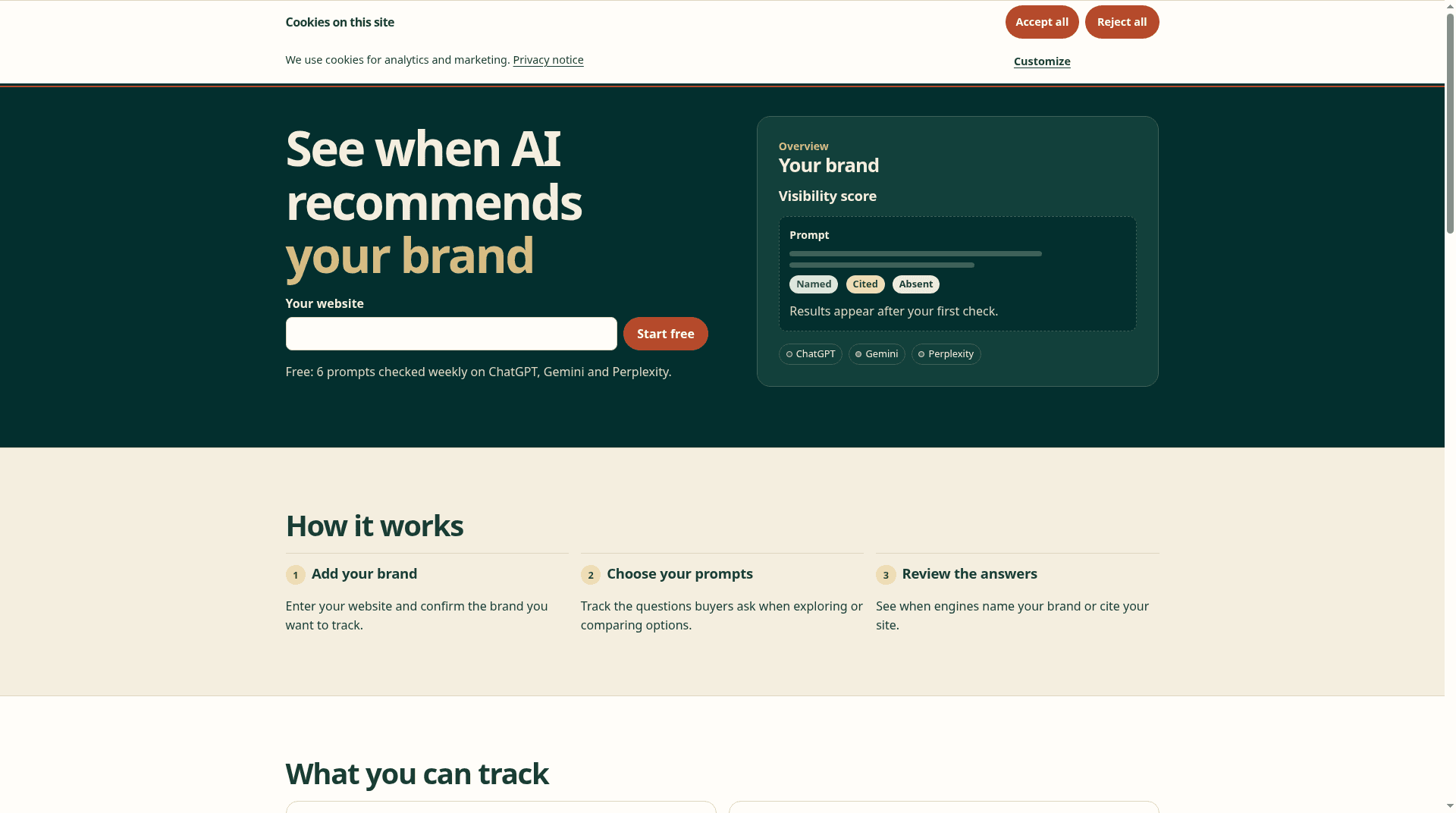
About this app
When someone asks ChatGPT, Gemini, or Perplexity for a recommendation, 1Alexander AI Visibility Tracker shows whether your brand was named, your site was cited, or you were left out. You add your website, pick the prompts buyers actually ask, and review the saved answers. You can trace citations to the pages and domains the engines used, and see prompts where a competitor was named and you were not. Visibility, share of voice, and average position come from those saved answers. Free is $0 a month for 1 brand, 6 tracked prompts, and 1 seat, with weekly checks on ChatGPT, Gemini, and Perplexity. Pro is $49 a month for 3 brands, 50 prompts, and 2 seats. It checks daily and adds Google AI Overviews, Grok, citation-gap insights, visibility-change alerts, and a shared report link. MCP is included on both plans.
Key features
- 1Track whether ChatGPT, Gemini, and Perplexity name your brand or cite your site across saved answers.
- 2Citation tracing to the pages and domains engines used, plus competitor-gap prompts where rivals won and you were absent.
- 3Free tier: 1 brand, 6 prompts, weekly checks, 3 engines, MCP included; Pro $49/mo adds daily checks, 5 engines, 3 brands, 50 prompts.
Target customer profile
Drawn from the product itself, not from a survey.
Demographic
B2B SaaS marketing leads and SEO managers
Pain points
Buyers research via AI assistants and never see their content or brand mentioned
Primary needs
Measure AI visibility across engines and find citation gaps to fix
Demographic
Founders and small marketing teams at early-stage startups
Pain points
Tight budgets and no clear way to know if AI tools recommend them
Primary needs
A free, simple tracker with weekly checks and actionable prompts
Demographic
Digital PR and content agencies serving multiple clients
Pain points
Manual prompt checking is slow and inconsistent across brands
Primary needs
Multi-brand tracking, daily checks and shareable evidence for clients
Demographic
Growth and product marketing managers in competitive niches
Pain points
Competitors get named in AI answers where their brand is absent
Primary needs
Competitor win analysis and prompts to reclaim lost visibility
Scout Review
Written by AI from measured evidence, scored out of 100.
1Alexander AI Visibility Tracker is a focused, well-presented entry into the AI-search visibility category. The site is fast (99/100 mobile Lighthouse), the design is distinctive, and the free tier is genuinely useful — 6 prompts, weekly checks across ChatGPT, Gemini, and Perplexity, with MCP included. Pro at $49/mo adds daily checks, Google AI Overviews and Grok, citation-gap insights, and a shared report link. The gaps are real but fixable: empty-state product previews that never show actual output, no visible docs or help center, thin security hardening (no CSP, no SOC 2), and no accessibility statement. Against Peec, Otterly, and Semrush it's a credible budget option, not yet a category leader.
Measure by measure
Usability
64Above-the-fold 'Start free' with a website field, free-tier limits stated upfront, and a full Free vs Pro comparison table make the path clear. Collapsed FAQs and no visible docs/help center keep it from going higher.
Design
70Warm forest-green/cream/ochre identity with disciplined type hierarchy and a genuinely comparable pricing table. Held back by empty-state product previews that show no real output and a cookie banner that fights the hero CTA.
Speed
88Lighthouse mobile 99/100 (LCP 1.5s, CLS 0, TBT 0ms) and desktop 100/100. The site is genuinely fast and lightweight, with no lag complaints in the collected evidence.
Security
52HTTPS with HSTS plus SPF/DMARC is solid table stakes, but the probe found no CSP, frame protection, or Referrer-Policy, and there's no SOC 2, pen-test, or security page. Standard for an early-stage tool, not a differentiator.
Accessibility
80Lighthouse accessibility scored a perfect 100/100 on automated checks, and the site is responsive with readable contrast. No WCAG statement, a11y docs, or multi-language support found, so it sits mid-band rather than top.
Growth
62Real, growing problem (AI answers replacing search) with concrete wedges: free weekly checks, MCP tools, citation-gap insights at $49. Early-stage (domain ~0.1yr, Twitter only) but the idea has room.
Improvement areas
- Product previews are empty states — show real answer, citation, and competitor-gap output to prove value.
- No visible help center or docs beyond a pricing table and collapsed FAQ.
- Thin security hardening (no CSP, frame protection, Referrer-Policy) and no SOC 2 or security page.
- No accessibility statement, no multi-language support, truncated footer email, low-res TOOLPILOT badge.
Design & Usability
The landing page is genuinely well-crafted: a warm forest-green and ochre palette, disciplined typography, and a pricing table that actually lets you compare Free and Pro line by line. The 'Start free' CTA sits above the fold next to a website field, and free-tier limits are stated before signup — good expectation-setting. The problem is the product previews: every hero and feature card is an empty state reading 'Results appear after your first check,' so the page sells a concept without ever showing a real answer, citation, or competitor gap. Collapsed FAQs and no visible docs compound the 'trust the copy' feeling.
Speed & Security
Speed is the standout: Lighthouse mobile 99/100 with LCP 1.5s, CLS 0, and TBT 0ms, desktop 100/100 — this is a genuinely snappy, lightweight site with no lag complaints in the evidence. Security is the weaker flank: HTTPS and HSTS are enforced and SPF/DMARC are present, but the probe found no CSP, no frame protection, no X-Content-Type-Options, and no Referrer-Policy — 6 of 12 checklist points. There's no SOC 2, ISO, pen-test, or bug-bounty claim and no security page. For an early-stage tool handling brand and prompt data that's normal, but it's table stakes, not a selling point.
Accessibility & Growth
Accessibility is strong on the measurable side — a perfect 100/100 Lighthouse axe-core score, responsive layout, readable contrast — but there's no WCAG conformance statement, no a11y documentation, and no multi-language support, so it sits mid-band rather than top. Growth is the interesting question: AI-answer visibility is a real, growing anxiety for B2B SaaS and SEO teams as buyers shift to ChatGPT, Gemini, and Perplexity. The product has concrete wedges — a free tier with weekly checks, MCP tools (check_prompt, get_citations, competitor_gap), and citation-gap insights at $49/mo — that distinguish it from Peec, Otterly, and Semrush. It's early (domain ~0.1 years, Twitter only), but the idea has room; the risk is that Semrush and Peec already own the category narrative.
Conclusion
If you're a B2B SaaS marketing lead or SEO manager who suspects AI assistants are recommending your competitors and not you, the free tier is a low-risk way to find out — six prompts and weekly checks will tell you something real within a week. Upgrade to Pro only when you need daily cadence, Google AI Overviews, or multi-brand tracking for clients. Skip it if you need enterprise compliance, deep documentation, or a proven track record — this is a young product and the site shows it. The idea is right; the execution is promising but still thin on proof.
Suggestions for improvement
- Replace empty-state product previews with real (anonymized) answer, citation, and competitor-gap screenshots so visitors see actual output.
- Add a help center or docs section covering prompt setup, MCP usage, and how visibility/share-of-voice are calculated.
- Harden security headers (CSP, X-Frame-Options, Referrer-Policy) and publish a short security/trust page.
- Publish an accessibility statement and consider a second language; fix the truncated footer email and low-res TOOLPILOT badge.
Alternatives comparison
Named competitors, point by point. Nobody paid to appear here or to be left out.
 1Alexander AI Visibility Tracker |  Peec AI |  Otterly.AI |  Semrush | |
|---|---|---|---|---|
| Free tier available | Yes — 1 brand, 6 prompts, weekly checks, 3 engines | Limited trial; paid plans primary | Trial available; paid plans primary | Limited free account; full features paid |
| AI engines monitored | ChatGPT, Gemini, Perplexity (free); + Google AI Overviews, Grok (Pro) | Multiple LLMs incl. ChatGPT, Gemini, Perplexity, Claude | ChatGPT, Perplexity, Gemini, Copilot, Google AI Overviews | AI visibility plus traditional search across major engines |
| Entry paid price | $49/month (Pro) | Higher-tier pricing; quote-based plans | Mid-tier subscription pricing | Higher, bundled SEO suite pricing |
| MCP / API integration | MCP included on both plans (check_prompt, get_citations, competitor_gap) | API available on higher plans | API/integrations on paid tiers | Extensive API and integrations |
| Multi-brand / agency support | Up to 3 brands on Pro, 2 seats, shared report link | Multi-brand and agency plans | Multi-brand tracking for agencies | Multi-project and agency tooling |
Peec AI
An AI search visibility platform that monitors how brands appear in AI-generated answers and tracks citations across models.
Otterly.AI
Monitors brand mentions and citations in AI search tools like ChatGPT and Perplexity, with reporting for marketing teams.
Semrush
Established SEO suite that has added AI visibility and brand monitoring features alongside traditional search tracking.
Comparing options? See 1Alexander AI Visibility Tracker alternatives, scored side by side
More Marketing & Sales apps
View all Marketing & Sales
Geogrid
92A UULE-powered local rank tracker for SEO agencies, offer...

EmbedMyReviews
92White-label reputation management software for agencies s...

Puzzly – B2B Lead Generation & Sales Intelligence Platform
92Puzzly is an all-in-one B2B lead generation platform that...

Vibe Coding Agent Skills
92A free, open-source platform offering 110 AI agent skills...

QRBliss
91Branded QR codes with AI Brand Sync, 15 free dynamic code...

WAButton
90WhatsApp website leads, forms and contact routing

DemoVexa
90Turn your code into professional product demo videos with AI-generated scripts, animated UI, and natural voiceovers.

PitchWhip
90AI cold call scripts & direct dials from LinkedIn

BACKLNK
90Backlnk is a free SEO and AI visibility website: 15 website checks, a full audit as a PDF report, and guides to get found in search and AI answers.

ThumbnailMaker
90AI YouTube thumbnail maker: paste a video link, get the brief, the thumbnail, and a check at feed size.

AuditCloser
89White-label website audits that close deals for digital a...

What the GIF
89Frame-perfect video-to-GIF maker that runs entirely in yo...


A platform dedicated to providing unbiased reviews of newly launched applications, analyzing everything from their features to their full potential.
info@scoutforge.net© 2026 Scoutforge. All rights reserved.
