Cycling through all six. Tap any point to stop.
Measured on six things
AI agents that manage your paid ads across platforms, wit...
Speed
34Lighthouse mobile 39/100 with a 13.1s LCP and 1.4s TBT — the page takes over ten seconds to paint its main content on a phone. Desktop is a respectable 70/100, so the gap is mobile-specific weight, not a broken stack.
Screenshots
1 / 1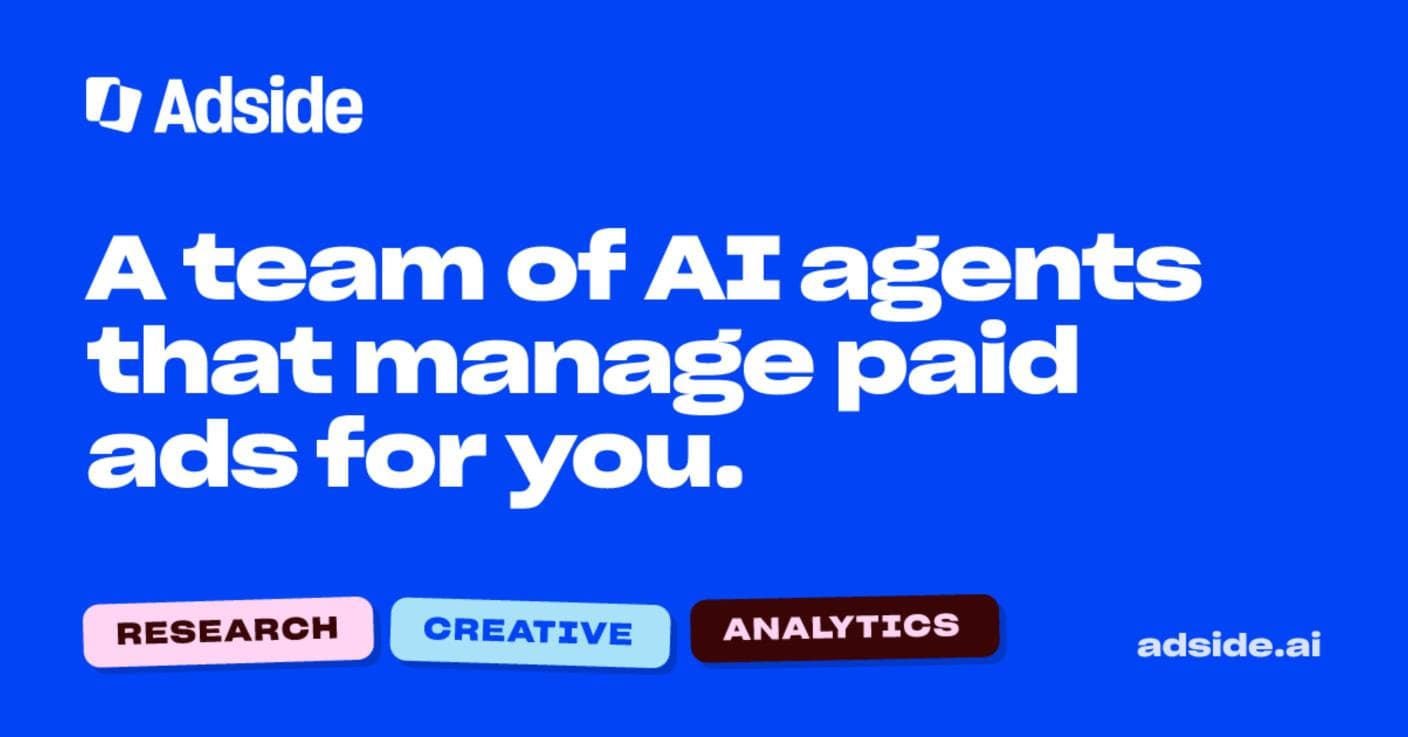
About this app
Adside is a platform that leverages a team of specialized AI agents to fully manage your paid advertising campaigns across Google, Meta, LinkedIn, Reddit, and Twitter. It handles everything from market research and competitor analysis to ad creation, monitoring, and optimization. The AI agents can draft strategies, generate static and video ads, rotate creatives, and provide detailed analytics. Adside offers two main service tiers: a self-serve AI Agency plan starting at $990 per brand per month (or $490 with annual prepay), which includes $100 of monthly creative credits and integrations with Claude Code and ChatGPT; and a Managed Service starting at $2,500 per month or 10% of ad spend, which adds a dedicated human expert to oversee the agents and accounts. Target customers include startups, brands, marketing agencies, and teams managing multiple brands. Standout features include competitor ad boards, social media monitoring, bulk creative imports, auto-resizing for every placement...
Key features
- 1Team of specialized AI agents that research markets, draft strategy, generate static and video ads, and rotate creatives across Google, Meta, LinkedIn, Reddit and Twitter.
- 2Competitor ad boards, social media monitoring across X/Reddit/G2, and automatic competitor discovery — pitched as a replacement for Foreplay and SpyFu.
- 3Per-brand pricing with unlimited users and no minimums: $990/brand/month (or $490 annual), plus a managed tier at $2,500/month or 10% of ad spend.
Target customer profile
Drawn from the product itself, not from a survey.
Demographic
Startups and early-stage brands
Pain points
Limited ad budget, lack of dedicated ad team, time-consuming manual campaign setup
Primary needs
Affordable ad management, quick campaign launch, AI-driven optimization, competitive research
Demographic
Marketing agencies managing multiple brands
Pain points
Scaling ad operations across clients, repetitive tasks, inconsistent creative production
Primary needs
Multi-brand management, unlimited users, bulk creative imports, competitor tracking, white-label reporting
Demographic
Small to mid-size businesses with in-house marketing teams
Pain points
Juggling multiple ad platforms, creative fatigue, lack of time for strategic analysis
Primary needs
Centralized ad management, automated ad rotation, performance analytics, Slack integration for collaboration
Scout Review
Written by AI from measured evidence, scored out of 100.
Adside is an AI-agent platform that runs paid ads across Google, Meta, LinkedIn, Reddit and Twitter, priced at $990 per brand per month (or $490 with annual prepay) for the self-serve AI Agency tier, and from $2,500/month or 10% of ad spend for the managed service. The positioning is consolidation: replace Foreplay, SpyFu, Motion, Atria, Funnel.io and half a dozen others with one tool. The landing page sells that story well — confident typography, a distinctive palette, and real product output on screen rather than abstract illustration. The pricing page is unusually honest, pre-answering the credit and per-seat questions most competitors dodge. The problems are concrete: a 13.1-second mobile LCP that undercuts the entire 'faster ads' pitch, a thin security header set for a product touching live ad accounts, and a couple of accessibility misses that are one-line fixes. The idea is sound and the wedge is real; the execution needs a performance pass and a trust-signal pass before the $990 price tag feels earned.
Measure by measure
Usability
63Clear double CTA, a tab strip that makes features scannable, and a pricing page that pre-answers the obvious objections (per-brand, no minimums, cancel anytime, credits at cost). Onboarding depth beyond the free trial is unverified.
Design
71Cohesive extended-grotesk type system, a bold blue/pink/maroon palette, and real product output (ad carousel, chat mockup) instead of abstract illustration. Held back by overlapping sticker labels and tiny, low-weight feature-card copy.
Speed
34Lighthouse mobile 39/100 with a 13.1s LCP and 1.4s TBT — the page takes over ten seconds to paint its main content on a phone. Desktop is a respectable 70/100, so the gap is mobile-specific weight, not a broken stack.
Security
52HTTPS enforced with HSTS, SPF and DMARC in place — the transport and email basics are solid. But CSP, frame protection, X-Content-Type-Options, Referrer-Policy and Permissions-Policy are all absent (6/12 checklist), and no SOC 2, ISO or pen-test claim appears on the site.
Accessibility
68Lighthouse accessibility 94/100 with only two failing audits — insufficient color contrast and a missing main landmark. Responsive across mobile and desktop. No WCAG statement or accessibility page found, and multi-language support was not observed.
Growth
66A real, expensive problem (multi-platform ad ops) with a specific wedge — consolidation of 10+ named tools into one per-brand subscription — and a managed tier that monetizes the same agents at 10% of spend. Early stage (domain ~0.8 years), but the idea has room.
Improvement areas
- Mobile performance: 13.1s LCP and 39/100 Lighthouse mobile score undercut the product's core speed pitch.
- Security transparency: missing CSP, frame protection and Referrer-Policy, plus no published SOC 2, pen-test or data-handling page.
- Accessibility polish: missing main landmark and contrast failures, with no WCAG statement or multi-language support.
Design & Usability
Adside's homepage is one of the more confident indie SaaS designs you'll see: a single extended-grotesk display face carried from hero to section headers, a saturated blue/pink/maroon palette that dodges the beige-SaaS default, and — crucially — real product output on screen. The hero carousel shows actual ad creatives; the mid-page mockup shows the agent chat with a Draft campaign card and Suggested next steps. That's a product demo disguised as a landing page, and it works. Usability follows through: two high-contrast Get Started CTAs, a tab strip that lets you scan Research / Brief & Brand / Creative Analytics / Ad Operations / Built for Teams without scrolling every card, and a pricing page that pre-empts the obvious objections — per brand not per seat, no minimums, cancel anytime, credits passed through at cost. The cracks are in the details: sticker labels collide with body copy, feature-card descriptions are set too small and too light to read comfortably, and the before/after carousel's pagination dots are nearly invisible. Onboarding depth past the free trial couldn't be verified from the site alone.
Speed & Security
Speed is the clearest problem. Lighthouse mobile scores 39/100 with a 13.1-second LCP and 1.4-second TBT — the main content takes over ten seconds to appear on a phone, which is fatal for a paid-ads product whose audience is, by definition, evaluating conversion funnels. Desktop scores 70/100, so the stack isn't broken; the mobile payload is just too heavy. CLS is a clean 0, so at least nothing jumps around while you wait. Security is a mixed bag: HTTPS is enforced with HSTS, and both SPF and DMARC are configured, which is more than many early-stage SaaS bother with. But the HTTP probe found no CSP, no frame protection, no X-Content-Type-Options, no Referrer-Policy and no Permissions-Policy — 6 of 12 checklist points. For a product that connects to customers' Google and Meta ad accounts and handles real ad spend, the absence of a published SOC 2, ISO certification, pen-test summary or bug bounty is a meaningful gap in trust signals, not just a missing badge.
Accessibility & Growth
Accessibility lands at 94/100 on the automated Lighthouse audit, which is genuinely strong — only two failing checks: insufficient color contrast somewhere in the palette, and a missing main landmark. Both are cheap fixes. What's absent is the surrounding evidence: no accessibility statement, no WCAG conformance claim, no observed multi-language support. The site is responsive across mobile and desktop, which covers the platform-coverage baseline. Growth is the more interesting question. The category is crowded — Foreplay owns ad research, Motion owns creative analytics, SpyFu owns competitor intel — and Adside's answer is consolidation: one per-brand subscription that replaces all of them, with a managed tier at $2,500/month or 10% of spend for teams that want a human in the loop. That's a real wedge, and the per-brand pricing (not per-seat, no minimums) is genuinely well-matched to agencies managing many brands. The limit is execution breadth: being credible across research, creative generation, analytics and operations simultaneously is a much harder sell than being the best at one. The domain is roughly eight months old, so this is early — the idea has room, the proof doesn't exist yet.
Conclusion
If you're a startup or agency running ads across multiple platforms and drowning in tool sprawl, Adside's pitch is aimed squarely at you — and the per-brand pricing genuinely rewards the multi-brand case that per-seat competitors punish. But before you hand over $990 a month and connect your ad accounts, do two things: load the site on your phone and time it, and ask their team directly for their security posture — SOC 2 status, how ad-account credentials are stored, and whether a pen test has been done. Neither answer is on the site. The product might well be worth the money; the evidence to prove it isn't public yet.
Suggestions for improvement
- Fix the mobile LCP — 13.1s is disqualifying for a product whose pitch is speed. Audit hero images and the ad-creative carousel first.
- Add CSP, X-Frame-Options, X-Content-Type-Options, Referrer-Policy and Permissions-Policy; publish a security page with SOC 2 status and data-handling detail.
- Add a <main> landmark and fix the contrast failures flagged by Lighthouse — both are quick wins that lift the a11y score toward 100.
- Increase feature-card body text size and weight, and fix the sticker-label overlap in the 'Every brand's ads' section.
Alternatives comparison
Named competitors, point by point. Nobody paid to appear here or to be left out.
 Adside | Foreplay | Motion | SpyFu | |
|---|---|---|---|---|
| Competitor ad research and inspiration boards | Built-in competitor ad boards, social monitoring and auto competitor discovery | Core product: save and organize competitor ads from Facebook and other platforms | Not a primary focus; Motion centers on creative analytics and reporting | PPC and SEO competitor research, including ad history and keyword tracking |
| Creative performance analytics and top-creative reports | Top-creative reports, performance dashboards and plain-English narratives included | Limited; focused on saving and organizing ads rather than performance reporting | Core product: creative reporting and analytics for ad teams | Competitor ad and keyword performance data, not your own creative analytics |
| AI ad creation and automated campaign operations | AI static and video ads, auto-resize, bulk import, campaign drafting and rotation | None; research and organization tool only | None; analytics and reporting, no ad generation or campaign ops | None; research and competitive intelligence only |
| Pricing model | $990/brand/month ($490 annual prepay); managed from $2,500/mo or 10% of ad spend | Subscription tiers per seat; pricing not verified in this review | Subscription tiers; pricing not verified in this review | Subscription tiers; pricing not verified in this review |
| Human expert oversight of campaigns | Managed service tier adds a dedicated human expert with Slack, email and phone access | No; self-serve research tool | No; self-serve analytics tool | No; self-serve research tool |
Foreplay
A competitor ad research and inspiration tool that allows users to save and organize ads from Facebook and other platforms. Adside replaces it with built-in competitor ad boards and social media monitoring.
Motion
An analytics and creative reporting tool for ads. Adside offers similar top creative reports and analytics as part of its AI agency features.
SpyFu
A competitor research tool for PPC and SEO. Adside includes competitor discovery and ad tracking, making it a potential alternative for ad-focused competitive analysis.
Comparing options? See Adside alternatives, scored side by side
More Marketing & Sales apps
View all Marketing & Sales
Geogrid
92A UULE-powered local rank tracker for SEO agencies, offer...

EmbedMyReviews
92White-label reputation management software for agencies s...

Puzzly – B2B Lead Generation & Sales Intelligence Platform
92Puzzly is an all-in-one B2B lead generation platform that...

Vibe Coding Agent Skills
92A free, open-source platform offering 110 AI agent skills...

QRBliss
91Branded QR codes with AI Brand Sync, 15 free dynamic code...

WAButton
90WhatsApp website leads, forms and contact routing

DemoVexa
90Turn your code into professional product demo videos with AI-generated scripts, animated UI, and natural voiceovers.

PitchWhip
90AI cold call scripts & direct dials from LinkedIn

BACKLNK
90Backlnk is a free SEO and AI visibility website: 15 website checks, a full audit as a PDF report, and guides to get found in search and AI answers.

ThumbnailMaker
90AI YouTube thumbnail maker: paste a video link, get the brief, the thumbnail, and a check at feed size.

AuditCloser
89White-label website audits that close deals for digital a...

What the GIF
89Frame-perfect video-to-GIF maker that runs entirely in yo...


A platform dedicated to providing unbiased reviews of newly launched applications, analyzing everything from their features to their full potential.
info@scoutforge.net© 2026 Scoutforge. All rights reserved.
