

A platform dedicated to providing unbiased reviews of newly launched applications, analyzing everything from their features to their full potential.
info@scoutforge.net© 2026 Scoutforge. All rights reserved.
A platform dedicated to providing unbiased reviews of newly launched applications, analyzing everything from their features to their full potential.
info@scoutforge.net© 2026 Scoutforge. All rights reserved.
A platform dedicated to providing unbiased reviews of newly launched applications, analyzing everything from their features to their full potential.
info@scoutforge.net© 2026 Scoutforge. All rights reserved.
Cycling through all six. Tap any point to stop.
Measured on six things
BoastIndex alerts you when pages drop out of Google, so traffic is not the first warning. See what changed, when it changed, and what needs attention.
Lighthouse mobile 46/100 with LCP 13.5s and FCP 4.6s — painfully slow on mobile. Desktop scores 85/100, so the gap points to heavy hero assets or client-side rendering. Mobile users will bounce before the dashboard mockup paints.
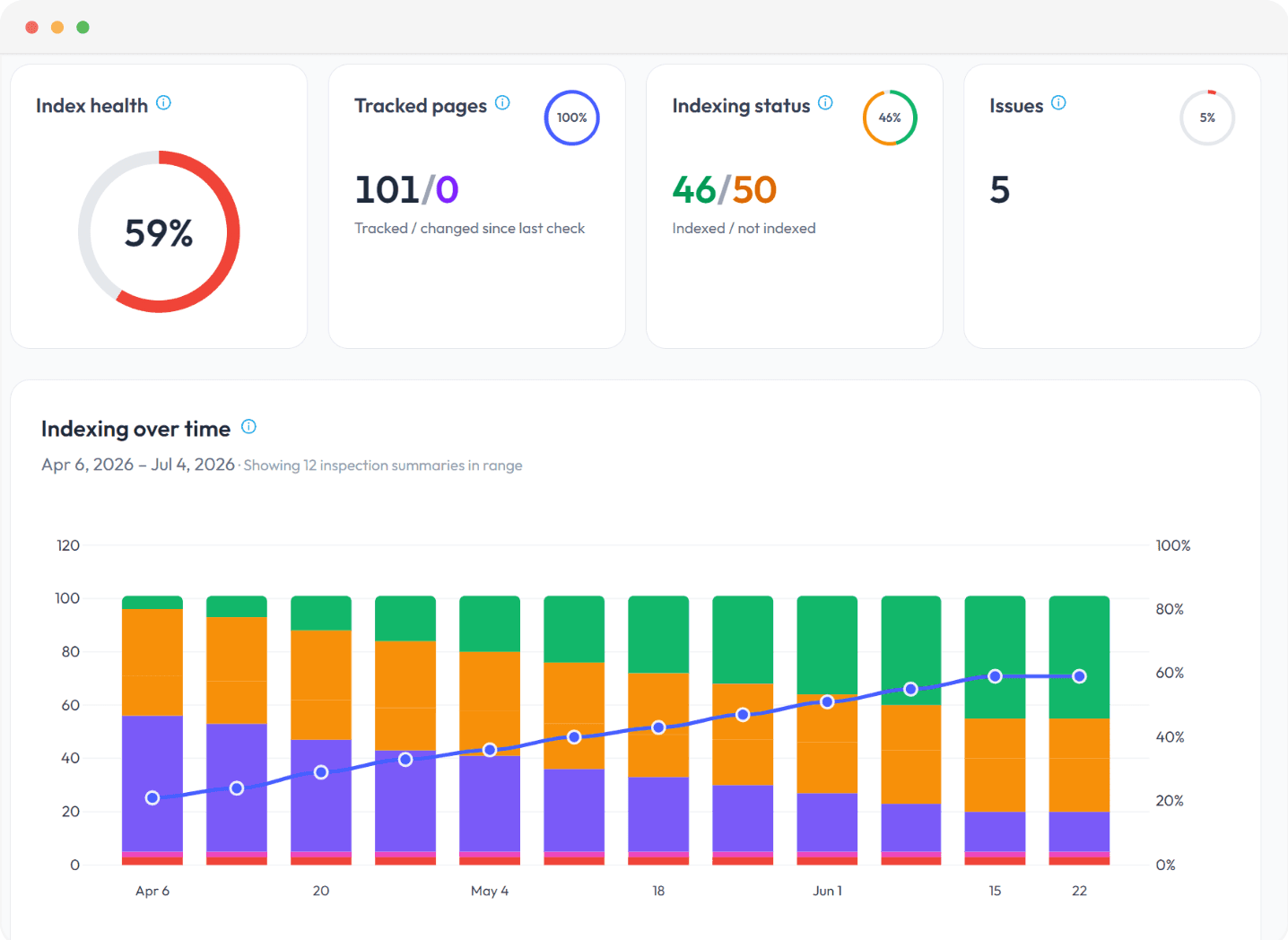
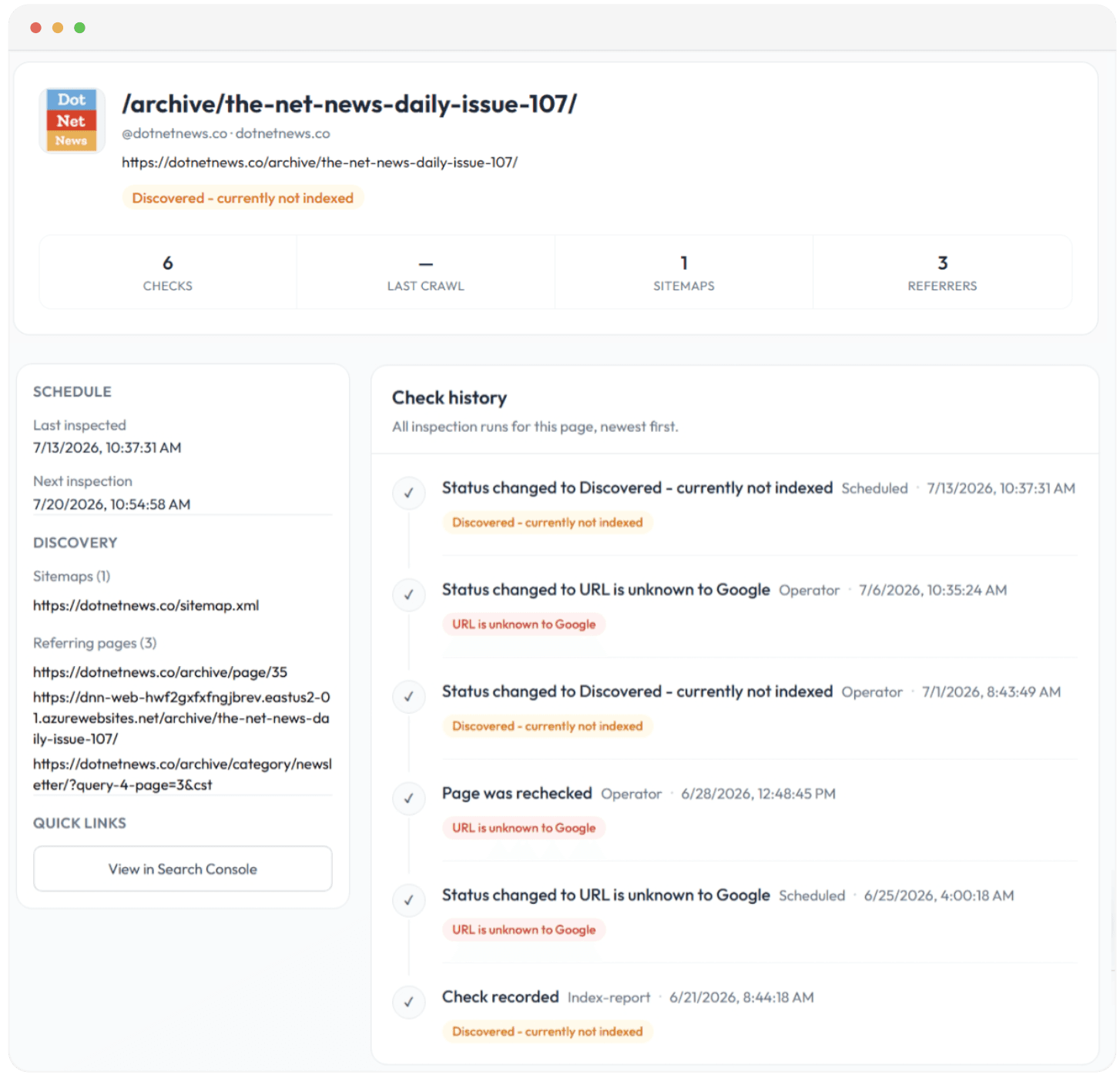
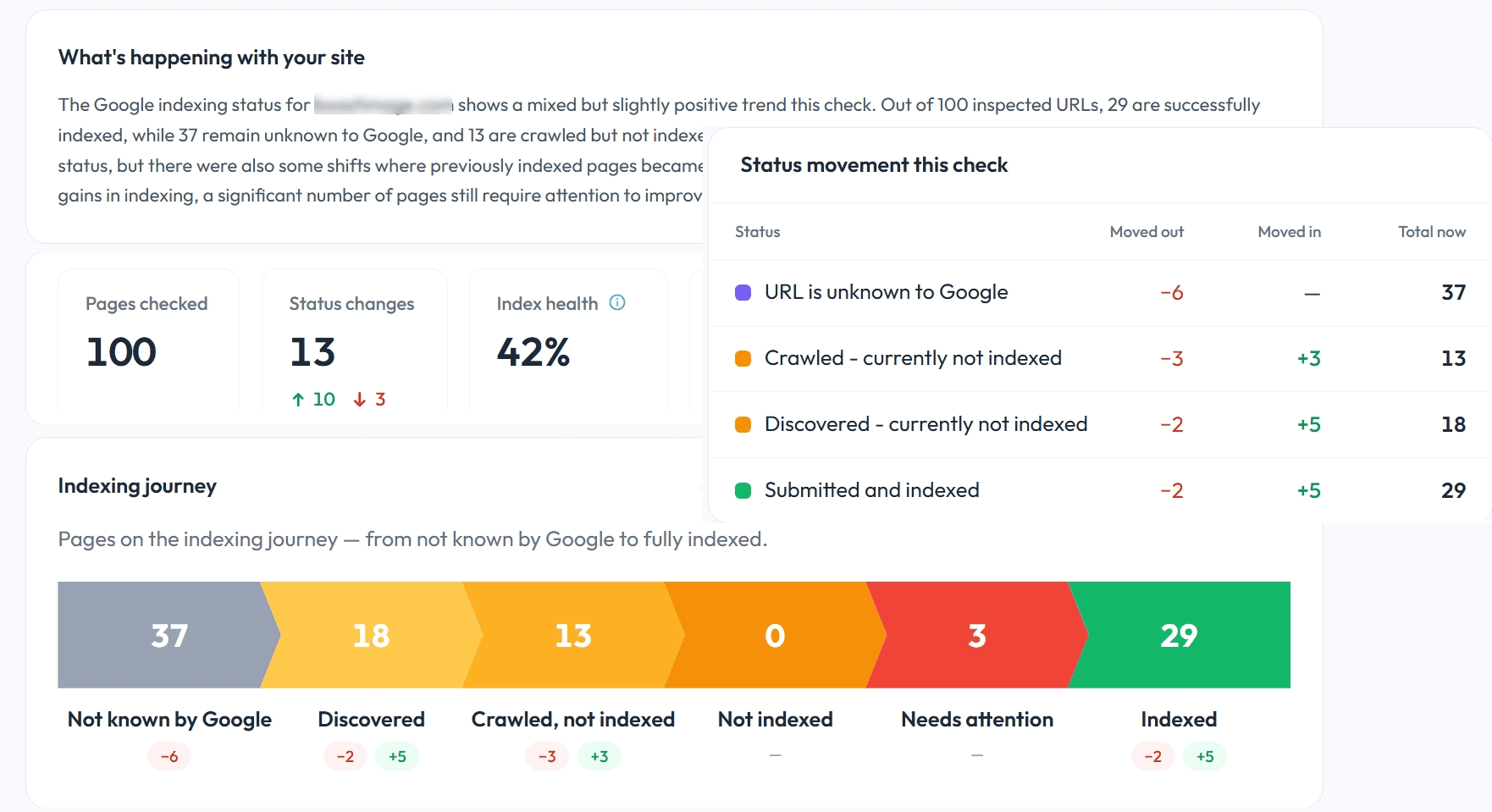
Important pages can disappear from Google's index after a release, canonical change, noindex mistake, or a decision you never saw coming. Search Console does not send a URL-level alert when that happens. Many teams find out later, when rankings slide or organic traffic, leads, and revenue start falling. BoastIndex gives you an earlier warning. Connect a Search Console property with read-only access, import the URLs you cannot afford to lose, and choose a daily, weekly, or monthly inspection schedule. BoastIndex records every result, detects status changes, and alerts you when a page becomes deindexed, blocked, noindexed, or otherwise needs review. That history shows what moved, when it moved, and whether the problem is isolated or affecting a wider group of pages.
Drawn from the product itself, not from a survey.
Demographic
SEO Professionals
Pain points
Manual index checks are time-consuming and miss changes between visits.
Primary needs
Automated monitoring and alerts for index status changes.
Demographic
Website Owners
Pain points
Unaware of pages dropping out of Google until traffic declines.
Primary needs
Early detection of index issues to prevent traffic loss.
Demographic
Digital Marketing Agencies
Pain points
Managing multiple client sites and tracking index status manually.
Primary needs
Centralized dashboard for monitoring multiple properties.
Written by AI from measured evidence, scored out of 100.
BoastIndex solves a problem SEO professionals actually have: Google Search Console will not tell you when a specific URL drops out of the index, and by the time you notice, traffic is already down. BoastIndex connects read-only to GSC, imports your important URLs, runs inspections on a daily, weekly, or monthly cadence, and alerts you when status changes. The pricing model is refreshingly honest — all features on all plans, you pay for inspection volume, not feature gates, with a $150/year managed plan or $120/year if you bring your own Google Cloud quota. There is also a $15 one-time report, free for the first 100 pages. The product-led homepage and clear onboarding are strengths. The weaknesses are real: mobile performance is poor (LCP 13.5s), accessibility has two fixable failures, and the site is dense enough that the call to action gets buried. Security headers are strong and data handling is transparent. For an early-stage tool, this is a competent, well-positioned entry into a category that genuinely needs it.
Clear 5-step onboarding (Connect GSC → Import URLs → Choose cadence → Monitor → Report), multiple import paths (sitemap, CSV, paste, API), and a free 100-page report. Quota-aware scheduling is a thoughtful touch. Docs depth unverified.
Product-led homepage with a real dashboard mockup showing tracked URLs, index health, and status changes. Clean typography and a coherent dark theme, but the page is dense and text-heavy. Solid for the category, not exceptional.
Lighthouse mobile 46/100 with LCP 13.5s and FCP 4.6s — painfully slow on mobile. Desktop scores 85/100, so the gap points to heavy hero assets or client-side rendering. Mobile users will bounce before the dashboard mockup paints.
HTTPS enforced with HSTS, CSP, frame protection, and full header set (11/12 probe points). Read-only GSC access and explicit data-storage disclosure are above average for the stage. SPF missing; no SOC 2 or pen-test claims found.
Lighthouse accessibility 93/100, but two real failures: insufficient color contrast and links without discernible names. No WCAG statement or multi-language support found. Automated score is strong; the failing audits are fixable and worth fixing.
Real, specific pain — URL-level deindexing with no GSC alert — and a clear wedge against GSC, Ahrefs, and Semrush. But the category is crowded and the moat is thin. Domain is 0.3 years old; traction is context, not the score.
BoastIndex's homepage does the one thing most SEO tools forget: it shows the product. The hero is a live-looking dashboard with tracked URLs, an index health score, and a feed of status changes — you understand what it does before you read a word of copy. The onboarding flow is equally direct: connect Search Console, import URLs by sitemap, CSV, paste, or API, pick a cadence, and start monitoring. The free 100-page report is a smart no-card trial that lets you see real data before committing. Where it slips is density — the page keeps stacking sections (GSC statuses, data path, workflow, sample report) until the actual call to action feels buried. And usability beyond onboarding is hard to judge: there is no visible docs hub, help center, or changelog in the fetched content, so the depth of support for edge cases (quota limits, multi-property agencies, failed inspections) is unverified. For a tool aimed at SEO professionals who will hit those edges fast, that is the gap to close next.
Speed is the weak spot. Lighthouse mobile scores 46/100 with an LCP of 13.5 seconds and FCP of 4.6 seconds — that is slow enough that mobile visitors may leave before the dashboard mockup renders. Desktop tells a different story at 85/100, which suggests the site is heavy on assets or client-side rendering that mobile hardware cannot keep up with. For a product whose pitch is 'catch problems early,' a slow first impression is an awkward contradiction. Security is much stronger: HTTPS enforced with HSTS, CSP, frame protection, X-Content-Type-Options, Referrer-Policy, and Permissions-Policy all present — 11 of 12 probe points. The only miss is SPF, which matters for email deliverability but not for the core product. BoastIndex also does the transparency work that matters here: it states plainly that the GSC connection is read-only, lists exactly what it stores (URLs, status, timestamps, changes), and explicitly says it does not request indexing or replace Google's verdict. There is no SOC 2 or pen-test claim, which is normal at this stage, but the data-handling disclosure is better than most tools twice its age.
Accessibility lands at a strong-but-imperfect 93/100 on Lighthouse, with two concrete failures: background/foreground contrast and links without discernible names. Both are quick fixes and both matter for a tool that will be used daily by professionals, some of whom rely on screen readers. There is no WCAG statement or multi-language support, which is fine for an early-stage English-first product but worth noting for agencies managing international clients. Growth is the more interesting question. BoastIndex names a real, specific problem: Search Console does not send URL-level alerts when a page drops out of the index, so teams find out when traffic falls. That is a genuine gap, and the positioning against GSC, Ahrefs, and Semrush is honest — none of them do recurring URL-level index monitoring with alerts as a primary feature. The wedge is clear. The risk is that the wedge is thin: this is a monitoring layer on top of an API Google already exposes, and a larger SEO suite could absorb it. The domain is 0.3 years old, so traction is early — but the idea itself has room if BoastIndex moves fast and owns the category before someone bigger notices.
Conclusion
The honest verdict: BoastIndex is a focused tool that does one thing well and prices it fairly. It is not trying to be an SEO suite, and it should not — its value is the alert you get before the traffic drop, and that is worth $150 a year to anyone who has watched a money page vanish from Google. The gaps are execution gaps, not idea gaps: fix the mobile LCP, fix the two accessibility failures, and add a real docs hub so agencies can trust it with client properties. If those land, BoastIndex has a legitimate shot at owning a niche that the big suites have ignored. If they do not, it stays a clever side project with a good landing page. The clock is ticking, and the domain is three months old.
Named competitors, point by point. Nobody paid to appear here or to be left out.
 BoastIndex BoastIndex |  Google Search Console Google Search Console |  Ahrefs Ahrefs |  Semrush Semrush | |
|---|---|---|---|---|
| Recurring URL-level index monitoring with alerts | Yes — core feature; daily/weekly/monthly cadence with change alerts | No — manual URL inspection only; no recurring alerts | No — site audit exists but no URL-level index change alerts | No — position tracking and site audits, not index status monitoring |
| Index status history per URL | Yes — full status history with timestamps and change detection | Partial — current status only, no historical timeline per URL | Partial — crawl history, not GSC index status history | Partial — audit history, not GSC index status history |
| Pricing model | $150/year managed or $120/year BYOK; $15 one-time report (free first 100 pages) | Free | Subscription tiers starting around $129/month | Subscription tiers starting around $139/month |
| Bulk URL import (sitemap, CSV, paste, API) | Yes — sitemap, CSV, pasted list, manual entry, and API | Partial — sitemap submission, not bulk inspection import | Yes — via site audit and project setup | Yes — via project and audit setup |
| Read-only GSC connection with data transparency | Yes — read-only scope, explicit storage disclosure, no indexing requests | Native — it is Google's own tool | Yes — GSC integration available on higher tiers | Yes — GSC integration available |
Google Search Console
Google's official tool for monitoring site presence in search results, but lacks automated recurring monitoring and alerts for specific URLs.
Ahrefs
Comprehensive SEO suite with site audit features, but index monitoring is not its primary focus and lacks URL-level change alerts.
Semrush
All-in-one SEO platform with position tracking and site audits, but doesn't provide dedicated Google index status monitoring with alerts.
Comparing options? See BoastIndex alternatives, scored side by side

A UULE-powered local rank tracker for SEO agencies, offer...

White-label website audits that close deals for digital a...

Specialized SEO services for moving companies to dominate...

Grow your app with self-learning ASO agents

MygomSEO is an AI marketing agent that audits your site, writes SEO content, publishes to 12+ CMS platforms, posts to social, and monitors rankings 24/7.

Track every indexing step for your owned websites.

Reputation monitoring across Google, AI search engines, reviews, news and social media, with sentiment analysis per mention.

AI writing tool for agencies and niche site owners, with ...

One API for Google Search and AI answers from ChatGPT, Ge...

Monitor and improve your brand's visibility in AI search ...

Rankdigger is an AI-powered SEO platform that simplifies ...

An AI-powered WordPress plugin that automates content cre...
A platform dedicated to providing unbiased reviews of newly launched applications, analyzing everything from their features to their full potential.
info@scoutforge.net© 2026 Scoutforge. All rights reserved.