Cycling through all six. Tap any point to stop.
Measured on six things
Rewrite pages against the answer AI gives today
Growth
63Real, specific problem (AI answers eating clicks while rankings hold) with a concrete wedge: read the live answer, then write the fix. GSC-first targeting of affiliate publishers is sharp. Early stage — domain ~0.6 years old, one social profile.
Screenshots
1 / 1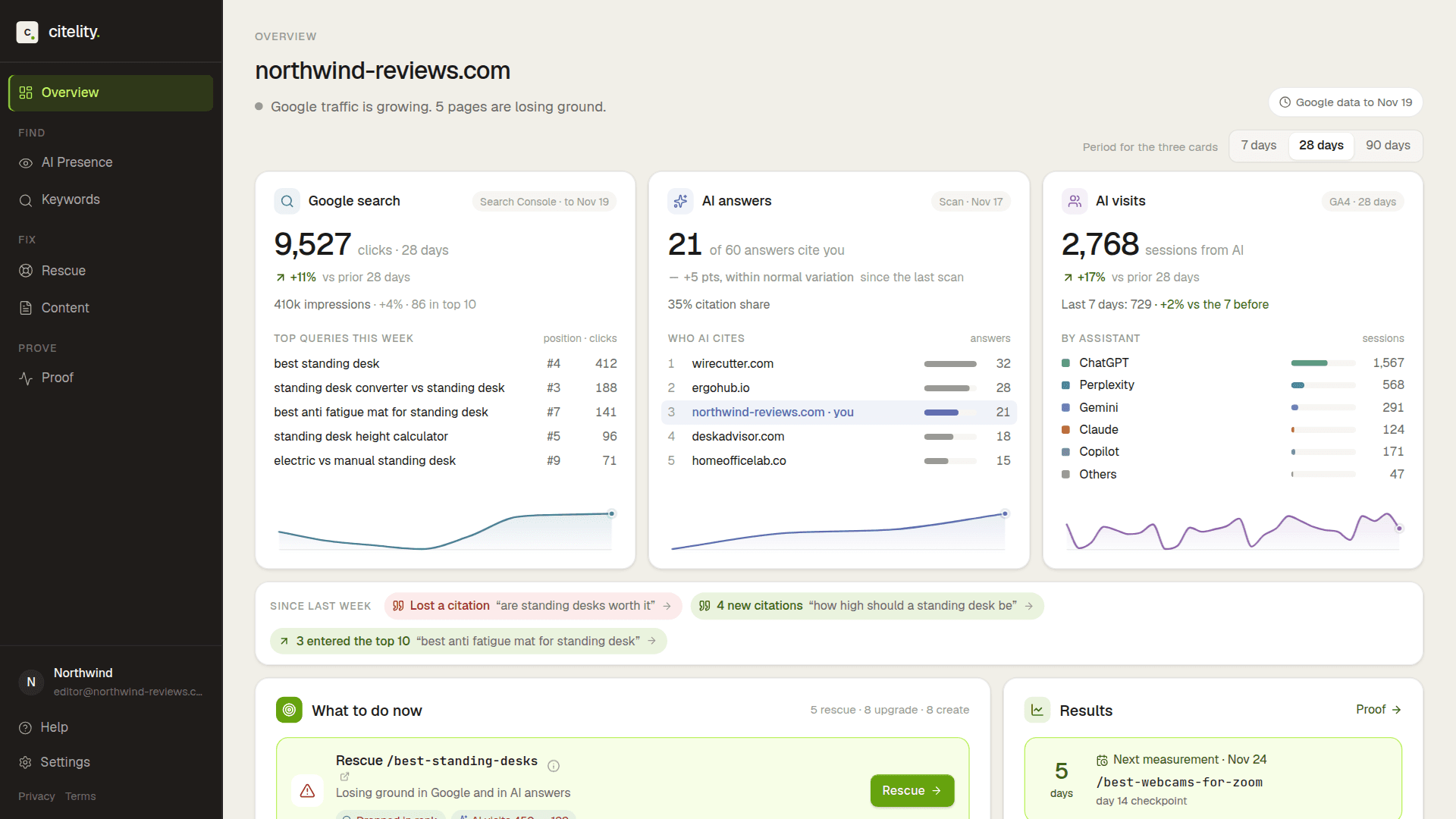
About this app
Most writers optimise against Google's top ten. citelity also reads the answer ChatGPT, AI Overviews and four other engines give right now, sees which competitors they cite, and writes the edit or article that covers what those sources say and you do not.
Key features
- 1GSC-first discovery: finds queries you rank for where AI answers now absorb the click, flagging pages whose ranking held while clicks fell.
- 2Reads live answers across six AI engines (ChatGPT, AI Overviews, Gemini, Claude and others) and shows which competitors get cited in your place.
- 3Rewrites the page against the current AI answer rather than Google's top ten, then measures the change in your own GSC and GA4 data.
Target customer profile
Drawn from the product itself, not from a survey.
Demographic
Bloggers and affiliate publishers who update their own pages
Pain points
A page can keep its position while an AI answer takes the click
Primary needs
Update a ranking guide so it covers what the cited AI sources say, then measure the result.
Scout Review
Written by AI from measured evidence, scored out of 100.
citelity attacks a real 2026 problem: AI answers taking clicks from pages that still rank. Its pitch is sharper than most — connect Search Console, see which queries now get answered without you, and have the page rewritten against the live answer rather than Google's top ten. The site backs that up with a disciplined design, a fast build (89 mobile / 98 desktop Lighthouse), and a clean security posture (12/12 headers, HSTS, CSP, DMARC). The gaps are the usual early-stage ones: no SOC 2 or security page despite asking for GSC and GA4 access, accessibility fails on contrast and landmarks, and a homepage that runs out of steam below the fold. At $49–$99/mo against Semrush, the writing quality is the whole bet — and that's the one thing a landing page can't prove.
Measure by measure
Usability
68Clear primary CTA with objections pre-answered (read-only, no card, 14-day trial), free tools usable with no account, and a short familiar nav. The duplicated screenshot with a floating demo pill adds clutter, and deeper onboarding is unverified.
Design
71Restrained warm off-white, near-black serif and one green accent used consistently; disciplined hero with a single dominant CTA. Undone by ~400px of dead space below the IN/OUT diagram, tiny low-contrast captions, and a self-screenshot that repeats the hero.
Speed
73Lighthouse mobile 89/100 (LCP 2.5s, CLS 0.042, TBT 132ms) and desktop 98/100 — a genuinely fast, well-built page. LCP at 2.5s is the one soft spot, sitting right on the 'needs improvement' line.
Security
74Full header stack verified: HTTPS enforced, HSTS, CSP, frame protection, Referrer-Policy, Permissions-Policy, plus SPF and DMARC — 12/12 on the probe. No SOC 2, ISO or bug-bounty claims found, which is normal at this stage but caps the score.
Accessibility
79Lighthouse accessibility 96/100, but three real fails: insufficient contrast, no main landmark, and unheadered <td> cells in a large table. The visual audit independently flags tiny low-contrast captions. No WCAG statement or multi-language support found.
Growth
63Real, specific problem (AI answers eating clicks while rankings hold) with a concrete wedge: read the live answer, then write the fix. GSC-first targeting of affiliate publishers is sharp. Early stage — domain ~0.6 years old, one social profile.
Improvement areas
- No security or data-handling page despite requesting read-only Search Console and GA4 OAuth access.
- Accessibility fails on contrast, missing main landmark, and unheadered table cells; no WCAG statement or multi-language support.
- Homepage ends with ~400px of empty space and repeats the hero in an embedded screenshot instead of showing a real fix example.
- Output quality — the core differentiator — is unproven; no public worked example with a measured 60-day result.
Design & Usability
The homepage is more considered than most indie SEO tools: a warm off-white palette, a near-black serif headline, and exactly one green accent that ties the CTA to the brand. The hero does its job — one dominant 'See which pages are losing traffic — free' button with 'read-only, no card, 14-day trial' sitting underneath, plus a secondary domain-input path for people who want to poke before signing up. Usability follows the same discipline: short nav with familiar labels, free tools that work without an account or email. Where it slips is the tail of the page — roughly 400px of empty background below the IN/OUT diagram, captions small and low-contrast enough to strain, and an embedded dashboard screenshot that repeats the hero instead of adding proof. Good bones, unfinished ending.
Speed & Security
Speed is a genuine strength. Lighthouse puts mobile at 89/100 with LCP 2.5s, CLS 0.042 and TBT 132ms, and desktop at 98/100 — the page is light and snappy, with LCP the only metric sitting near the threshold. Security is similarly well-tended: the HTTP probe found HTTPS enforced with HSTS, a Content-Security-Policy, frame protection, X-Content-Type-Options, Referrer-Policy and Permissions-Policy, plus SPF and DMARC configured — 12/12 on the checklist. What's missing is the paperwork layer: no SOC 2, ISO 27001, penetration-test summary or bug-bounty program surfaced in the collected content. For a product that asks you to connect Search Console and GA4 read-only, a short security/data-handling page would close an obvious trust gap. Solid engineering, thin attestation.
Accessibility & Growth
Accessibility scores 96/100 on Lighthouse, but the failing audits are the ones that matter to real users: insufficient contrast, no main landmark, and a large table whose <td> cells lack headers. The visual audit independently flags the same problem — microcopy under the CTA and inside the IN/OUT cards is small and pale. No WCAG conformance statement or multi-language support was found. Growth is the more interesting question. The problem citelity names is real and current: a page keeps its ranking while an AI answer absorbs the click, and Google's own tools don't show you who got quoted instead. The wedge — read the live answer across six engines, then write the page against it — is a genuine differentiator versus trackers like Peec and Otterly, which report but don't write. Targeting affiliate publishers who maintain their own ranking guides is specific and underserved. The limit is execution and trust: Semrush is the listed alternative and has vastly more data and distribution, and the 'Response Gap Engine' claim is only as good as the writing quality it produces. Early stage — domain registered 2026, one social profile — so the idea has room, the proof does not exist yet.
Conclusion
citelity is worth a trial if you're an affiliate publisher watching rankings hold while clicks slide — that specific pain is exactly what it's built for, and the free read-only GSC check costs you nothing but a login. Go in with clear eyes: the differentiator is the writing, so judge the first two or three fixes on whether the output is actually quotable, not on whether the dashboard looks good. Before you connect GA4, look for a data-handling page; there isn't an obvious one. And if you need multi-site management or enterprise compliance, this isn't there yet. Promising wedge, unproven output.
Suggestions for improvement
- Publish a security and data-handling page covering what citelity reads from GSC/GA4, where it's stored, and retention — you're asking for OAuth access with no trust page.
- Fix the three Lighthouse a11y fails: contrast on microcopy, add a <main> landmark, and give the large table proper <th> headers.
- Trim the ~400px of dead space below the IN/OUT diagram and replace the self-referential dashboard screenshot with a real before/after fix example.
- Show one complete worked example — query, current AI answer, cited competitors, the rewrite, and the measured 60-day delta — so buyers can judge output quality before paying.
Alternatives comparison
Named competitors, point by point. Nobody paid to appear here or to be left out.
 citelity |  Semrush | |
|---|---|---|
| Starts from queries you already rank for (Search Console-first) | Yes — GSC-first is the core entry point | Yes — GSC integration available, but keyword-database-first |
| Reads live AI answers and shows which competitors are cited | Yes — six AI engines included on every tier | Partial — AI visibility tracking exists but is a newer, add-on-style module |
| Rewrites the page against the live AI answer | Yes — Claude Opus draft plus self-critique pass | No — content tools optimize for keywords/SERP, not live AI answers |
| Measures impact in your own GSC + GA4 traffic | Yes — 60-day measurement in your own numbers | Yes — position/traffic tracking, but you connect the impact yourself |
| Entry price | From $49/mo (Starter), $99/mo Pro; 14-day trial | Tiered subscription, generally higher for comparable SEO suites |
| Compliance and security attestation | Strong headers (12/12) but no SOC 2/ISO/pen-test published | Established vendor with published compliance and security documentation |
Comparing options? See citelity alternatives, scored side by side
More Marketing & Sales apps
View all Marketing & Sales
Geogrid
92A UULE-powered local rank tracker for SEO agencies, offer...

EmbedMyReviews
92White-label reputation management software for agencies s...

Puzzly – B2B Lead Generation & Sales Intelligence Platform
92Puzzly is an all-in-one B2B lead generation platform that...

Vibe Coding Agent Skills
92A free, open-source platform offering 110 AI agent skills...

QRBliss
91Branded QR codes with AI Brand Sync, 15 free dynamic code...

WAButton
90WhatsApp website leads, forms and contact routing

DemoVexa
90Turn your code into professional product demo videos with AI-generated scripts, animated UI, and natural voiceovers.

PitchWhip
90AI cold call scripts & direct dials from LinkedIn

BACKLNK
90Backlnk is a free SEO and AI visibility website: 15 website checks, a full audit as a PDF report, and guides to get found in search and AI answers.

ThumbnailMaker
90AI YouTube thumbnail maker: paste a video link, get the brief, the thumbnail, and a check at feed size.

AuditCloser
89White-label website audits that close deals for digital a...

What the GIF
89Frame-perfect video-to-GIF maker that runs entirely in yo...


A platform dedicated to providing unbiased reviews of newly launched applications, analyzing everything from their features to their full potential.
info@scoutforge.net© 2026 Scoutforge. All rights reserved.
