

A platform dedicated to providing unbiased reviews of newly launched applications, analyzing everything from their features to their full potential.
info@scoutforge.net© 2026 Scoutforge. All rights reserved.
A platform dedicated to providing unbiased reviews of newly launched applications, analyzing everything from their features to their full potential.
info@scoutforge.net© 2026 Scoutforge. All rights reserved.
A platform dedicated to providing unbiased reviews of newly launched applications, analyzing everything from their features to their full potential.
info@scoutforge.net© 2026 Scoutforge. All rights reserved.
Cycling through all six. Tap any point to stop.
Measured on six things
Iris is the AI thought partner that lives in iMessage and RCS. Process, vent and grow with her daily. Available 24/7.
HTTPS not enforced, zero security headers, no SPF or DMARC. For a product handling emotional disclosures over iMessage, the absence of basic transport hardening is a real gap.
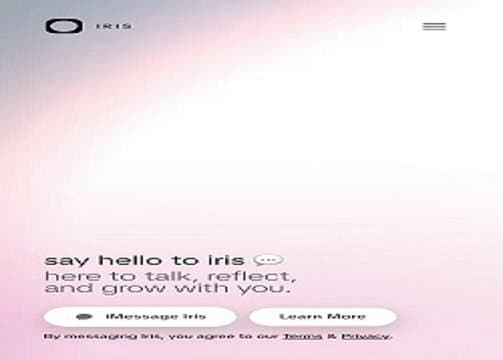
Iris is an iMessage thought partner created by Flagship Labs 105, Inc., a Flagship Pioneering company. Available via iMessage and RCS, Iris helps you talk through your thoughts, reflect on your feelings, and explore life’s questions with a supportive, judgment-free AI thought partner. Iris is not a medical or clinical service.
Drawn from the product itself, not from a survey.
Demographic
Busy professionals aged 25-45
Pain points
Limited time for traditional therapy, high stress, need for immediate support
Primary needs
Convenient, on-demand access to a non-judgmental listener
Demographic
Young adults (18-30) navigating life transitions
Pain points
Feelings of isolation, anxiety, uncertainty about the future
Primary needs
A safe space to explore thoughts and feelings without commitment
Demographic
Individuals hesitant about formal therapy
Pain points
Stigma, cost, or scheduling barriers to seeing a therapist
Primary needs
Informal, private, and low-pressure support for everyday challenges
Written by AI from measured evidence, scored out of 100.
Iris is a bet that the future of AI emotional support isn't an app — it's a text thread. That bet is smart. Onboarding is the best in the category: one tap, no signup, no download, straight into an iMessage conversation. The landing page is minimal to a fault, the mobile LCP is sluggish at 4.1s, and the security posture is genuinely alarming — 0/12 on standard headers, no SPF, no DMARC, no enforced HTTPS. For a product where people disclose their worst days, that's the gap that matters most. Accessibility is excellent (100/100), and the growth positioning is differentiated against Woebot, Replika, and Youper. Iris doesn't need to be a therapist. It needs to be trustworthy. Right now it's convenient, well-positioned, and under-hardened.
Zero-friction onboarding: tap 'Text Iris' and you're chatting in iMessage. No signup, no download. But no help center, FAQ, or docs anywhere — just Terms and Privacy.
Clean, minimal landing page with a single 'Text Iris' CTA. No screenshots, demos, or product visuals — the iMessage thread itself is the product, but the site does little to show it off.
Desktop Lighthouse 98/100, mobile 82/100 with LCP 4.1s. The page is featherweight, but mobile LCP is sluggish enough to notice on a cold load.
HTTPS not enforced, zero security headers, no SPF or DMARC. For a product handling emotional disclosures over iMessage, the absence of basic transport hardening is a real gap.
Lighthouse a11y 100/100 with one failing audit on accessible names. No WCAG statement published, but the minimal text-first page is inherently screen-reader friendly.
A real, underserved wedge: non-clinical, zero-install emotional support via iMessage. Specific audience, clear differentiation from app-based rivals — but the category is crowded and the moat is thin.
Iris's design philosophy is radical subtraction: the homepage is a headline, a button, and a privacy link. There's no product tour, no screenshots, no demo video — you're expected to just tap 'Text Iris' and figure it out. For a product whose entire value prop is low-friction access, that's coherent. Onboarding is genuinely the best in this category: no signup, no download, no email verification, just an iMessage thread. The tradeoff is that there's zero documentation. No FAQ, no help center, no 'what can Iris do' page. Users who want to know whether Iris remembers context, how data is stored, or what happens if they say something alarming are left to guess. Compared to Woebot and Youper, which ship structured onboarding and mood-tracking flows, Iris is refreshingly frictionless but also under-explained. The design is competent, not impressive — it does the minimum to convert a visitor into a texter and nothing more.
Speed is a tale of two platforms. Desktop Lighthouse lands at 98/100, which is essentially perfect. Mobile drops to 82/100 with an LCP of 4.1 seconds — that's slow enough that a user on a cold mobile connection will stare at a blank screen before the CTA appears. CLS is 0 and TBT is 49ms, so once it loads it's stable and responsive. The page itself is featherweight, so the mobile LCP is likely a hosting or render-blocking issue rather than page weight. Security is where Iris falls apart. The HTTP probe returned 0/12 on standard hardening: no enforced HTTPS, no HSTS, no CSP, no frame protection, no Referrer-Policy, no Permissions-Policy, no SPF, no DMARC. For a product where users disclose anxiety, relationship stress, and potentially crisis-adjacent thoughts, that's not a nitpick — it's a trust problem. There's no security page, no SOC 2, no bug bounty, no published data-handling detail beyond a generic privacy link. The iMessage transport itself is encrypted, which helps, but the web surface and email domain are wide open. This is the dimension that most needs work.
Accessibility is a genuine strength: Lighthouse scored 100/100, with a single failing audit around accessible names on visible-text elements. The text-first, minimal page is inherently screen-reader friendly, and there's no heavy interactive chrome to break keyboard navigation. What's missing is a published accessibility statement or WCAG conformance claim — table stakes for a product in the mental-health-adjacent space where accessibility is often a legal and ethical requirement. Growth is the interesting question. Iris's wedge is real: it's not an app, it's a text thread. That removes the two biggest barriers in this category — download friction and the stigma of an app icon on your home screen. The target audience (busy professionals, therapy-hesitant young adults) is specific and underserved by app-based rivals like Woebot and Youper. But the moat is thin: any competitor could ship an iMessage integration, and the 'not a medical service' disclaimer caps how deep the product can go. The category has headroom — mental-health AI is growing — but Iris needs to prove it can hold a position before the incumbents copy the channel.
Conclusion
Iris is early — domain registered months ago, no reviews to speak of, no pricing page visible. That's fine for a product at this stage. What's not fine is shipping a mental-health-adjacent service with zero transport hardening. The iMessage channel is encrypted end-to-end, which is a real advantage, but the web surface and email domain are exposed. If Flagship Labs wants Iris to be taken seriously by the professionals it's targeting, the next sprint should be security headers, SPF/DMARC, and a published data-handling page. The product concept is strong. The execution on trust infrastructure is not yet there. Fix that and Iris has a real shot at being the default 'text a thought partner' product — a category that doesn't quite exist yet but probably should.
Named competitors, point by point. Nobody paid to appear here or to be left out.
 Iris - Your iMessage Thought Partner Iris - Your iMessage Thought Partner |  Woebot Woebot |  Replika Replika |  Youper Youper | |
|---|---|---|---|---|
| Primary interface | iMessage / RCS text thread — no app required | Dedicated mobile app | Dedicated mobile and web app | Dedicated mobile app |
| Onboarding friction | One tap — no signup, no download | App download + account creation | App download + account + avatar setup | App download + account + mood baseline |
| Clinical framing | Explicitly non-clinical; not a medical service | CBT-based, clinically informed framework | Companion/emotional support, not clinical | Therapy-adjacent with mood tracking and exercises |
| Mood tracking / structured exercises | Not advertised; conversation-only | Yes — CBT exercises and mood logs | Limited; primarily conversational | Yes — mood tracking and personalized exercises |
| Stated security posture | No published security page; 0/12 on header probe | HIPAA-adjacent claims; published privacy detail | Published privacy policy; no public audit | Published privacy policy; no public audit |
Woebot
AI-powered mental health chatbot using CBT techniques, available via app.
Replika
AI companion app for emotional support and casual conversation.
Youper
AI therapy assistant app that tracks mood and provides personalized exercises.
Comparing options? See Iris - Your iMessage Thought Partner alternatives, scored side by side

Uni-1 is an advanced multimodal text-to-image AI model th...

Fast, open-source AI video generator with 4K support, mul...

A free online AI-powered tool that instantly converts ima...

HeyVid AI is a free all-in-one AI video and image generat...

Private on-device dictation for Apple-silicon Macs.

An AI-powered photo restoration app that brings old, blur...

An AI-powered patent drafting assistant that acts like a ...

AI face swap online with no subscription, pay per use.

Export all your Apple Voice Memos to one text file.

AI writer that fact-checks before writing, with real sour...

MygomSEO is an AI marketing agent that audits your site, writes SEO content, publishes to 12+ CMS platforms, posts to social, and monitors rankings 24/7.

AI-powered business plan generator that creates investor-...
A platform dedicated to providing unbiased reviews of newly launched applications, analyzing everything from their features to their full potential.
info@scoutforge.net© 2026 Scoutforge. All rights reserved.