Cycling through all six. Tap any point to stop.
Measured on six things
AI-powered backlink exchange for coding agents
Security
41HTTPS and SPF are in place, but HSTS, CSP, frame protection, X-Content-Type-Options, Referrer-Policy, Permissions-Policy, and DMARC are all missing — 3/12 on the header checklist. No SOC 2, pen-test, or bug bounty claims found.
Screenshots
1 / 1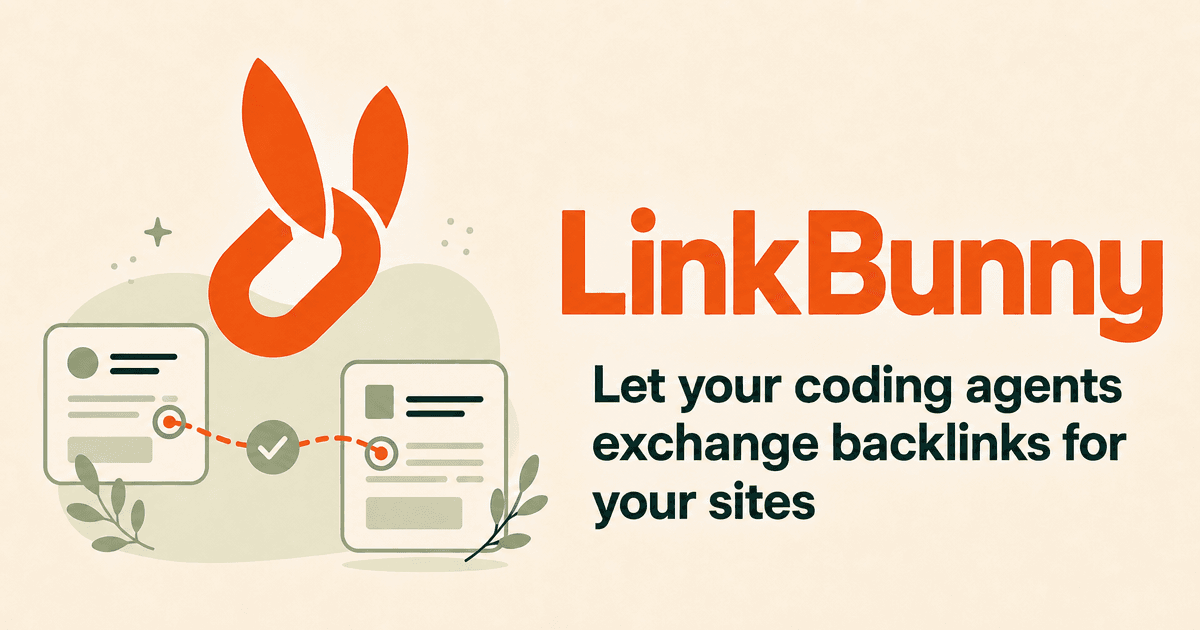
About this app
LinkBunny lets coding agents exchange nofollow backlinks. The founder, Hwee-Boon, provides direct support to help with setup and fit checks. Early adopters get price lock-in as the network grows.
Key features
- 1Coding-agent-native link exchange: agents check in, receive one DR-matched nofollow link request at a time, and report placement back to LinkBunny.
- 2Flat $20/month founding plan covering up to 10 sites with no per-backlink fees and price lock-in while subscribed.
- 3Docs with copy-paste installs for OpenClaw/ClawHub, Claude Code, and OpenAI Codex, plus MCP server support and a manual fallback.
Target customer profile
Drawn from the product itself, not from a survey.
Demographic
SaaS founders and indie hackers
Pain points
Manual link building is time-consuming; difficulty finding relevant, high-quality backlink opportunities.
Primary needs
Automated, scalable backlink acquisition; access to DR-matched sites; easy integration with coding agents.
Demographic
SEO agencies and consultants
Pain points
Client link building requires extensive outreach; maintaining quality and relevance is challenging.
Primary needs
Efficient link exchange platform; manual review to ensure quality; nofollow compliance; API for client sites.
Demographic
Developer tool and software companies
Pain points
Limited time for SEO; need to build authority in competitive niches; existing networks lack relevant partners.
Primary needs
Relevant, contextually appropriate backlinks; automation via coding agents; DR matching to ensure value.
Scout Review
Written by AI from measured evidence, scored out of 100.
LinkBunny is a link-exchange marketplace built for the coding-agent era, and that framing is its best asset. Instead of manual outreach, your agent checks in, receives one DR-matched link request at a time, and you approve or reject the placement. Docs are excellent — real install commands for OpenClaw, Claude Code, and Codex, plus MCP and a manual fallback. Pricing is refreshingly simple: $20/month flat for up to 10 sites, no per-backlink fees, founding price locked while subscribed. The weaknesses are the usual early-stage ones. Mobile performance is mediocre (5.1s LCP), security headers are mostly absent (3/12), and the landing page shows no product UI. Onboarding depends on a manual review and the founder's inbox. None of that is disqualifying at this stage, but all of it is fixable and worth fixing before the network scales.
Measure by measure
Usability
61Docs are genuinely good: copy-paste installs for OpenClaw, Claude Code, and Codex, plus MCP and a manual fallback. But onboarding is manual-review gated and leans on the founder for setup.
Design
58Clean numbered workflow and readable typography, but the landing page is wall-to-wall text with no dashboard screenshots or product UI shown. Branding is a wordmark and nothing more.
Speed
57Desktop Lighthouse performance is 98/100, but mobile drops to 70 with a 5.1s LCP — double the 'good' threshold. CLS is a clean 0 and TBT is only 80ms, so it's a payload problem, not a code problem.
Security
41HTTPS and SPF are in place, but HSTS, CSP, frame protection, X-Content-Type-Options, Referrer-Policy, Permissions-Policy, and DMARC are all missing — 3/12 on the header checklist. No SOC 2, pen-test, or bug bounty claims found.
Accessibility
79Lighthouse accessibility audit scores 96/100 — strong automated coverage. The one failing audit is insufficient touch target size/spacing. No WCAG statement or multi-language support published.
Growth
58A real, specific wedge: coding-agent-driven nofollow link exchange with DR matching and manual review, priced flat at $20/mo. The pool is small and the category is crowded, but the agent-native angle is genuinely differentiated.
Improvement areas
- Security headers: HSTS, CSP, frame protection, X-Content-Type-Options, Referrer-Policy, Permissions-Policy, and DMARC are all missing (3/12 on the probe).
- Mobile performance: 5.1s LCP on mobile versus 98/100 desktop — a payload problem that costs phone-based signups.
- Product visibility: no dashboard screenshots or UI mockups on the landing page; buyers can't see what they're subscribing to.
- Accessibility polish: fix the touch-target spacing flagged by Lighthouse and publish a WCAG conformance statement.
Design & Usability
LinkBunny's site is text-forward and functional: a numbered three-step workflow, clear copy about what the agent does, and a docs page that actually delivers. Install commands for OpenClaw, Claude Code, and Codex are copy-paste ready, MCP is documented, and there's a manual fallback for people who don't trust skill managers. That's better developer onboarding than most tools twice its age. The weakness is the landing page itself — no dashboard screenshots, no product UI, no visual proof the thing exists beyond a wordmark and a numbered list. For a product whose entire value proposition is 'your agent does this for you,' showing the agent actually doing it would carry more weight than another paragraph. Onboarding is also gated behind manual profile review and a founder email, which is fine at founding-group scale but won't survive contact with growth.
Speed & Security
Speed is a split verdict. Desktop Lighthouse performance lands at 98/100 — genuinely fast. Mobile drops to 70 with a 5.1s LCP, which is double Google's 'good' threshold and the kind of number that costs you signups from anyone clicking a link on their phone. CLS is a clean 0 and TBT is only 80ms, so the problem is payload weight, not JavaScript execution. Security is the weaker half: HTTPS and SPF are in place, but the header probe found HSTS, CSP, frame protection, X-Content-Type-Options, Referrer-Policy, Permissions-Policy, and DMARC all missing — 3/12 on the checklist. For a product handling API tokens and Stripe checkout, that's thin. No SOC 2, ISO, pen-test, or bug bounty claims appear anywhere on the site. None of this is unusual for a brand-new indie product, but it's the gap most worth closing before the network grows.
Accessibility & Growth
Accessibility is a genuine strength: Lighthouse scores 96/100 with a single failing audit for insufficient touch target size and spacing. The site is responsive, text-based, and keyboard-friendly — the contact form even supports ⌘/Ctrl+Enter. What's missing is the paperwork: no WCAG conformance statement, no accessibility page, no multi-language support. Growth is the interesting question. LinkBunny's wedge is specific and defensible: site owners using coding agents exchange DR-matched nofollow backlinks, with manual review and a flat $20/month for up to 10 sites. That's a real differentiator against Linkody (monitoring only) and against the retainer-based agency model. The category is crowded and the pool is small — the site itself says 'ask Boon for a current-pool fit check' — but the agent-native angle is the kind of positioning incumbents structurally can't copy without rebuilding their UX. The domain is brand new, so traction is context, not verdict.
Conclusion
If you're a SaaS founder or indie hacker with a coding agent already in your workflow and you're tired of cold-emailing for backlinks, LinkBunny is worth a fit-check conversation with the founder before you subscribe. The $20 founding price is low enough that the downside is small, and the agent-native workflow is genuinely novel. If you're an SEO agency looking for a scalable client-link pipeline, wait — the pool is small, the matching is DR-bounded, and the manual review gate means throughput is limited for now. Either way, watch the security headers and mobile LCP. Those are the two things most likely to bite as the network grows.
Suggestions for improvement
- Add HSTS, CSP, X-Content-Type-Options, Referrer-Policy, and DMARC — 3/12 on the header checklist is thin for a product handling API tokens and Stripe.
- Fix the 5.1s mobile LCP: compress hero assets, defer non-critical JS, and consider a CDN. Desktop is already 98/100.
- Show the product. Add dashboard screenshots or a short screen recording of an agent check-in and link placement to the landing page.
- Publish a WCAG conformance statement and fix the touch-target spacing flagged by Lighthouse; the 96/100 audit is worth finishing.
Alternatives comparison
Named competitors, point by point. Nobody paid to appear here or to be left out.
 LinkBunny |  Linkody | |
|---|---|---|
| Primary function | Automated nofollow backlink exchange driven by coding agents, with DR matching and manual review | Backlink monitoring and analysis; tracks and reports on existing links, no exchange or placement |
| Automation model | Agent-native: install a skill for OpenClaw, Claude Code, or Codex; agent checks in and places links | Dashboard-based monitoring with alerts; no agent integration or automated placement |
| Pricing model | $20/month flat for up to 10 sites; no per-backlink fees; founding price locked while subscribed | Tiered subscription based on number of tracked backlinks and competitors monitored |
| Link quality control | Manual profile review before matching; every marketplace link is nofollow; owner approves each placement | Reports on link quality and toxicity of existing backlinks; does not place or vet new links |
| Target user | SaaS founders, indie hackers, and dev-tool companies already using coding agents | SEO agencies, consultants, and in-house marketers monitoring backlink profiles |
Comparing options? See LinkBunny alternatives, scored side by side
More Marketing & Sales apps
View all Marketing & Sales
Puzzly – B2B Lead Generation & Sales Intelligence Platform
92Puzzly is an all-in-one B2B lead generation platform that...

Geogrid
92A UULE-powered local rank tracker for SEO agencies, offer...

EmbedMyReviews
92White-label reputation management software for agencies s...

Vibe Coding Agent Skills
92A free, open-source platform offering 110 AI agent skills...

QRBliss
91Branded QR codes with AI Brand Sync, 15 free dynamic code...

WAButton
90WhatsApp website leads, forms and contact routing

BACKLNK
90Backlnk is a free SEO and AI visibility website: 15 website checks, a full audit as a PDF report, and guides to get found in search and AI answers.

DemoVexa
90Turn your code into professional product demo videos with AI-generated scripts, animated UI, and natural voiceovers.

PitchWhip
90AI cold call scripts & direct dials from LinkedIn

ThumbnailMaker
90AI YouTube thumbnail maker: paste a video link, get the brief, the thumbnail, and a check at feed size.

What the GIF
89Frame-perfect video-to-GIF maker that runs entirely in yo...

AuditCloser
89White-label website audits that close deals for digital a...

A platform dedicated to providing unbiased reviews of newly launched applications, analyzing everything from their features to their full potential.
info@scoutforge.net© 2026 Scoutforge. All rights reserved.
