Cycling through all six. Tap any point to stop.
Measured on six things
Browser-based AI roleplaying game for solo adventures with an AI game master.
Speed
46Lighthouse mobile 48/100 and desktop 46/100, with LCP 7.1s and a CLS of 0.587 — the page visibly jumps as it loads. FCP at 1.1s is the one bright spot.
Screenshots
1 / 1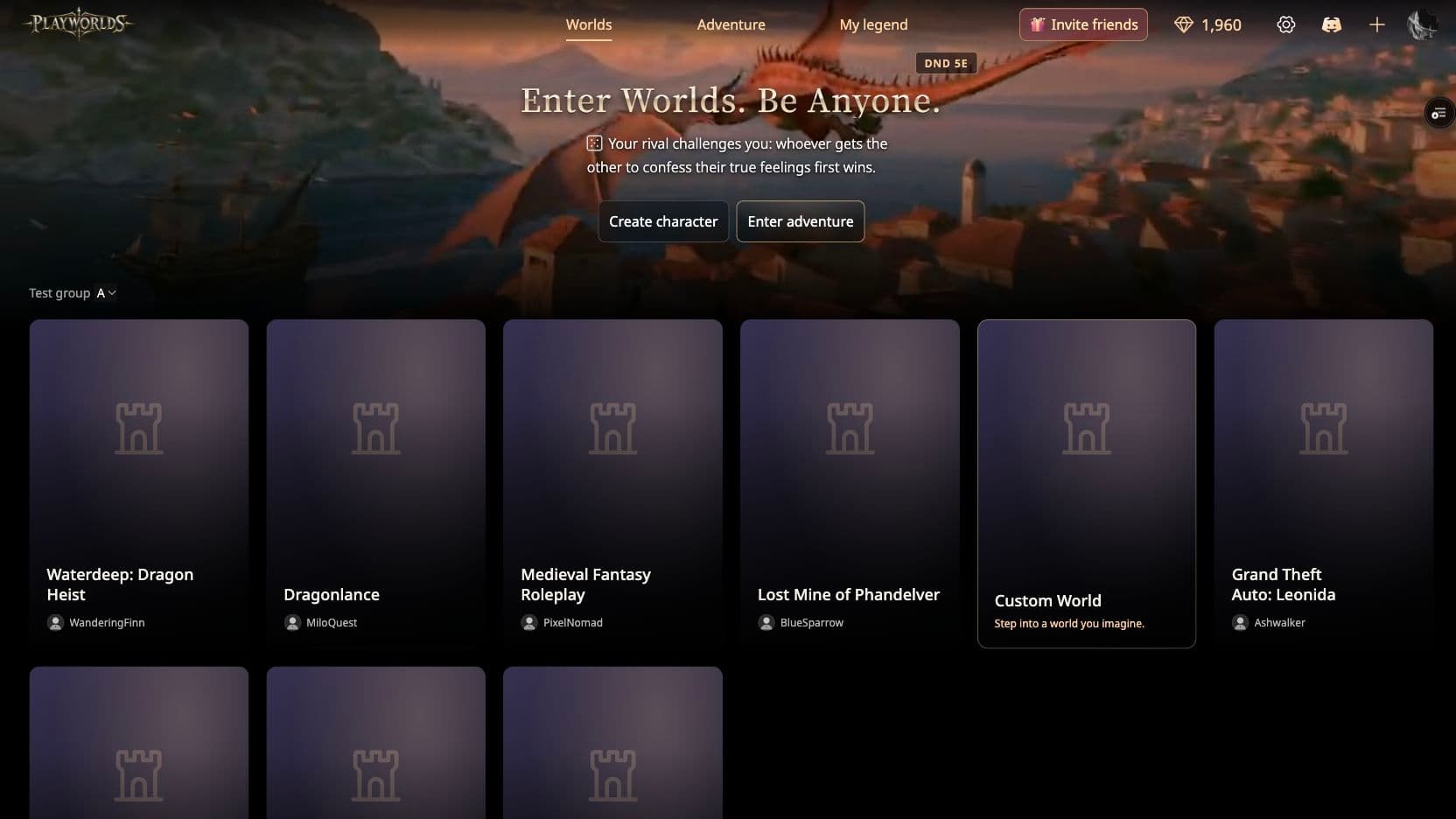
About this app
Playworlds is a browser-based AI roleplaying game for solo adventures. Create a character, choose a world, and explore an interactive story with an AI game master. Character sheets, dice, and saved adventure progress keep the game together in one interface. Browse worlds without signing in, then use Google or Discord to play and save adventures. Playworlds is an independent adaptation, not an official Dungeons & Dragons product.
Key features
- 1Browser-based solo AI roleplay with an AI game master narrating alongside character sheets and dice.
- 2World library browsable without an account; Google or Discord sign-in to create characters and save progress.
- 35E-flavored mechanics (DND 5E tags, character sheets, dice) bundled in one interface rather than a chat thread.
Target customer profile
Drawn from the product itself, not from a survey.
Demographic
Solo roleplaying fans
Pain points
Difficulty scheduling a group
Primary needs
An AI game master for solo play
Demographic
Players exploring character ideas
Pain points
Need a place to try a character
Primary needs
Character creation and saved progress
Demographic
Interactive storytelling fans
Pain points
Want stories shaped by player choices
Primary needs
Interactive adventures in a browser
Scout Review
Written by AI from measured evidence, scored out of 100.
Playworlds is a browser-based solo AI roleplay game with a genuinely good art direction and a clear pitch: pick a world, make a character, and let an AI game master run a 5E-flavored session with sheets, dice and saved progress in one place. The homepage sells the mood well — painted key art, a strong serif headline, a scannable world grid — but the conversion layer is soft, with two small ghost buttons doing the work of a primary CTA. Measured performance is the real problem: 48/100 mobile, 7.1s LCP and a 0.587 layout shift mean the atmosphere arrives late and the page jumps while it does. Security is basic-but-present (HTTPS, HSTS, 5/12 headers). Accessibility is the surprise strength at 97/100 with one color-only link issue. The idea has a real wedge over chatbots and AI Dungeon; whether it converts is unproven at six months old.
Measure by measure
Usability
60Clear short nav and a genuinely useful FAQ (no account to browse, Google/Discord to play). But the hero offers two small ghost buttons and no dominant path in, and creator tags are near-illegible.
Design
68Cohesive dark-fantasy art direction with strong painted key art and a serif hero headline. Undermined by weak hero CTAs, an unfinished-looking card grid, and placeholder icons in the product screenshot.
Speed
46Lighthouse mobile 48/100 and desktop 46/100, with LCP 7.1s and a CLS of 0.587 — the page visibly jumps as it loads. FCP at 1.1s is the one bright spot.
Security
52HTTPS and HSTS are in place, but the header checklist is 5/12: no CSP, no frame protection, no Referrer-Policy, no SPF. No published audits or bug bounty found.
Accessibility
80Lighthouse accessibility 97/100 with a single failing audit (links relying on color alone). Responsive layout and readable contrast elsewhere, but no WCAG statement or a11y docs published.
Growth
58Real, specific wedge: structured 5E-flavored solo play with sheets, dice and saved progress — the thing a chatbot can't hold together. Early domain (~0.6y), so headroom is unproven.
Improvement areas
- Performance: LCP 7.1s and CLS 0.587 on mobile — image weight and missing dimension reservations are the culprits.
- Conversion: no dominant hero CTA; two low-contrast ghost buttons compete with nav links for attention.
- Security headers: 5/12 checklist — missing CSP, frame protection, Referrer-Policy, Permissions-Policy and SPF.
Design & Usability
The homepage commits to a mood and mostly lands it: painted dragon key art, a serif 'Enter Worlds. Be Anyone.' headline, and a world grid that reads as a curated set rather than a dump. Where it slips is the conversion layer — the two hero buttons are small outlined pills with roughly the visual weight of the nav links, so the primary action doesn't announce itself. The second row of the world grid holds three cards and leaves two-fifths of the row empty, which reads as unfinished rather than intentional. The product screenshot showing placeholder castle icons and a 'Test group A' label is the kind of detail that quietly costs trust. Usability is carried by a short, clearly labelled nav and an FAQ that actually answers the first-time questions (browse without an account, Google/Discord to play and save). But the path from 'interested' to 'playing' relies on the visitor finding those small buttons themselves.
Speed & Security
Speed is the weakest measured dimension. Lighthouse puts mobile at 48/100 and desktop at 46/100, with LCP at 7.1 seconds and a cumulative layout shift of 0.587 — nearly six times the 0.1 'good' threshold. That CLS number is the tell: the page visibly reflows as the heavy painted key art loads, which is exactly the wrong first impression for a product whose whole appeal is atmosphere. First contentful paint at 1.1s shows the shell arrives quickly; it's the imagery that drags. Security sits at a middling 5/12 on the header checklist: HTTPS is enforced and HSTS is set, which covers the basics, but there's no CSP, no frame protection, no X-Content-Type-Options, no Referrer-Policy and no Permissions-Policy. SPF is absent while DMARC is present. No SOC 2, ISO, pen-test or bug bounty is published — normal for a product this young, but it means there's nothing to verify beyond the transport layer.
Accessibility & Growth
Accessibility is the standout measured result: 97/100 on the Lighthouse axe audit, with a single failing rule — links that rely on color alone to be distinguishable. That's a one-line CSS fix and the rest of the automated surface is clean, which is genuinely uncommon. The caveat is that automated checks cover maybe a third of WCAG; there's no published accessibility statement, no WCAG conformance claim, and no mention of multi-language support, so keyboard and screen-reader behavior beyond the audit is unverified. Growth is a judgement on the idea, not the traction. The problem is real and specific: solo players who can't schedule a group and want DND-shaped play without a human GM. The wedge against the listed alternatives is concrete — AI Dungeon is looser and less mechanical, ChatGPT forgets your character sheet between sessions, and Playworlds bundles world, sheet, dice and saved progress into one interface, which the FAQ states directly. That's a defensible position. The limit is that the category is crowded and the moat is thin: nothing here is structurally hard for a chatbot wrapper to copy, and the domain is roughly six months old, so there's no evidence yet that solo RPG players will pay for structure over convenience.
Conclusion
If you've been running solo sessions by yelling at a chatbot and losing your character sheet every third message, Playworlds is aimed squarely at you and the FAQ knows it. The product's core loop — world, sheet, dice, saved progress — is the right shape for the problem. What stands between it and a recommendation is execution detail: fix the layout shift and the LCP, promote one hero CTA to actually look like a CTA, and replace the placeholder screenshot before anyone else notices it. None of those are hard. All of them are the difference between 'interesting' and 'I'm signing in with Discord right now.'
Suggestions for improvement
- Compress and lazy-load the painted key art to cut LCP from 7.1s and kill the 0.587 CLS — reserve image dimensions in CSS.
- Promote one hero CTA to a solid, high-contrast button; demote the other to a text link so there's a single obvious path in.
- Replace the product screenshot showing placeholder castle icons and 'Test group A' with a real session capture.
- Add CSP, X-Content-Type-Options, Referrer-Policy and Permissions-Policy headers; publish a short security/data-handling page.
Alternatives comparison
Named competitors, point by point. Nobody paid to appear here or to be left out.
 Playworlds |  AI Dungeon |  ChatGPT | |
|---|---|---|---|
| Dedicated character sheet and dice mechanics | Yes — character sheets, dice and saved progress in one interface | Partial — story-focused, lighter on structured sheets and dice | No — improvised in chat, no native sheets or dice |
| Saved, resumable adventure progress | Yes — adventures linked to Google/Discord account | Yes — adventures saved to account | Partial — depends on chat history and context limits |
| Curated world library | Yes — browsable world cards with painted key art and creator credits | Yes — scenarios and community-created worlds | No — no world catalogue, user supplies the premise |
| Free browsing without an account | Yes — browse worlds signed out, sign in only to play and save | Limited — account required for most play | Account required |
| Multiplayer / group play | No — currently solo adventures only | Yes — supports multiplayer play | No native multiplayer |
AI Dungeon
A text-based AI adventure game that generates unlimited story possibilities; supports solo and multiplayer play.
ChatGPT
General-purpose AI chatbot that can roleplay and improvise scenes but lacks dedicated RPG mechanics like dice and character sheets.
Comparing options? See Playworlds alternatives, scored side by side
More Entertainment & Fun apps
View all Entertainment & Fun
SheetScroll
90> You play; SheetScroll turns the page. It listens through the microphone or a MIDI piano and holds the page until it's sure where you are.

Pushup RPG: Fitness Quest
90Pushup RPG is a camera-based push-up counter and fitness RPG for home workouts. Real push-ups and squats become attacks as you defeat 48 foes across 8 biomes, earn XP and loot, join guilds, and battle in live 40-second duels. Free on iOS and Android.

Flag Maker
89Free browser flag maker: 28 layouts, 197 country templates, SVG/PNG/HOI4 TGA—no account.

Peanut Tennis
89Find tennis courts & tournaments in Australia

TUNL - Cave Flyer
89A hold-to-thrust cave flyer with a new daily level, ghost races, and a global leaderboard.

Cantoro
88Custom AI songs with a name, heard free before paying $4....

How Long Timer
88HowLongHowManyDays.com is a free online countdown timer that lets you track the time remaining until specific times, dates, holidays, and special even

Video to Frames
88Free browser video frame extractor: PNG, JPG, or WebP, nothing uploaded.

i Word Unscrambler
88Free Word Unscramble for scrabble and words games.

AI Dance Trend
88Turn one photo into a 10-second AI dance video — no app, ...

Random Movie Generator
88Free random movie picker from 142k+ films—no sign-up.

FaceSwapAI
87AI face swap for photos, videos, GIFs with free trial.


A platform dedicated to providing unbiased reviews of newly launched applications, analyzing everything from their features to their full potential.
info@scoutforge.net© 2026 Scoutforge. All rights reserved.
