Cycling through all six. Tap any point to stop.
Measured on six things
Recover deleted songs. Keep your Spotify and YouTube Music favorites forever.
Growth
58Real, specific problem with a clear target user and a monitoring wedge. But 'find where to buy it' is the easy part to copy, and the category has no structural moat.
Screenshots
1 / 1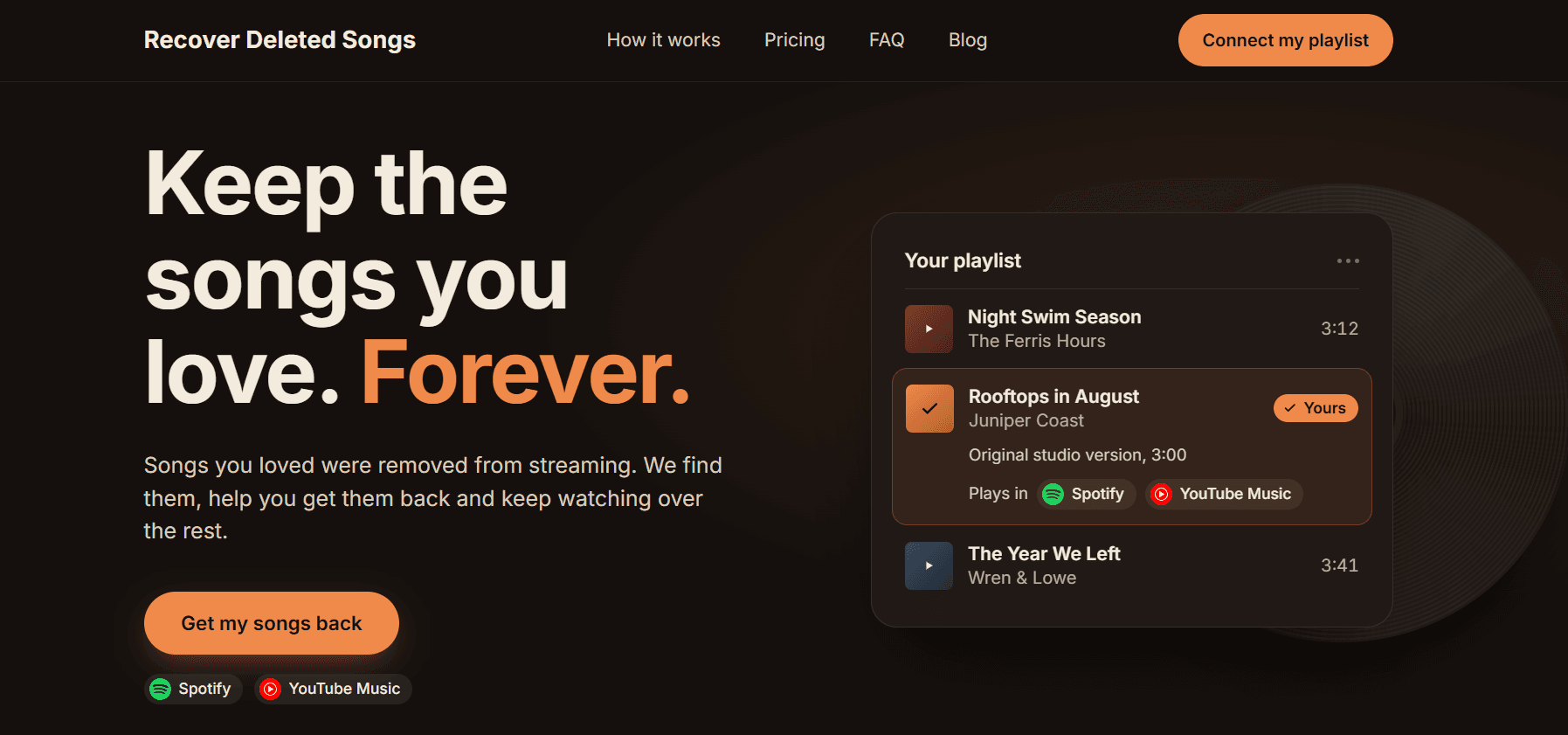
About this app
Recover Deleted Songs is a music service for Spotify and YouTube Music listeners who want to keep the songs they love, even when recordings disappear from streaming or are replaced with different versions. Streaming services, labels and artists remove songs without warning. On streaming, you don't own anything. Recover Deleted Songs checks playlists and liked songs, identifies removed or replaced tracks, and helps listeners find the exact recording to buy from music stores. It also provides step-by-step guidance for playing purchased files in Spotify or YouTube Music. Ongoing library checks and alerts help listeners spot when songs disappear or change. Purchased music files remain theirs even if they cancel their subscription. Recover Deleted Songs is designed for music fans, playlist collectors and anyone attached to a particular recording. Connect your Spotify or Youtube Music. We'll watch over your songs from then on.
Key features
- 1Scans Spotify and YouTube Music playlists and liked songs to find removed or version-swapped tracks.
- 2Shows the exact original version and where to buy it, with prices from music stores.
- 3Ongoing library monitoring with weekly checks (Standard) or instant alerts (Pro).
- 4Step-by-step guidance for playing purchased files in Spotify or YouTube Music via Local Files.
- 5Read-only access model: no password visibility, no purchases, no playlist changes, no data sharing.
Target customer profile
Drawn from the product itself, not from a survey.
Scout Review
Written by AI from measured evidence, scored out of 100.
Recover Deleted Songs is a focused, well-presented tool for a real and under-served frustration: songs you love disappearing from streaming or being swapped for a different version. The site is fast (Lighthouse 98 mobile, 100 desktop), visually cohesive, and unusually honest about what it cannot do — the 'We can't' list and the FAQ on buying and Local Files are genuinely good. Usability is competent but gated behind connecting a streaming account with no trial. Security is solid on headers but lacks third-party assurance. Accessibility is strong on automated checks with one real contrast issue. The idea is differentiated but not defensible: the monitoring wedge is real, the buy-guidance step is copyable. A credible, well-built product with a clear pitch and a moat still to be built.
Measure by measure
Usability
64Clear four-step flow, a pre-emptive 'We can't' privacy list and a genuinely useful FAQ. No free trial or demo, and the core action requires handing over a streaming account first.
Design
71Cohesive dark/cream palette with one orange accent and a hero playlist card that shows the product working. Held back by small low-contrast secondary text and inconsistent CTA labelling.
Speed
88Lighthouse mobile 98/100 with LCP 951ms and CLS 0; desktop 100/100. A genuinely fast, lightweight page with no measured lag signals.
Security
72HTTPS enforced with HSTS and most security headers present; read-only access is claimed clearly. Missing CSP and DMARC, and no SOC 2, ISO or pen-test evidence found.
Accessibility
80Lighthouse accessibility 96/100 with a single failing contrast audit. No WCAG statement or multi-language support evidenced, but the automated baseline is strong.
Growth
58Real, specific problem with a clear target user and a monitoring wedge. But 'find where to buy it' is the easy part to copy, and the category has no structural moat.
Improvement areas
- No free trial or demo; users must connect a streaming account before seeing any value.
- Missing CSP and DMARC; no SOC 2, ISO or pen-test evidence for a product requesting account access.
- Low-contrast secondary text and quote captions on cream sections, flagged by both audits.
- Inconsistent primary CTA labelling across nav, hero and pricing.
Design & Usability
The design is the strongest part of this product. A warm near-black and cream palette with a single orange accent gives the page a clear focal point, and the hero's playlist card shows the actual product — track rows, a 'Yours' pill, service chips — instead of abstract imagery. The three feature cards and the four-step timeline keep the rhythm orderly. The cracks are in the details: secondary body text and quote captions are small and low-contrast on the cream section, and the primary CTA changes label between 'Connect my playlist' and 'Get my songs back' depending on where you are. Usability is competent rather than exceptional. The four-step flow is spelled out, the 'We can't' privacy list pre-empts the obvious objection, and the FAQ actually answers the Local Files question. But there is no free trial or demo, and the first real action is connecting a streaming account — a meaningful ask before any value is shown.
Speed & Security
Speed is the standout measured result: Lighthouse mobile 98/100 with LCP 951ms, CLS 0 and TBT 30ms, and desktop 100/100. The page is lightweight and snappy, with no lag complaints in the collected evidence. Security is solid but not exceptional. HTTPS is enforced with HSTS, and frame protection, X-Content-Type-Options, Referrer-Policy and Permissions-Policy are all present — nine of twelve checklist points. The gaps are a missing Content-Security-Policy and no DMARC record. The site makes a clear, well-placed read-only access claim ('no password, no changes, no data sharing'), which is the right thing to say for a product that connects to Spotify and YouTube Music. What is absent is third-party assurance: no SOC 2, ISO 27001, pen-test summary or bug bounty found in the collected material. For a product that asks for account access, a published security page would do more than a friendly FAQ answer.
Accessibility & Growth
Accessibility scores well on automated checks — Lighthouse 96/100 — with a single failing audit for insufficient background/foreground contrast. That failure lines up exactly with the visual audit's note about small, low-contrast secondary text on the cream section, so it is a real, reproducible issue rather than a false positive. Beyond that, there is no accessibility statement, no WCAG conformance claim and no evidence of multi-language support. Growth potential is a judgement call on the idea. The problem is real and sharply named: streaming removes songs without warning, and the version you loved gets swapped for a remaster or live take. The target customer is specific — playlist collectors attached to particular recordings — and the monitoring-plus-ownership wedge is genuinely differentiated from a plain streaming subscription. The limit is that the rescue step ('here is where to buy it, and here is what it costs') is the easy part to replicate, and the category has no structural moat. The domain is brand new, so traction is context only, not a verdict.
Conclusion
If you are the kind of listener who has lost a favourite recording to a licensing purge or a silent remaster swap, this is aimed squarely at you, and the pitch is honest about the limits. The pricing is modest — $1.99 for weekly checks, $3.99 for instant alerts — and the read-only access model is the right call. The things to watch are the missing trial, the absent security certifications and the contrast issue on the cream sections. None of those are dealbreakers; all of them are fixable. The bigger question is whether 'we watch your library and tell you where to buy it' stays distinctive once the music stores notice the same opportunity.
Suggestions for improvement
- Pick one primary CTA label and use it everywhere — 'Connect my playlist' and 'Get my songs back' currently compete on the same page.
- Fix the low-contrast secondary text and quote captions on the cream sections; both the visual audit and Lighthouse flagged it.
- Add a free trial or a read-only demo so users can see the value before connecting a streaming account.
- Publish a security page with your access model and, ideally, a third-party audit or pen-test summary; add CSP and DMARC.
Alternatives comparison
Named competitors, point by point. Nobody paid to appear here or to be left out.
 Recover Deleted Songs | ||
|---|---|---|
| Detects removed or version-swapped songs in playlists | Yes — scans Spotify and YouTube Music playlists and liked songs | Not specified in provided details |
| Ongoing monitoring and alerts | Weekly checks on Standard; instant alerts on Pro | Not specified in provided details |
| Guidance on buying the exact version | Yes — shows where to buy and what it costs | Not specified in provided details |
| Pricing | $1.99/month Standard; $3.99/month Pro | Not specified in provided details |
Comparing options? See Recover Deleted Songs alternatives, scored side by side
More Online Backup apps
View all Online Backup
SendVeil
88Send large original files through private, expiring links, with EU storage.

PCDOTS PST Converter
85Convert Outlook PST files to 16 formats and clouds withou...

SysInfo OST to PST Converter
84Convert, migrate, and recover OST files to PST and 13+ fo...

yourdrive
84YourDrive is a self-hosted file manager and media timeline that runs entirely on your own infrastructure. Organize files in nested folders, move them with drag-and-drop, search instantly, and browse photos and videos by month and year. Files stream straight to your own AWS S3, Azure Blob, MinIO, Cloudflare R2 or Wasabi storage. Install with one command. Free for personal use; teams pay per server, not per seat.
PCDOTS Email Recovery Software
83Recovers emails from corrupt mailboxes across 50+ platforms.

KeepTik
83Download TikTok videos without a watermark, save photo posts as images, and bulk download selected TikTok profile posts with KeepTik for Chrome and Edge.

ServerOS
83One daemon, total control of your Linux servers

Alcazar Dead Man's Switch
82An encrypted digital legacy service that securely deliver...

Softaken Cloud Backup
82Professional Email Backup for Cloud-Based Accounts
PCDOTS Email Converter
82Convert emails between 250+ formats and clients on Window...

Clay
82Your AI builds the website. Clay.site hosts it, free to start.

App-Vault
81Encrypted photo and file vault for iPhone. AES-256 on device, pattern lock, decoy vault and calculator disguise. No account, no cloud.


A platform dedicated to providing unbiased reviews of newly launched applications, analyzing everything from their features to their full potential.
info@scoutforge.net© 2026 Scoutforge. All rights reserved.
