Cycling through all six. Tap any point to stop.
Measured on six things
Fraud detection and prevention with traffic quality scoring. Detects multiple accounts, account sharing and takeovers.
Speed
46Lighthouse desktop 100/100 but mobile 49/100 with LCP 6.4s and TBT 888ms. The interactive demo widgets and sliders are heavy on mobile main-thread. Desktop is fine; mobile is the weak spot.
Screenshots
1 / 1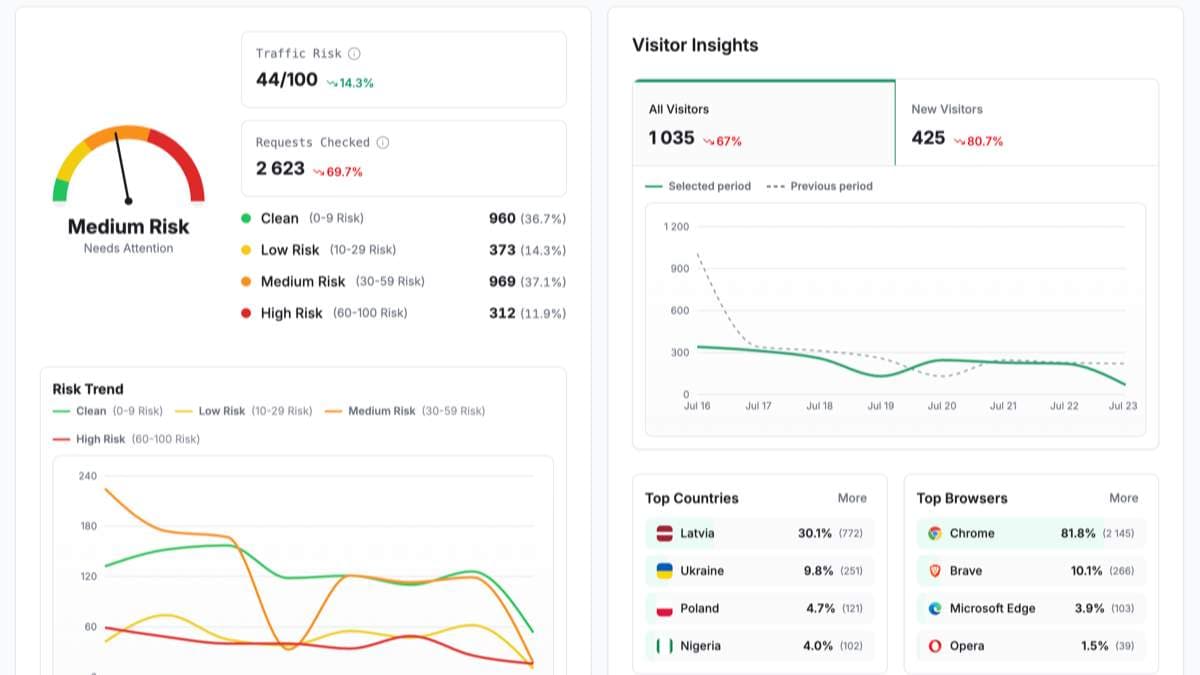
About this app
ShieldLabs is fraud detection and prevention with traffic quality scoring. It detects users running multiple accounts, account sharing and takeovers under any masking, so you prevent losses from free-trial, bonus, promo and API abuse. More than 100 device and network signals are collected on every visit and cross-checked against each other, with 99.9% identification accuracy. Visitors, users, devices and IP addresses are identified and scored, risk signals such as VPN, proxy, Tor and anti-detect browsers are returned by name, and traffic quality is scored by source, channel and campaign. Bots, automated traffic and AI agents are identified too. Five minutes to install, self-serve pricing from a free tier with 5,000 identifications.
Key features
- 1Visitor identification from 300+ device, network, and browser signals, persistent across cleared cookies, rotated IPs, and incognito.
- 2Explainable 0-100 risk score with named signals: VPN, Proxy, Tor, Datacenter IP, Anti-detect browser, OS tamper, automation.
- 3High-Risk Events for multi-accounting, account sharing, impossible travel, and account takeover with tunable detection rules.
- 4Traffic-quality scoring by source, channel, and campaign, plus paid-click fraud filtering for ad budget protection.
- 5Self-serve pricing from a free tier of 5,000 identifications, then $79–$799/mo with API and webhooks on every paid plan.
Target customer profile
Drawn from the product itself, not from a survey.
Demographic
E-commerce businesses
Pain points
High rate of fraudulent orders, promo abuse, and chargebacks affecting margins.
Primary needs
Detect and prevent fraud in real-time, reduce chargebacks, and protect revenue.
Demographic
SaaS companies
Pain points
Free trial abuse, account sharing, and multi-accounting leading to lost revenue.
Primary needs
Identify and prevent abuse, ensure accurate user metrics, and protect subscription revenue.
Demographic
iGaming platforms
Pain points
Bonus abuse, multi-accounting, and syndicate attacks causing financial losses.
Primary needs
Detect and block fraudulent accounts, prevent bonus abuse, and maintain a fair gaming environment.
Scout Review
Written by AI from measured evidence, scored out of 100.
ShieldLabs is a fraud-detection and traffic-quality platform that scores every visitor 0-100 from 300+ device, network, and browser signals, then flags multi-accounting, account sharing, account takeover, promo/bonus abuse, and free-trial cycling. It targets SaaS, iGaming, e-commerce, fintech, and marketplaces — the segments where fake accounts directly burn margin. The pitch is sharp and the pricing is refreshingly transparent: a free tier of 5,000 identifications, then $79/$319/$799 per month at $0.00396 down to $0.00159 per identification, with API, webhooks, and support on every paid plan. The site is well-built, the demo widget is real, and the accessibility score is genuinely strong. The weak spots are mobile performance (49/100, LCP 6.4s), a security posture that's missing standard headers despite the product being about security, and no published compliance or documentation. It's an early-stage tool with a real wedge and a few rough edges.
Measure by measure
Usability
66Free tier of 5,000 identifications, no credit card, demo on every page, and a self-serve pricing slider with a full feature matrix. Buyers can qualify without a sales call. Public docs/help center not surfaced.
Design
71Dark, confident landing page with a live traffic-quality widget and a real 0-100 risk-score card showing named signals. Pricing slider and full feature matrix are clean. Dense copy, but the product UI shown is genuine, not stock.
Speed
46Lighthouse desktop 100/100 but mobile 49/100 with LCP 6.4s and TBT 888ms. The interactive demo widgets and sliders are heavy on mobile main-thread. Desktop is fine; mobile is the weak spot.
Security
52HTTPS enforced with HSTS, SPF and DMARC set. HTTP probe 6/12: no CSP, no frame protection, no X-Content-Type-Options, no Referrer-Policy. Payload encryption claimed; no SOC 2, ISO, or pen-test published.
Accessibility
80Lighthouse accessibility 97/100 with one failing audit: insufficient color contrast. No WCAG statement or keyboard-nav docs found. Responsive and English-only. Strong automated score, thin manual/a11y documentation.
Growth
62Real, expensive problem (multi-accounting, trial abuse, ATO) with a specific wedge: pre-signup identity and traffic-quality scoring at self-serve prices, where Sift/Forter/Riskified sell enterprise transaction fraud.
Improvement areas
- Mobile performance: Lighthouse 49/100, LCP 6.4s, TBT 888ms — the interactive demo widgets and slider are the likely cause.
- Security headers: no CSP, frame protection, X-Content-Type-Options, Referrer-Policy, or Permissions-Policy on a security product's own site.
- No public documentation or help center surfaced; onboarding depth past the marketing pages is unverified.
- No published compliance or trust signals: no SOC 2, ISO 27001, pen-test report, or bug-bounty program.
Design & Usability
ShieldLabs' site is a dark, high-contrast landing page built around a live traffic-quality widget that shows 51,762 identifications checked and a real 0-100 risk-score card with named signals (Proxy, Datacenter IP, Anti-detect browser). That's a genuine product UI on the homepage, not a stock mockup, and it does more selling than the copy does. The pricing page uses a traffic slider (5K to 1M+) and a full feature matrix across Free/Starter/Growth/Scale, so a buyer can self-qualify without a sales call. Usability is carried by the free tier — 5,000 identifications, no credit card, demo button on every page — plus API, webhooks, and support on every paid plan. The gap is documentation: no public help center or docs URL surfaced in the fetched content, so onboarding depth past the marketing pages is unverified. Design and usability are both above-average for an early-stage fraud tool, held back by dense copy and missing docs.
Speed & Security
Speed is a split personality. Lighthouse desktop performance is 100/100, but mobile is 49/100 with LCP 6.4s, TBT 888ms, and FCP 2.5s. The culprit is almost certainly the interactive demo widgets and pricing slider loading heavy JavaScript on mobile main-thread; CLS is 0, so layout is stable, it's just slow to become interactive on a phone. If your buyers check the site on mobile, that's a real first-impression tax. Security is competent but thin on the surface: HTTPS enforced with HSTS, SPF and DMARC present, and 'Payload Encryption' listed as a platform feature. But the HTTP probe scored 6/12 — no Content-Security-Policy, no frame protection, no X-Content-Type-Options, no Referrer-Policy, no Permissions-Policy. For a company whose entire pitch is stopping abuse, missing CSP and clickjacking protection on your own marketing site is an awkward look. No SOC 2, ISO 27001, pen-test report, or bug bounty is published, which is normal for this stage but leaves enterprise buyers with nothing to point at.
Accessibility & Growth
Accessibility is a genuine strength: Lighthouse scores 97/100 with a single failing audit — insufficient color contrast, likely the muted text on the dark theme or the risk-score widget labels. There's no WCAG conformance statement or keyboard-navigation documentation, and the site is English-only, so the automated score is doing most of the work. Still, 97 is well above the category norm for a young B2B tool. Growth is the more interesting question. The problem ShieldLabs names is real and expensive: multi-accounting, free-trial cycling, promo and bonus farming, and account takeover cost SaaS, iGaming, e-commerce, fintech, and marketplaces actual money. The wedge is clear — Sift, Forter, and Riskified sell enterprise transaction and payment fraud with sales-led pricing; ShieldLabs sells pre-signup identity and traffic-quality scoring, self-serve, from $79/mo with a free tier. That's a defensible position against incumbents who structurally can't drop to a $79 self-serve plan without cannibalizing enterprise deals. The limit is that identity signals are a commodity — anyone can collect device and network signals — so the moat has to come from accuracy, integrations, and the identity graph over time, none of which the site proves yet.
Conclusion
The honest read: ShieldLabs is a competent, well-positioned early-stage fraud tool with a real product behind the marketing. The self-serve pricing and free tier are a genuine differentiator against Sift, Forter, and Riskified, who sell enterprise contracts and can't easily match a $79/mo entry point. The identity-and-traffic-quality angle is the right wedge for SaaS and iGaming, where payment-fraud incumbents are a poor fit. What's missing is the boring stuff that closes enterprise deals and keeps mobile visitors around: a Content-Security-Policy, a SOC 2 or pen-test report, public documentation, and a mobile performance pass. None of those are fatal at this stage, but all of them are the difference between a promising tool and one a security team will actually sign off on. If the team ships docs, tightens the headers, and fixes the mobile LCP, this becomes a much easier recommendation.
Suggestions for improvement
- Add a Content-Security-Policy, X-Content-Type-Options, Referrer-Policy, and frame protection — you sell security, so your own headers should be clean.
- Publish a public docs/help center with API reference and integration guides; the marketing pages currently carry all the weight.
- Fix mobile LCP (6.4s) and TBT (888ms) by deferring or lazy-loading the interactive demo widgets and pricing slider.
- Publish a security page with SOC 2 status, pen-test summary, or a bug-bounty program — enterprise buyers need something to point at.
Alternatives comparison
Named competitors, point by point. Nobody paid to appear here or to be left out.
 ShieldLabs |  Sift |  Forter |  Riskified | |
|---|---|---|---|---|
| Primary fraud focus | Pre-signup identity and traffic-quality scoring: multi-accounting, account sharing, ATO, promo/trial abuse | ML-based transaction and payment fraud detection across e-commerce and marketplaces | E-commerce fraud prevention focused on payment and checkout, revenue optimization | E-commerce chargeback protection and risk management with a guarantee model |
| Pricing model | Self-serve: free tier 5,000 IDs, then $79–$799/mo ($0.00396–$0.00159 per identification) | Sales-led enterprise pricing, typically custom-quoted annual contracts | Enterprise custom pricing, sales-led, no public self-serve tier | Enterprise custom pricing with chargeback-guarantee commercial model |
| Free tier / trial | Yes — 5,000 free identifications, no credit card required | No public free tier; demo and sales contact required | No public free tier; enterprise demo only | No public free tier; enterprise demo only |
| Target customer | SaaS, iGaming, e-commerce, fintech, marketplaces, crypto, travel, ticketing | Enterprise e-commerce, marketplaces, digital goods, payments | Enterprise e-commerce and digital commerce brands | Enterprise e-commerce merchants seeking chargeback guarantees |
| Traffic-quality / ad-fraud scoring | Yes — traffic-quality score by source, channel, and campaign; paid-click fraud filtering | Not a core offering; focused on transaction risk scoring | Not a core offering; focused on checkout fraud and approvals | Not a core offering; focused on chargeback protection |
| Published compliance / trust signals | None published on site: no SOC 2, ISO, pen-test, or bug bounty mentioned | Enterprise-grade compliance program (SOC 2, etc.) typical for the category | Enterprise compliance and security program typical for the category | Enterprise compliance and security program typical for the category |
Sift
Sift is a fraud detection and prevention platform that uses machine learning to identify fraudulent users and transactions.
Forter
Forter provides fraud prevention for e-commerce, helping businesses increase revenue and reduce fraud.
Riskified
Riskified is a fraud prevention solution for e-commerce, offering chargeback protection and risk management.
Comparing options? See ShieldLabs alternatives, scored side by side
More Security apps
View all Security
OBVELO
88Privacy gateway that masks personal data in LLM traffic

kosa8
88Sealed VMs for AI agents with instant rewind, audit trails & zero key exposureSealed VMs for AI agents with instant rewind and audit tr...

Sidenty
87Sidenty is a professional digital identity protection ser...

ProcessSpy
87A native macOS process explorer and advanced monitor that...

Basalt
86Eighteen PDF tools in one native Mac window: merge, split, compress, OCR, Bates numbering, forms, signing and redaction. Offline. $29 once.

Sanctix
85Sanctions screening with verifiable SHA-256 audit trails.

PromptTrace
85Free hands-on AI security labs for prompt injection and L...

eGuard
84Verifiable parental controls for families in the Philippines

yourdrive
84YourDrive is a self-hosted file manager and media timeline that runs entirely on your own infrastructure. Organize files in nested folders, move them with drag-and-drop, search instantly, and browse photos and videos by month and year. Files stream straight to your own AWS S3, Azure Blob, MinIO, Cloudflare R2 or Wasabi storage. Install with one command. Free for personal use; teams pay per server, not per seat.

Noden
84Native macOS SSH, SFTP & RDP client with a Keychain-backe...

VaultKeepR
84Password manager with no email, no account, no tracking. ...

Archonum
84Real-device browser automation for AI agents


A platform dedicated to providing unbiased reviews of newly launched applications, analyzing everything from their features to their full potential.
info@scoutforge.net© 2026 Scoutforge. All rights reserved.
