Cycling through all six. Tap any point to stop.
Measured on six things
Topical maps for SEO, built on live Google search data
Speed
46Lighthouse mobile 57/100 with LCP 3.5s and TBT 747ms — a marketing page that ships enough JavaScript to feel sluggish on mobile. Desktop 77/100 is fine; CLS is excellent at 0.002.
Screenshots
1 / 2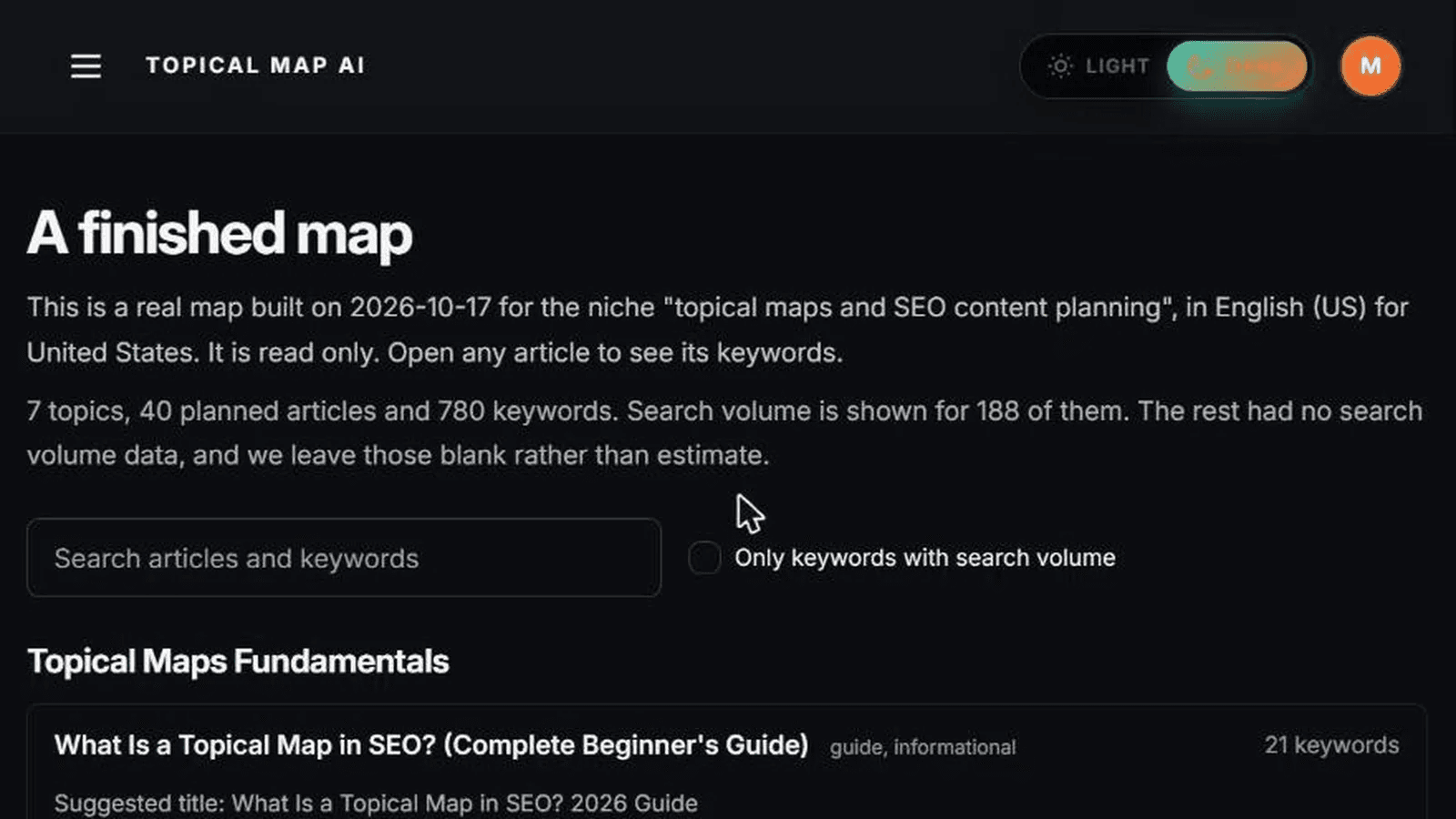
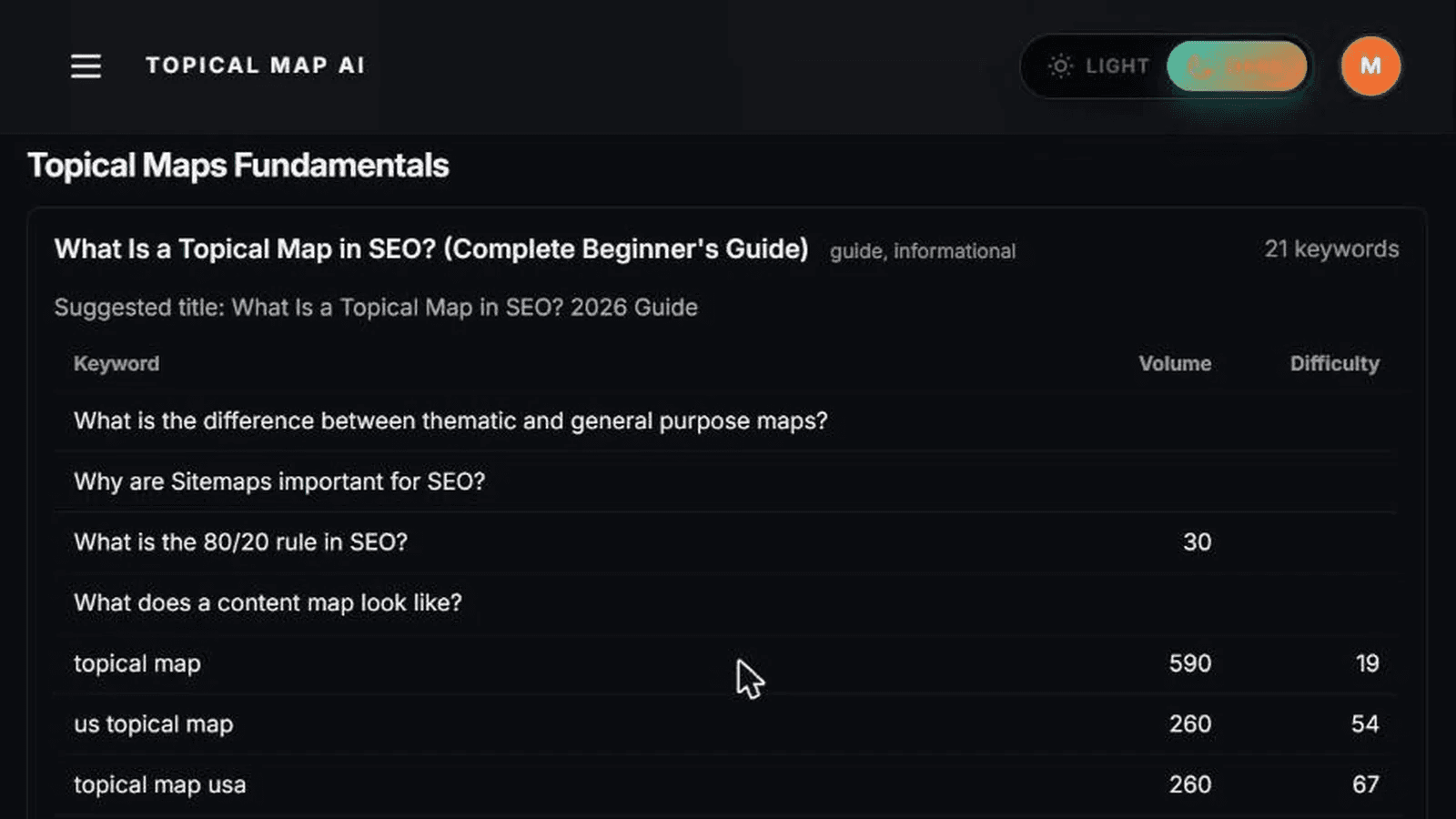
About this app
Enter a topic or site and get a complete SEO topical map. An SEO map lists hundreds of keywords grouped into clusters, with search volume and difficulty shown wherever Google reports a number. Exports to CSV and PDF.
Key features
- 1AI-generated topical maps: hundreds of keywords clustered by topic, with search volume and difficulty from DataForSEO where available.
- 2Content briefs per cluster, plus CSV, Excel and PDF export — including white-label PDF reports for client work.
- 3Batch generation (5-10 maps at once), 20+ languages, 25+ countries, bring-your-own OpenAI key, and REST API on the top tier.
Target customer profile
Drawn from the product itself, not from a survey.
Demographic
Solo bloggers and niche site owners
Pain points
Manual keyword research and clustering is time-consuming and error-prone; limited budget for expensive SEO tools.
Primary needs
Affordable, automated topical map generation with export options and content briefs.
Demographic
Freelance SEOs and content marketers
Pain points
Need to deliver client-ready reports quickly; juggling multiple tools and spreadsheets.
Primary needs
Batch map generation, white-label exports, and easy collaboration for client work.
Demographic
Small agencies and content teams
Pain points
Scaling content strategy across multiple clients is resource-intensive; enterprise tools are overkill.
Primary needs
Team collaboration, API access, and scalable pricing to manage multiple projects efficiently.
Scout Review
Written by AI from measured evidence, scored out of 100.
Topical Map AI is a focused, competent indie SEO tool that does one job — turning a niche into a clustered topical map with search volume, difficulty and content briefs — and does it with a genuinely tidy interface and honest data handling. The landing page is average-to-good, the app UI is better than the marketing, and the 3-step flow plus CSV/PDF export and white-label reports make it a plausible pick for solo bloggers and freelancers who find Ahrefs and Semrush overkill. The weaknesses are real: a mobile page that ships too much JavaScript (LCP 3.5s, TBT 747ms), a security posture that stops at HTTPS and DMARC, accessibility gaps that hit the core table experience, and no visible documentation. It's a solid mid-tier product with a clear niche and room to sharpen.
Measure by measure
Usability
62Clear 3-step flow, visible search/filter controls, CSV/PDF export and content briefs make the core job legible. Undercut by a price-first modal, blank table cells where DataForSEO has no volume, and no visible docs or help center.
Design
58Competent, template-driven SaaS landing page: consistent orange accent, clear hero hierarchy, and a genuinely tidy dark-mode map UI. The auto-loading welcome modal and generic feature-card grid keep it firmly average.
Speed
46Lighthouse mobile 57/100 with LCP 3.5s and TBT 747ms — a marketing page that ships enough JavaScript to feel sluggish on mobile. Desktop 77/100 is fine; CLS is excellent at 0.002.
Security
52HTTPS enforced with SPF and DMARC in place, but zero of the modern hardening headers (no HSTS, CSP, frame protection, Referrer-Policy) and no published SOC 2, pen-test or bug bounty. Table stakes met, nothing more.
Accessibility
70Lighthouse 88/100 with 20+ language support is solid, but contrast failures, out-of-order headings, unlabeled form inputs and a headerless data table are real WCAG gaps. No published a11y statement.
Growth
60A real, specific problem (topical mapping is tedious) with a clear wedge: single-job focus, white-label PDFs, BYO OpenAI key, and a price well under Ahrefs/Semrush. Crowded category, but the niche is defensible.
Improvement areas
- Mobile performance: 57/100 Lighthouse with 3.5s LCP and 747ms TBT — trim JavaScript on the marketing page.
- Security hardening: add HSTS, CSP, frame protection and Referrer-Policy; publish a security page and consider a pen-test.
- Accessibility: fix table headers, form labels, heading order and contrast; publish a WCAG conformance statement.
- Documentation: no visible help center or docs; move the pricing modal behind a click instead of firing on load.
Design & Usability
Topical Map AI looks like what it is: a focused indie SEO tool with a clean, consistent orange-accented landing page and a genuinely well-built dark-mode map interface. The tabular typography in the app is disciplined — right-aligned numbers, quiet separators, honest blank cells where DataForSEO has no volume. The marketing site is more generic: a hero, three how-it-works cards, a six-card feature grid, testimonials, a comparison table. Usability is where it earns its keep — the 3-step flow (generate, customize/export, create) is legible, the search and 'only keywords with search volume' filter sit right above the content, and CSV/PDF export plus content briefs cover the actual job. What drags it down: a welcome modal that fires before you've read anything and shows pricing up front, a low-contrast 'Maybe later' dismissal, and no visible documentation or help center to speak of.
Speed & Security
Speed is the weak spot. Lighthouse mobile scores 57/100 with an LCP of 3.5s and 747ms of total blocking time — that's a lot of JavaScript for a page that mostly displays text and a button. Desktop is a healthier 77/100 and CLS is essentially perfect at 0.002, so the layout is stable; it's the main-thread work that bites. Security is table stakes and not much else: HTTPS is enforced and SPF/DMARC are configured, but there's no HSTS, no CSP, no frame protection, no Referrer-Policy or Permissions-Policy — 4 of 12 checklist points. No SOC 2, ISO, pen-test or bug bounty is published anywhere I could find. For a tool that handles your OpenAI API key and client deliverables, that's thin. Neither dimension is broken; both are clearly behind what a paid $56-$179/mo product should ship.
Accessibility & Growth
Accessibility lands at a respectable 88/100 on Lighthouse with 20+ language support, but the failing audits are the kind that matter: insufficient color contrast, headings out of sequence, form elements without labels, and a large data table with no `<td>` headers. For a product whose entire value is a big table of keywords, that last one is a real problem for screen-reader users. No WCAG conformance statement is published. Growth is the more interesting question. The problem is real — manual keyword clustering is genuinely miserable — and the positioning is sharp: one job, done well, at a fraction of Ahrefs or Semrush. The differentiators are concrete: white-label PDF export for freelancers, content briefs built in, bring-your-own OpenAI key to control costs, batch generation and a REST API on the top tier. The limit is that the wedge is narrow and copyable; the incumbents already have the keyword data and could bolt on clustering. The site's own claims of 3,000+ accounts and 11,000+ maps suggest real usage, but the category is crowded and the moat is thin.
Conclusion
If you're a solo blogger or freelance SEO who wants a topical map without paying for a full suite, Topical Map AI is a reasonable $56/mo bet — the white-label PDF export and content briefs alone justify it for client work. Go in knowing what you're getting: a single-purpose tool, not a platform. The honest blank cells where DataForSEO has no volume are a feature, not a bug, and the app UI is better than the site selling it. What would move this from solid to strong: cut the mobile JavaScript weight, add the missing security headers and a real docs/help center, fix the table headers and form labels, and publish an accessibility statement. None of that is hard. All of it would make the product match the confidence of its pricing page.
Suggestions for improvement
- Cut mobile JavaScript weight — 747ms TBT and 3.5s LCP are dragging a text-heavy page down.
- Add HSTS, CSP, frame protection and Referrer-Policy; publish a security page and consider a pen-test.
- Fix the data table: add `<th>` headers, label form inputs, correct heading order, raise contrast.
- Ship a real docs/help center and move the pricing modal behind a click instead of firing it on load.
Alternatives comparison
Named competitors, point by point. Nobody paid to appear here or to be left out.
 Topical Map AI |  Ahrefs |  Semrush | |
|---|---|---|---|
| Dedicated topical map generation | Yes — core product, AI-clustered maps with content briefs | No — keyword research and backlinks, no dedicated topical map | No — full SEO suite, topical mapping not a dedicated feature |
| Starting price | $56/mo (Basic, 25 maps); Pro $104, Enterprise $179 | Significantly higher; full suite pricing | Significantly higher; full suite pricing |
| Search volume & difficulty data | Partial — DataForSEO, blank where no volume reported | Yes — proprietary keyword database | Yes — proprietary keyword database |
| White-label PDF export for clients | Yes — branded PDF reports with your logo | Reports available; white-label not a focus | Reports available; white-label on higher tiers |
| Backlink analysis & site audits | No — single-purpose topical mapping tool | Yes — industry-leading backlink index and site audit | Yes — backlink analytics, site audit, rank tracking |
| Multi-language support | 20+ languages, 25+ countries | Multi-language keyword databases | Multi-language keyword databases |
Ahrefs
A comprehensive SEO suite offering backlink analysis, keyword research, and site audits, but not specialized for topical mapping.
Semrush
An all-in-one SEO and content marketing platform with keyword research and rank tracking, but lacking dedicated topical map generation.
Comparing options? See Topical Map AI alternatives, scored side by side
More Marketing & Sales apps
View all Marketing & Sales
Puzzly – B2B Lead Generation & Sales Intelligence Platform
92Puzzly is an all-in-one B2B lead generation platform that...

Geogrid
92A UULE-powered local rank tracker for SEO agencies, offer...

EmbedMyReviews
92White-label reputation management software for agencies s...

Vibe Coding Agent Skills
92A free, open-source platform offering 110 AI agent skills...

QRBliss
91Branded QR codes with AI Brand Sync, 15 free dynamic code...

WAButton
90WhatsApp website leads, forms and contact routing

BACKLNK
90Backlnk is a free SEO and AI visibility website: 15 website checks, a full audit as a PDF report, and guides to get found in search and AI answers.

DemoVexa
90Turn your code into professional product demo videos with AI-generated scripts, animated UI, and natural voiceovers.

PitchWhip
90AI cold call scripts & direct dials from LinkedIn

ThumbnailMaker
90AI YouTube thumbnail maker: paste a video link, get the brief, the thumbnail, and a check at feed size.

What the GIF
89Frame-perfect video-to-GIF maker that runs entirely in yo...

AuditCloser
89White-label website audits that close deals for digital a...


A platform dedicated to providing unbiased reviews of newly launched applications, analyzing everything from their features to their full potential.
info@scoutforge.net© 2026 Scoutforge. All rights reserved.
