Cycling through all six. Tap any point to stop.
Measured on six things
Snap a photo of any room, patio or yard. Re-Design's AI returns a photorealistic, shoppable design concept in about 30 seconds. Free to try.
Security
52HTTPS enforced with HSTS, plus SPF and DMARC configured — 6/12 header checklist points. Missing CSP, frame protection, X-Content-Type-Options, Referrer-Policy and Permissions-Policy. No SOC 2, ISO or pen-test claims published.
Screenshots
1 / 1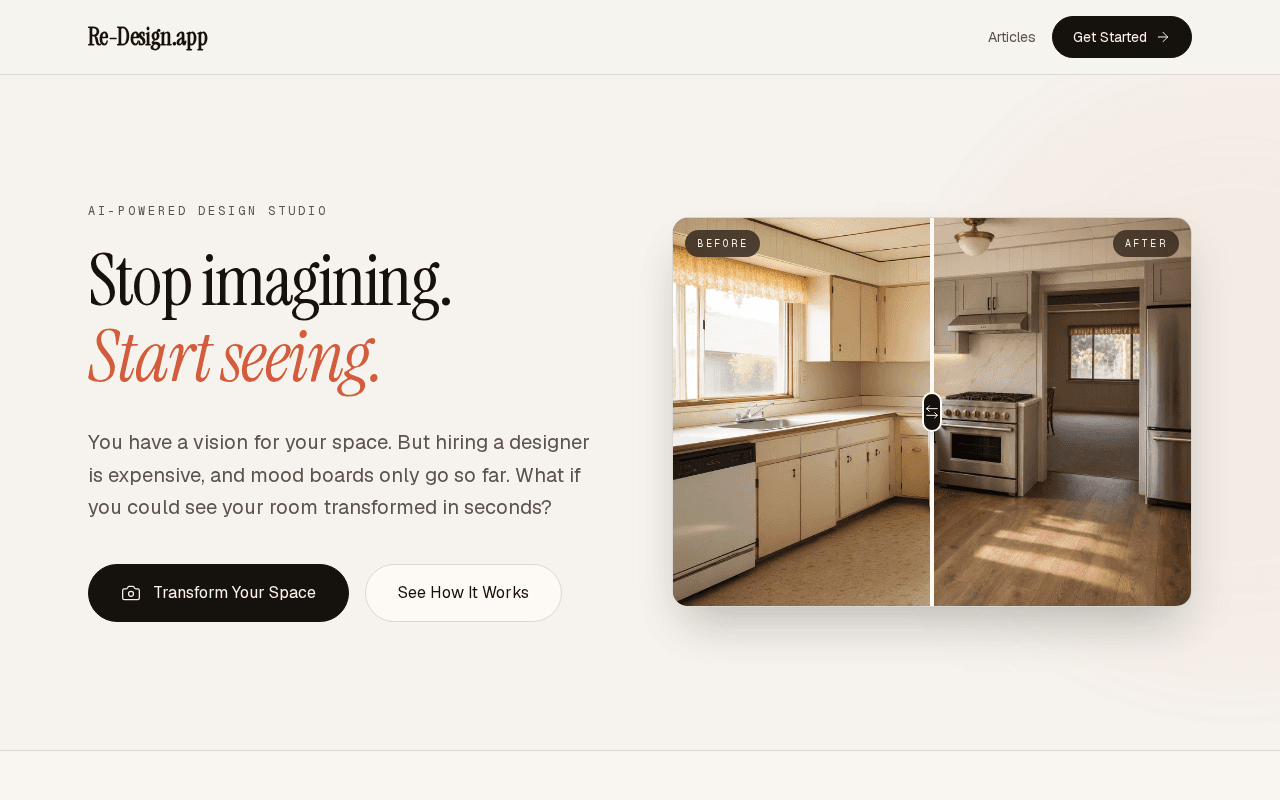
About this app
Re-Design is an AI design studio for any space, indoor or outdoor. Take or upload a photo of a living room, kitchen, closet, office, patio or backyard. The AI reads the room's architecture, lighting and dimensions and returns an editorial-quality redesign in about 30 seconds, with items you can shop. Free to try, no credit card. Zack built Re-Design so anyone can see a room or yard redesigned before spending money on a designer or furniture. Just snap a photo and get a photorealistic, shoppable concept in about 30 seconds.
Key features
- 1AI redesigns any room or outdoor space from a single photo in about 30 seconds.
- 2Photorealistic, editorial-quality output with before/after comparison sliders.
- 3Shoppable results — every design comes with items you can actually buy.
- 4Free to try, no credit card required; covers living rooms, kitchens, closets, offices, patios and backyards.
Target customer profile
Drawn from the product itself, not from a survey.
Demographic
Homeowners aged 30-55
Pain points
High cost of interior designers, difficulty visualizing changes, time-consuming renovation processes.
Primary needs
Affordable design ideas, quick visualization of redesigns, shoppable product recommendations.
Demographic
Real estate agents and stagers
Pain points
Need to quickly showcase property potential, limited budget for professional staging, time constraints.
Primary needs
Fast, cost-effective virtual staging, high-quality visuals to attract buyers, easy integration into listings.
Demographic
Interior design enthusiasts and DIYers
Pain points
Lack of design expertise, uncertainty about style choices, overwhelming options.
Primary needs
Inspiration and guidance, instant feedback on design ideas, access to purchase items.
Scout Review
Written by AI from measured evidence, scored out of 100.
Re-Design is a clean, well-positioned AI interior design tool with a genuinely low-friction entry: snap a photo, get a photorealistic redesign in about 30 seconds, shop the items. The landing page is polished, the before/after sliders do real work, and the accessibility baseline (95/100) is better than most indie tools manage. The problems are the ones you'd expect at this stage: a 7.1s mobile LCP that undercuts the '30 seconds' pitch, a thin security header profile with no published compliance, and no help center or docs to catch users when the AI output misses. The idea itself has room — Modsy's shutdown and the human-designer model of Spacejoy and Havenly leave a gap for instant AI output — but the shoppable angle is the only piece that's hard to copy, and it needs to be the product, not a feature.
Measure by measure
Usability
64Three-step flow (snap, analyze, shop) is spelled out clearly and the free-to-try, no-credit-card entry keeps friction low. No help center, docs or FAQ surfaced, so deeper questions have nowhere to land.
Design
72Clean, modern landing page with a strong hero, before/after sliders and a clear Problem→Solution→How It Works flow. Polished for an early-stage indie tool, though the visual language is standard AI-SaaS fare.
Speed
68Lighthouse mobile 75/100 and desktop 82/100, with CLS 0 and TBT 26ms. The 7.1s mobile LCP is the weak spot — the hero image work drags first paint well past the 2.5s 'good' line.
Security
52HTTPS enforced with HSTS, plus SPF and DMARC configured — 6/12 header checklist points. Missing CSP, frame protection, X-Content-Type-Options, Referrer-Policy and Permissions-Policy. No SOC 2, ISO or pen-test claims published.
Accessibility
82Lighthouse accessibility 95/100 with only two failing audits: insufficient color contrast and a missing main landmark. No WCAG statement or a11y page published, but the automated baseline is strong for an early-stage product.
Growth
58Real problem (designer costs, visualization gap) with a concrete wedge: instant AI output plus shoppable items. Modsy's shutdown leaves a gap, but Spacejoy and Havenly still own the human-designer lane.
Improvement areas
- Mobile LCP of 7.1s undercuts the '30 seconds' pitch — optimize hero image loading.
- No help center, FAQ or docs to support users when AI output misses the mark.
- Security headers only 6/12 — missing CSP, frame protection, Referrer-Policy and Permissions-Policy.
- No WCAG statement or accessibility page despite a strong 95/100 automated score.
Design & Usability
Re-Design's landing page is a competent, modern AI-SaaS site: bold hero, before/after sliders for living room, kitchen and outdoor spaces, and a Problem→Solution→How It Works→Transformations structure that reads cleanly. The design language is polished but familiar — nothing here would make you stop scrolling if you'd seen ten other AI design tools this month. Usability is where the product's promise lives: three steps (snap, analyze, shop), free to try, no credit card, and a stated 30-second turnaround. That's a genuinely low-friction entry. The gap is depth — no help center, no FAQ, no docs surfaced on the homepage, so anyone whose redesign comes back weird has nowhere to go. For an early-stage tool that's forgivable, but it's the difference between a demo and a product.
Speed & Security
Speed is a mixed bag. Lighthouse gives mobile 75/100 and desktop 82/100, with CLS 0 and TBT 26ms — the layout is stable and the main thread is calm. But mobile LCP is 7.1s, which is roughly three times the 'good' threshold, and for a product whose entire pitch is 'see your room in 30 seconds,' a seven-second wait before the hero even paints is a bad first impression. Security sits at the category-typical band for an early-stage web app: HTTPS enforced, HSTS on, SPF and DMARC configured, but only 6/12 on the header checklist — no CSP, no frame protection, no X-Content-Type-Options, no Referrer-Policy, no Permissions-Policy. No SOC 2, ISO or pen-test claims are published. None of that is unusual for a product this young, but it's also not a security story the site is telling.
Accessibility & Growth
Accessibility is a genuine strength: Lighthouse scores 95/100 with only two failing audits — insufficient color contrast and a missing main landmark. No WCAG statement is published, but the automated baseline is well above what most indie tools manage. Growth is the more interesting question. The problem Re-Design names is real: interior designers are expensive, mood boards don't show you your actual room, and the visualization gap is genuine. The wedge is instant AI output plus shoppable items, and the alternatives list is telling — Modsy has shut down, and Spacejoy and Havenly are human-designer marketplaces, not instant-AI tools. That leaves a real lane. The limit is that 'AI redesigns your room' is becoming a crowded category fast, and the shoppable output is the only piece that's hard to copy. The domain is 0.4 years old, so this is very early — the idea has room, but the moat is thin.
Conclusion
If you're a homeowner who wants to see your living room redesigned before you spend $4,000 on a sofa, Re-Design is worth the free try — the 30-second promise is real on desktop, and the shoppable output is the part that actually saves you money. If you're a real-estate agent or stager, the value proposition is even sharper: virtual staging without the staging bill. Just don't expect a design partner. This is a fast, cheap first look, not a replacement for a designer who'll tell you the rug is wrong. Try it, screenshot the good outputs, and keep your expectations calibrated to the price.
Suggestions for improvement
- Fix the 7.1s mobile LCP — compress or lazy-load the hero before/after imagery so the '30 seconds' pitch doesn't start with a seven-second wait.
- Add a help center or FAQ covering what to do when the AI output misses — wrong style, wrong dimensions, unusable items.
- Publish a security page with at least a CSP, frame protection and Referrer-Policy; the header checklist is half-empty.
- Add a main landmark and fix the contrast failures — you're two audits away from a clean accessibility sheet.
Alternatives comparison
Named competitors, point by point. Nobody paid to appear here or to be left out.
 Re-Design |  Spacejoy |  Modsy |  Havenly | |
|---|---|---|---|---|
| Design turnaround time | About 30 seconds, AI-generated | Days — human designer turnaround | Days — 3D rendering service (shut down) | Days — matched with a human designer |
| Shoppable product recommendations | Yes — items included with every design | Yes — curated shoppable product lists | Yes — furniture recommendations (service defunct) | Yes — shoppable product selections |
| Human designer involvement | None — fully AI-generated | Yes — professional designers | Yes — human designers (service defunct) | Yes — matched with a professional designer |
| Free trial / no-credit-card entry | Yes — free to try, no credit card | Limited — paid design packages | N/A — service shut down | Limited — paid design packages |
| Outdoor / patio spaces supported | Yes — patios and backyards included | Primarily indoor rooms | Primarily indoor rooms (defunct) | Primarily indoor rooms |
Spacejoy
Online interior design service that offers personalized room designs and shoppable product lists.
Modsy
Virtual interior design platform that provides 3D renderings and furniture recommendations (note: Modsy has shut down, but similar services exist).
Havenly
Online interior design service connecting users with professional designers for custom room designs.
Comparing options? See Re-Design alternatives, scored side by side
More Design & Creativity apps
View all Design & Creativity
RoomCreator
92An AI-powered interior and exterior design tool that tran...

What the GIF
89Frame-perfect video-to-GIF maker that runs entirely in yo...

TranscriptYou
88Free YouTube transcript generator with timestamps and AI ...

RestorePhotosApp
88An AI-powered photo restoration app that brings old, blur...

Portrait Gift
88AI-powered personalized face swap art platform creating c...

ButterKit
82macOS app for App Store screenshots: 3D mockups, auto-tra...

BeartIMAGE
88BeartIMAGE is a free, web-based image processing platform engineered for fast, bulk photo editing and conversion directly in your browser.

Pixelimg
88A free online AI-powered tool that instantly converts ima...

Coloring Pages Pro
87A massive collection of free printable coloring pages for...

QRocodile
87Design And Animate QR Codes People Want to Scan

FaceSwapAI
87AI face swap for photos, videos, GIFs with free trial.

TryInk
86Try on a tattoo on your own body photo before you book.


A platform dedicated to providing unbiased reviews of newly launched applications, analyzing everything from their features to their full potential.
info@scoutforge.net© 2026 Scoutforge. All rights reserved.
