Cycling through all six. Tap any point to stop.
Measured on six things
Generate up to 4K videos with native audio from images an...
Security
50HTTPS and HSTS are in place, but the probe found no CSP, frame protection, Referrer-Policy, or Permissions-Policy (4/12), and no SPF/DMARC. No SOC 2, ISO, or bug-bounty page found.
Screenshots
1 / 1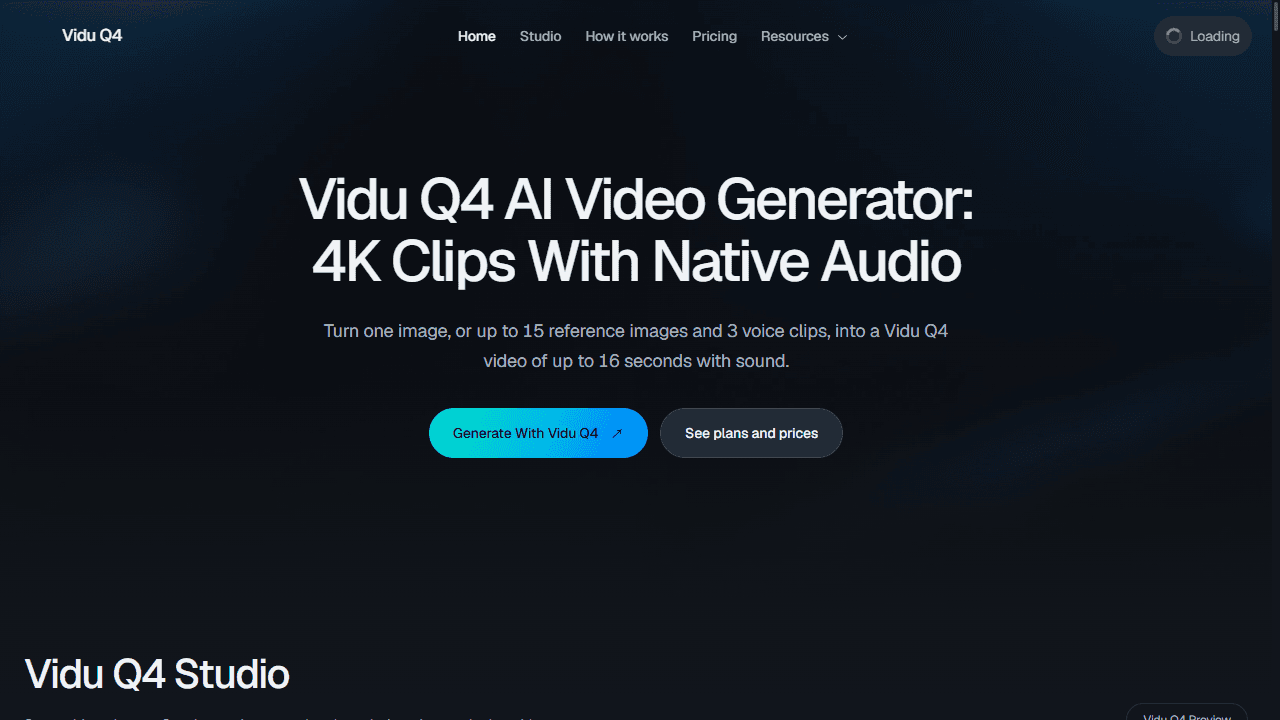
About this app
Vidu Q4 is an AI video model from Shengshu Technology that generates video and synchronized audio together. Launched as a Preview in early October 2026, it supports image-to-video and reference-to-video modes, producing clips from 3 to 16 seconds at resolutions up to 4K. The model excels at maintaining character consistency with up to 15 reference images and 3 voice references, making it ideal for AI series, advertising, social content, and previsualization. While it lacks text-to-video support (unlike its predecessor Vidu Q3), its native audio generation, high-resolution output, and multi-reference capabilities position it as a powerful tool for creators who start from images and need polished, sound-integrated results. Pricing is credit-based, with draft renders at 540p costing significantly less than final 4K outputs.
Key features
- 1Reference-to-video with up to 15 reference images and 3 voice references for character and voice consistency across clips.
- 2Native synchronized audio generation — dialogue, lip-sync, and sound effects produced in the same pass as the video.
- 3Output from 540p to 4K in 3–16 second clips, with per-second credit pricing that makes 540p drafts cheap.
Target customer profile
Drawn from the product itself, not from a survey.
Demographic
AI series and short drama makers
Pain points
Maintaining character consistency across episodes and syncing dialogue
Primary needs
Up to 15 reference images and 3 voice references for consistent cast
Demographic
Advertisers and brand teams
Pain points
Expensive reshoots and post-production audio syncing
Primary needs
Turn product stills into moving shots with native audio at 2K/4K
Demographic
Social media creators
Pain points
Creating engaging short-form video with sound quickly
Primary needs
3-16 second clips with sound, ready to upload, aspect ratio preserved
Demographic
Filmmakers and previs artists
Pain points
Visualizing action scenes and camera moves before shooting
Primary needs
Fast generation of complex action sequences and multi-shot scenes
Scout Review
Written by AI from measured evidence, scored out of 100.
Vidu Q4 is a Preview-stage AI video model from Shengshu Technology that generates video and synchronized audio together from images and references. The site is a working studio with live credit math, real generated examples, and clear resolution tiers from 540p to 4K. It's strongest where it's most specific: character consistency via up to 15 reference images and 3 voice references, aimed at series makers and advertisers. It's weakest on the fundamentals around the product — no trial before sign-in, no docs, inconsistent reference limits between copy and UI, and a security posture that stops at HTTPS and HSTS. Desktop performance is excellent; mobile LCP of 6.6s is not. Accessibility is solid on automated checks. Growth potential is real but unproven against three well-funded incumbents.
Measure by measure
Usability
58Live cost estimate and resolution/audio toggles make generation predictable, but sign-in is required before any trial, docs are absent, and the UI caps references at 12 while the copy promises 15.
Design
66A working studio UI with real generated examples and clear per-second credit math. Copy-heavy and utilitarian rather than polished, but the tool itself is legible and the gallery proves the output.
Speed
58Desktop Lighthouse 99/100 and TBT 0ms show a light site, but mobile LCP of 6.6s drags the mobile score to 72. No published render-time benchmarks; queue tiers are advertised but not quantified.
Security
50HTTPS and HSTS are in place, but the probe found no CSP, frame protection, Referrer-Policy, or Permissions-Policy (4/12), and no SPF/DMARC. No SOC 2, ISO, or bug-bounty page found.
Accessibility
80Lighthouse 95/100 with CLS 0. Failing audits are narrow (aria/role mismatches, unlabeled table cells in the credits table). No a11y statement or WCAG claim, and the site is English-only.
Growth
62Real, specific wedge: reference-driven character consistency plus native synced audio for series and ad work. Crowded category (Runway, Sora, Pika) and no text-to-video, but the segment it names is underserved.
Improvement areas
- No text-to-video support (a regression from Vidu Q3) and no anonymous trial or demo before sign-in.
- Thin security posture: no CSP, frame protection, Referrer-Policy, Permissions-Policy, SPF, or DMARC; no audit page.
- Reference limit inconsistency (UI caps at 12 images, copy promises 15) and no docs or help center beyond a pricing FAQ.
Design & Usability
Vidu Q4's site is a functional studio, not a landing page — upload references, set motion, resolution, duration, and audio, and the credit cost updates live per second (540P=1, 4K=8). That predictability is genuinely good UX for a credit-based tool. The Inspirations gallery shows real generated clips with prompts, which is the most honest thing on the page. Where it slips: sign-in is required before you can try anything, there's no docs or help center beyond a pricing FAQ, and the reference uploader caps at 12 images while the marketing copy promises 15. The page also buries the tool under several paragraphs explaining what a video model is — useful for SEO, tedious for a returning user.
Speed & Security
Speed is split: desktop Lighthouse 99/100 with TBT 0ms and CLS 0, but mobile LCP of 6.6s pulls the mobile score to 72. The site is light; the mobile paint is the problem, and there are no published render-time benchmarks to tell you how long a 4K clip actually takes. Security is the weakest measured dimension: HTTPS and HSTS are present, but the probe found no CSP, no frame protection, no X-Content-Type-Options, no Referrer-Policy, no Permissions-Policy, and no SPF or DMARC — 4 of 12 checklist points. No SOC 2, ISO, pen-test, or bug-bounty page was found. For a tool that takes credit-card payments and holds your uploaded reference images and voice samples, that's a thin posture.
Accessibility & Growth
Accessibility scores well on automated checks: Lighthouse 95/100, CLS 0, and the failing audits are narrow — aria/role mismatches, some visible labels without matching accessible names, and a credits table with <td> cells but no headers. No WCAG statement or language switcher, so the site is English-only and makes no conformance claim. Growth is the interesting one. The idea is specific and defensible: reference-to-video with up to 15 images and 3 voice references, native synced audio, 3–16 second clips up to 4K, aimed squarely at AI series and short-drama makers who need a consistent cast across episodes. That's a real, expensive problem — reshoots and audio syncing — and the wedge is concrete. The limits are equally concrete: no text-to-video (a step back from Vidu Q3), a crowded category with Runway, Sora, and Pika, and a domain registered in October 2026 with no traction signals in the collected evidence. The idea can grow; whether this site is the one that captures it is unproven.
Conclusion
If you make episodic AI content and the pain is keeping a character's face and voice consistent across shots, Vidu Q4's reference-to-video mode is aimed directly at you, and the per-second credit pricing makes experimentation cheap at 540p. Go in knowing what you're getting: a Preview model with no text-to-video, a site that won't let you try before signing in, and no published security certifications. Draft at 540p, check hands and limbs on the first render, then commit to 2K or 4K. The tool is real. The trust infrastructure around it isn't there yet.
Suggestions for improvement
- Add an anonymous demo or a free first generation so users can judge output quality before creating an account.
- Publish real render-time benchmarks per resolution and queue tier instead of just naming the tiers.
- Reconcile the reference limit: the UI caps at 12 images, the marketing copy says 15. Pick one and match it.
- Ship a security page with CSP, DMARC, and any audit or pen-test results — this is a paid product holding user media.
Alternatives comparison
Named competitors, point by point. Nobody paid to appear here or to be left out.
 Vidu Q4 AI Video Generator |  Runway ML |  Sora by OpenAI |  Pika Labs | |
|---|---|---|---|---|
| Text-to-video generation | Not supported — every clip starts from at least one image | Yes — core feature | Yes — primary input mode | Yes — text or image input |
| Native synchronized audio generation | Yes — dialogue, lip-sync, and sound effects in one pass | Partial — audio tools available, not native lip-sync generation | Yes — Sora generates audio with video | Limited — audio features not a core strength |
| Character consistency via reference images | Up to 15 reference images + 3 voice references | Character reference features available, fewer references | Limited reference-based consistency | Basic image-to-video, limited multi-reference |
| Maximum output resolution | Up to 4K | Up to 4K on higher tiers | Up to 1080p typically | Up to 1080p |
| Pricing model | One-time credit packs: $19.9 / $49.9 / $99.9, credits never expire | Monthly subscription tiers | Included with ChatGPT Plus/Pro subscription | Freemium with monthly subscription tiers |
| Free trial or demo before signup | No — sign-in required before any generation | Free tier with limited credits | Limited access via ChatGPT subscription | Yes — free tier available |
Runway ML
AI video generation platform with text-to-video, image-to-video, and advanced editing tools, known for high-quality output and creative control.
Sora by OpenAI
Text-to-video AI model that generates realistic and imaginative scenes from text prompts, with a focus on longer clips and complex narratives.
Pika Labs
AI video generation tool that specializes in short, stylized clips from text or images, popular for social media content and quick ideation.
Comparing options? See Vidu Q4 AI Video Generator alternatives, scored side by side
More Design & Creativity apps
View all Design & Creativity
RoomCreator
92An AI-powered interior and exterior design tool that tran...

ThumbnailMaker
90AI YouTube thumbnail maker: paste a video link, get the brief, the thumbnail, and a check at feed size.

Tracé slides
89Interactive math & physics slides with live graphs and an...

English Test Coach
89English Test Coach checks your IELTS essays and letters, gives an estimated band score across all four criteria, and tells you exactly what to revise next.

What the GIF
89Frame-perfect video-to-GIF maker that runs entirely in yo...

Portrait Gift
88AI-powered personalized face swap art platform creating c...

TranscriptYou
88Free YouTube transcript generator with timestamps and AI ...

Pixelimg
88A free online AI-powered tool that instantly converts ima...

ButterKit
82macOS app for App Store screenshots: 3D mockups, auto-tra...

RestorePhotosApp
88An AI-powered photo restoration app that brings old, blur...

BeartIMAGE
88BeartIMAGE is a free, web-based image processing platform engineered for fast, bulk photo editing and conversion directly in your browser.

Coloring Pages Pro
87A massive collection of free printable coloring pages for...


A platform dedicated to providing unbiased reviews of newly launched applications, analyzing everything from their features to their full potential.
info@scoutforge.net© 2026 Scoutforge. All rights reserved.
