Cycling through all six. Tap any point to stop.
Measured on six things
GPU containers. Built for AI.
Usability
58Clear reading order and a genuinely useful FAQ, plus a deep /guides library of buyer's comparisons. But there is no self-serve signup or demo — every path ends in 'Discuss a project'.
Screenshots
1 / 1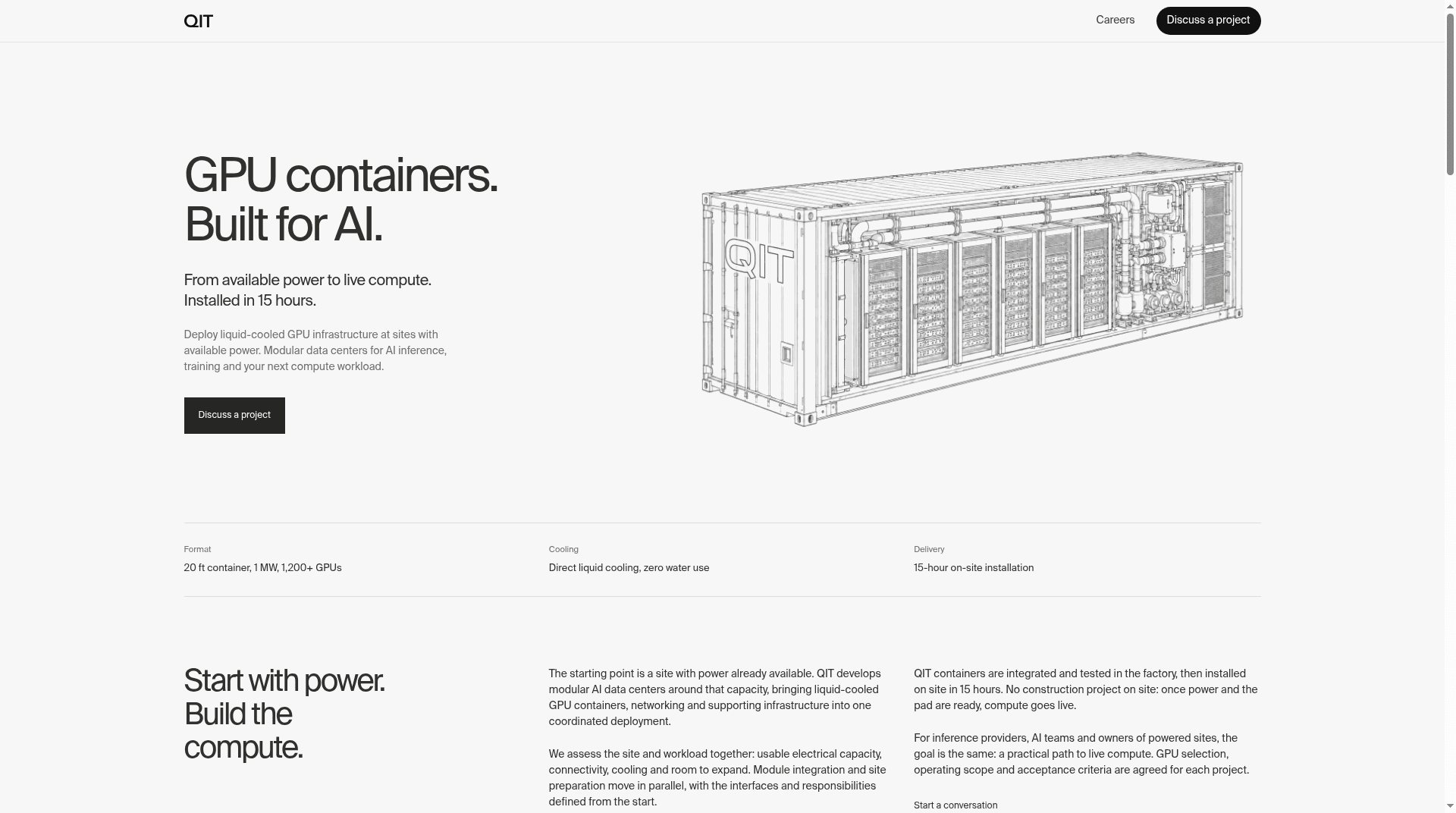
About this app
QIT designs, builds and operates its own hardware, data centers and software. It deploys liquid-cooled GPU containers at powered sites and runs a compute platform with three products: a Model API with 407 published models across image, video, audio, text and 3D; serverless GPUs (QIT Pods) that scale from zero; and reserved or bare-metal GPU capacity. Pay-as-you-go pricing is freemium: H100 from $3.08/hr, L40S from $1.25/hr, and new business-email accounts receive $1.56 in free credits. EU and US data residency are available, and customer content is not used to train models. The API and serverless control plane carry a 99.99% monthly uptime SLA. QIT targets a six-month modular AI infrastructure deployment for inference and training.
Key features
- 1QIT M1: chip-agnostic 1 MW liquid-cooled compute module, factory-integrated, ~15-hour on-site install, ready for service in weeks.
- 2Model API with 407 published models across image, video, audio, text, 3D and training, billed per generation or token.
- 3Serverless QIT Pods scaling from zero plus reserved/bare-metal GPU capacity — H100 from $3.08/hr, L40S from $1.25/hr.
Target customer profile
Drawn from the product itself, not from a survey.
Demographic
Owners of powered industrial or mining sites
Pain points
Stranded electrical capacity with no high-value use; underused transformers and land.
Primary needs
A partner to turn existing power into revenue-generating AI compute.
Demographic
Enterprise AI infrastructure teams
Pain points
Air cooling can't handle dense GPU racks; data center construction timelines drag on.
Primary needs
Liquid-cooled, chip-agnostic modules with clear scope and one accountable partner.
Demographic
AI inference and training startups
Pain points
Cloud GPU bills scale painfully; waiting on hyperscaler capacity; no room for custom hardware.
Primary needs
Fast access to owned or dedicated GPU compute in weeks, not years.
Scout Review
Written by AI from measured evidence, scored out of 100.
QIT is a modular AI data center company with a genuinely sharp pitch: take an energized industrial site, drop in a chip-agnostic 1 MW liquid-cooled container, and be serving GPU compute in weeks instead of years. The site backs that up with real engineering visuals, a deep /guides library that compares itself honestly against Armada, Crusoe and Dell, and a pricing page that publishes 407 models and per-second GPU rates. It also loads at 98/100 on Lighthouse and passes 11 of 12 security header checks. The weak spots are consistent: no self-serve path, no published compliance evidence, and body copy that fails contrast. It reads like a company that knows its engineering and hasn't finished its paperwork.
Measure by measure
Usability
58Clear reading order and a genuinely useful FAQ, plus a deep /guides library of buyer's comparisons. But there is no self-serve signup or demo — every path ends in 'Discuss a project'.
Design
71Custom line-art container and rack drawings give a real engineered identity, and the monochrome grid is disciplined. Small light-grey body text and zero product UI or hardware photography hold it back.
Speed
88Lighthouse 98/100 on both mobile and desktop: LCP 1.7s, CLS 0, TBT 0ms, FCP 901ms. A static, light page that loads like it means it.
Security
74HTTPS enforced with HSTS, CSP, frame protection and Referrer-Policy; SPF and DMARC set. Permissions-Policy is the one missing header, and no SOC 2 or audit claim is published.
Accessibility
79Lighthouse 97/100 with one failing audit: contrast. The visual audit confirms it — small light-grey copy on off-white. No WCAG statement or a11y page found.
Growth
63A real, specific wedge: turn stranded industrial power into liquid-cooled GPU compute in weeks, not years. Chip-agnostic and one-partner scope is a genuine differentiator against Armada and Crusoe.
Improvement areas
- No self-serve signup, sandbox or live demo — every path funnels into a sales conversation.
- No published compliance evidence: SOC 2, ISO 27001, pen-test summary or bug bounty not found.
- Body copy and captions fail contrast; no accessibility statement or WCAG conformance claim.
Design & Usability
The site is a confident piece of enterprise marketing: a monochrome grid, custom line-art of containers and racks, and a spec strip (Format, Cooling, Delivery) that gives buyers the numbers without a feature grid. The technical diagram of the six-rack layout is credible engineering visual, not decoration. Where it slips is legibility — hero copy, captions and footnotes are small light grey on off-white — and the absence of any product UI or real hardware photography, so 'live compute' is proven entirely in drawings. Usability is decent for a sales-led product: clear scroll order, a FAQ that answers GPU support and install speed, and a /guides library that goes head-to-head with Crusoe Spark, Armada and Dell. But there is no self-serve path at all — pricing lists 407 models and per-second rates, and the only action is 'Discuss a project'.
Speed & Security
Speed is the standout measured result: Lighthouse 98/100 on mobile and desktop, LCP 1.7s, CLS 0, TBT 0ms, FCP 901ms. For a page this text-heavy that is genuinely well-built — static, light, no heavy SPA. Security is solid on the transport layer: HTTPS enforced, HSTS, CSP, frame protection, X-Content-Type-Options and Referrer-Policy all present, SPF and DMARC configured, 11 of 12 header checks passing. The gap is Permissions-Policy and, more importantly, the absence of any published compliance evidence — no SOC 2, ISO 27001, pen-test summary or bug bounty found in the collected content. For a company asking enterprises to hand over GPU workloads and site power data, that paperwork matters more than the header score.
Accessibility & Growth
Accessibility lands at 97/100 on the automated audit with exactly one failure: insufficient contrast between background and foreground. The visual audit independently confirms it — small light-grey supporting text on an off-white page. That is a one-line CSS fix away from a clean sweep, and there is no accessibility statement or WCAG conformance claim anywhere on the site. Growth is the more interesting question. The category — modular, liquid-cooled AI data centers — is crowded with Armada, Crusoe Spark, Giga Energy, Flexnode and Dell, and QIT's own /guides pages compare against all of them. The wedge is specific and defensible: chip-agnostic 1 MW modules, ~15-hour on-site install, ready for service in weeks, and a reference project (POD 001) that reuses an existing host transformer on an operating Texas bitcoin-mining site. That is a real answer to a real problem — stranded power with no high-value use. The limit is execution credibility: a 0.1-year-old domain and a preliminary-design reference project are not yet proof the modules ship.
Conclusion
If you own a powered site with underused transformers, QIT is worth a conversation — the scope is clear, the reference project is concrete, and the comparison pages do not flinch from naming competitors. If you are an AI team that wants to spin up a GPU in a browser tab, this is not that product yet. The next milestone to watch is published compliance documentation and a second reference project that has actually gone live, not just 'issued for study'.
Suggestions for improvement
- Fix the contrast on body copy, captions and footnotes — it is the single failing Lighthouse audit and a one-line CSS change.
- Publish a security/compliance page: SOC 2 status, pen-test summary, data residency details and a subprocessor list.
- Add a self-serve or sandbox path for the Model API and QIT Pods so developers can try before booking a sales call.
- Ship a second reference project with real go-live dates and photos of installed hardware to replace the drawings-only proof.
Alternatives comparison
Named competitors, point by point. Nobody paid to appear here or to be left out.
 QIT | Armada | Crusoe | |
|---|---|---|---|
| Primary offering | Modular liquid-cooled GPU containers (QIT M1, 1 MW) plus a GPU cloud platform | Edge and modular data center deployments with containerized AI-ready compute | Cloud GPU capacity plus Spark containerized modular data center units |
| Cooling approach | Direct liquid cooling, zero water use; liquid-to-liquid CDU with adiabatic dry coolers | Containerized modular deployments; cooling specified per deployment | Spark Liquid variant offers liquid cooling alongside air-cooled Spark units |
| GPU / chip flexibility | Chip-agnostic: NVIDIA B200, B300, Vera Rubin, AMD Helios; GB300 NVL72 rack-scale | AI-ready compute deployments; hardware selection per project | NVIDIA-based cloud fleet; Spark units built around customer hardware |
| Deployment speed | ~15-hour on-site set and connect; ready for service in weeks on an energized site | Modular containerized deployment; timeline scoped per site | Factory-built Spark units shipped to prepared sites |
| Cloud / API access | Model API with 407 models, serverless QIT Pods scaling from zero, reserved capacity | Infrastructure-focused; no public model API catalogue | Crusoe Cloud GPU instances and managed inference offerings |
| Published pricing | Public per-second/per-hour rates: H100 $3.08/hr, L40S $1.25/hr, B300 $5.46/hr; model API per-token pricing | Quote-based; no public rate card found in collected evidence | Cloud GPU pricing published per instance type; modular units quote-based |
Armada
Edge and modular data center provider offering containerized, AI-ready compute deployments.
Crusoe
Cloud and modular infrastructure company known for its Spark containerized data center units.
Comparing options? See QIT alternatives, scored side by side
More Cloud Hosting apps
View all Cloud Hosting
Denpex
89AI-powered GPU failure diagnosis for distributed ML training

deed.page
89Permanent web hosting for AI agents, no human step

kosa8
88Sealed VMs for AI agents with instant rewind, audit trails & zero key exposureSealed VMs for AI agents with instant rewind and audit tr...

Plori
87Cloud AI agents with persistent disk, memory, and real CL...

Lizard
85Fast & affordable cloud sandboxes for AI agents

GPUBank
85Rent cloud GPUs by the second at all-in prices, payable i...

yourdrive
84YourDrive is a self-hosted file manager and media timeline that runs entirely on your own infrastructure. Organize files in nested folders, move them with drag-and-drop, search instantly, and browse photos and videos by month and year. Files stream straight to your own AWS S3, Azure Blob, MinIO, Cloudflare R2 or Wasabi storage. Install with one command. Free for personal use; teams pay per server, not per seat.

ServerOS
83One daemon, total control of your Linux servers

FrameCourier
83Photo & video delivery platform with no per-seat fees

Amelia's Agent
82AI builder: describe a site or app, watch it build, publi...

Easypanel
81A Docker-based server control panel for easy app deployment, database management, and SSL handling with an intuitive web interface.

SysInfo Microsoft Teams Migration Tool
81Migrate Teams, channels, and chats between Microsoft 365 ...


A platform dedicated to providing unbiased reviews of newly launched applications, analyzing everything from their features to their full potential.
info@scoutforge.net© 2026 Scoutforge. All rights reserved.
