Cycling through all six. Tap any point to stop.
Measured on six things
AI-friendly admin dashboards & website templates
Security
52HTTPS is enforced with HSTS, and SPF/DMARC are published. But the header probe scored 6/12 — no CSP, no frame protection, no X-Content-Type-Options, no Referrer-Policy — and no SOC 2 or pen-test claims appear on-site.
Screenshots
1 / 1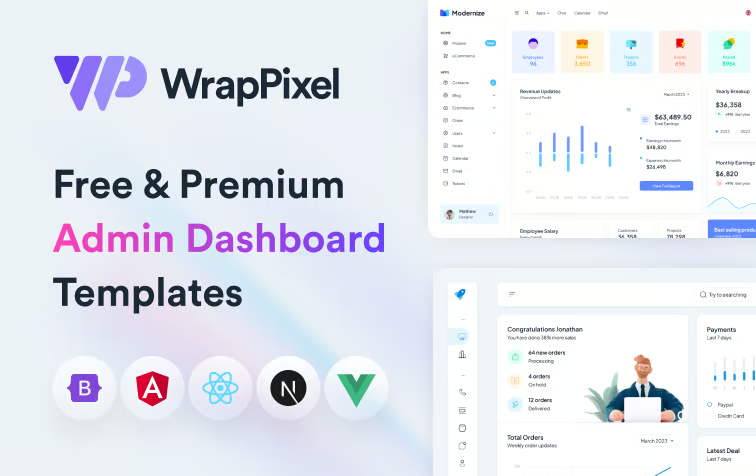
About this app
WrapPixel is a one-stop marketplace for premium and free admin dashboards, UI kits, and website templates built on React, Next.js, Vue, Angular, Bootstrap, Tailwind, and Shadcn. Since 2016, the platform has served over 537,000 creatives and helped build more than 300,000 web apps. Its hand-coded templates are designed to be AI-friendly, so developers can skip the trial-and-error of AI-generated code and start with production-ready, well-structured codebases. With a focus on maintainable architecture, regular updates, and dedicated support, WrapPixel is trusted by teams at Accenture, Wipro, Infosys, and Oracle. Whether you need a free dashboard for a side project or a premium template for enterprise SaaS, WrapPixel provides the building blocks to launch faster.
Key features
- 1Multi-framework admin dashboards and UI kits: Bootstrap, React, Angular, Vue, Tailwind, Next.js, Nuxt, Shadcn, Astro.
- 2Free and premium tiers — free templates like NextKit and Studiova alongside $49–$59 premium dashboards.
- 3Live Preview on every template card, plus version history, ratings and download counts for comparison shopping.
Target customer profile
Drawn from the product itself, not from a survey.
Demographic
Frontend developers & engineers
Pain points
Spending too much time building UI from scratch; AI-generated code often needs heavy refactoring.
Primary needs
Production-ready, well-documented templates with clean, scalable code.
Demographic
Agencies & freelancers
Pain points
Tight project deadlines; need to deliver polished dashboards without reinventing the wheel.
Primary needs
Multi-framework templates that can be customized quickly for client projects.
Demographic
Startups & enterprise teams
Pain points
Limited design resources; pressure to launch MVPs fast while maintaining quality.
Primary needs
Reliable, pre-built UI components like auth, tables, charts, and forms.
Scout Review
Written by AI from measured evidence, scored out of 100.
WrapPixel is a ten-year-old template marketplace that has clearly figured out the commerce side: consistent product cards, transparent pricing from free to $59, Live Preview on everything, and support that customers actually praise. The framework coverage is genuinely broad, and the 'AI-ready' positioning is a smart read of where developer pain currently lives. Where it falls short is in the polish around the product. Mobile performance is poor at 62/100 with a 7.9s LCP, security headers are half-implemented at 6/12 with no published compliance, and the accessibility audit fails on unnamed links and contrast. None of these are fatal for a template shop, but they are the difference between a competent store and a trusted one. The core promise — production-ready code that beats AI output — is plausible and well-aimed; it just needs to be demonstrated rather than declared.
Measure by measure
Usability
63Free templates plus Live Preview on every card lower the risk of buying blind, and support runs through a help page and Discord. Navigation is clear, though the catalogue's breadth can overwhelm a first-time visitor.
Design
58A dense, information-rich marketplace grid with consistent product cards showing price, downloads, rating and version. Functional and scannable, but visually generic — it reads like a template store, not a designed brand.
Speed
57Desktop Lighthouse performance is 96/100 with CLS 0, but mobile drops to 62/100 with a 7.9s LCP and 4.2s FCP. The image-heavy template grid punishes phone users while desktop flies.
Security
52HTTPS is enforced with HSTS, and SPF/DMARC are published. But the header probe scored 6/12 — no CSP, no frame protection, no X-Content-Type-Options, no Referrer-Policy — and no SOC 2 or pen-test claims appear on-site.
Accessibility
58Lighthouse accessibility lands at 86/100, but four real failures remain: low color contrast, links distinguishable only by color, links without discernible names, and undersized touch targets. No WCAG statement is published.
Growth
62The 'AI-ready, production-grade code' angle is a real wedge against raw AI output, and the multi-framework catalogue widens the addressable market. But ThemeForest and Creative Tim already own this shelf, so the moat is code quality, not category.
Improvement areas
- Mobile performance: 62/100 Lighthouse with a 7.9s LCP — image-heavy grid needs compression and lazy loading.
- Security headers incomplete (6/12) and no published SOC 2, ISO or pen-test documentation.
- Accessibility failures: unnamed links, color-only link distinction, low contrast, undersized touch targets.
Design & Usability
WrapPixel's storefront is built for scanning, not for seduction. Product cards carry price, download count, rating, version and last-updated date, which is exactly what a developer comparison-shopping across nine frameworks wants. The framework filter row (Bootstrap, React, Angular, Vue, Tailwind, Next.js, Nuxt, Shadcn, Framer, Astro) makes the breadth legible. Usability is helped by two concrete choices: free templates like NextKit and Studiova sit alongside the $49–$59 paid ones, and every card exposes a Live Preview so nobody buys blind. Support is routed through a help page and Discord, and the testimonials on-site specifically praise response speed. The weakness is navigation depth — with this many SKUs, there is no guided 'pick your stack' path, so a first-time visitor can drown in options before reaching a decision. It works, but it is a catalogue, not a concierge.
Speed & Security
Speed is a split verdict. Desktop Lighthouse performance is 96/100 with CLS 0 and TBT 66ms — genuinely fast and stable. Mobile is the problem: 62/100 with a 7.9s LCP and 4.2s FCP, which means phone users stare at a half-rendered template grid for the better part of eight seconds. For a marketplace whose entire job is browsing images, that is the wrong place to be slow. Security is baseline-competent rather than hardened. HTTPS is enforced and HSTS is present, and SPF and DMARC records are published, which covers the fundamentals. But the header probe scored 6/12: no Content-Security-Policy, no frame protection, no X-Content-Type-Options, no Referrer-Policy, no Permissions-Policy. There is also no published SOC 2, ISO certification, pen-test summary or bug bounty. For a store that processes payments and hands customers downloadable code, that is a thin public security posture — not a breach, but not a flex either.
Accessibility & Growth
Accessibility sits at 86/100 on Lighthouse, which is respectable until you read the failing audits: insufficient color contrast, links distinguishable only by color, links with no discernible name, and touch targets too small or too tightly spaced. Those are not cosmetic — the unnamed links are a real screen-reader blocker, and the touch-target issue hits mobile users directly. No accessibility statement or WCAG conformance claim is published, so there is no signal that this is being tracked. Growth is the more interesting question. WrapPixel's pitch — 'AI-ready' templates that skip the refactoring of raw AI output — names a real, current pain for developers, and the multi-framework catalogue (Bootstrap through Shadcn, Nuxt, Astro) widens the addressable market well beyond a single stack. The 2016 domain and the 537k+ creatives claim give it tenure. But the category is crowded: ThemeForest owns the long tail and Creative Tim owns the design-forward premium tier. WrapPixel's only durable wedge is that its code is measurably cleaner and better documented than both the AI output and the cheaper marketplace competition — and the site asserts that rather than proving it.
Conclusion
If you are a developer or agency shopping for a dashboard starter, WrapPixel is a reasonable place to look, especially with free options like NextKit and Studiova to test the code quality before spending $49–$59. The Live Previews and the breadth of frameworks mean you can almost certainly find your stack. Go in with realistic expectations: this is a marketplace, not a platform, and the site itself is not the polished artifact its templates are. The single most useful thing you can do is download a free template and read the code — that will tell you in ten minutes whether the 'AI-ready' claim holds up for your team. If it does, the paid tiers are priced fairly. If it does not, ThemeForest and Creative Tim are one tab away.
Suggestions for improvement
- Fix mobile LCP: compress and lazy-load the template grid images, and serve responsive sizes — 7.9s on mobile is costing you conversions.
- Add the missing security headers (CSP, X-Content-Type-Options, Referrer-Policy, frame protection) and publish a security page.
- Publish an accessibility statement and fix the unnamed links and contrast failures flagged by Lighthouse.
- Add a guided 'pick your stack' onboarding path so first-time visitors aren't paralyzed by the size of the catalogue.
Alternatives comparison
Named competitors, point by point. Nobody paid to appear here or to be left out.
 WrapPixel |  ThemeForest |  Creative Tim | |
|---|---|---|---|
| Framework coverage | Bootstrap, React, Angular, Vue, Tailwind, Next.js, Nuxt, Shadcn, Astro, Framer | Very broad, community-submitted across many stacks and CMS platforms | React, Vue, Angular, Bootstrap, Tailwind, Next.js |
| Free tier availability | Yes — NextKit, Studiova, Awake, Resume and more at $0 | Limited free items; most listings are paid | Some free kits, but premium-heavy catalogue |
| Live preview before purchase | Yes — Live Preview link on every template card | Yes — standard demo preview on listings | Yes — live demos for most products |
| Typical premium price | $49–$59 per admin template | Wide range, commonly $20–$80 with variable quality | Premium kits often $69–$149 |
| AI-friendly / AI-ready positioning | Explicit core pitch: hand-coded, AI-ready templates to skip AI refactoring | Not a positioning focus; quality varies by author | Design-forward positioning, not AI-code-oriented |
| Dedicated support | 1 year dedicated support plus Discord community | Author-dependent; 6 months typical, extensions paid | Support included with premium purchases |
ThemeForest
A large marketplace for website templates and themes, including admin dashboards, but with varying quality and less focus on AI-friendly code.
Creative Tim
Provides premium UI kits and templates for frameworks like React, Vue, and Angular, with a strong design focus but fewer free options.
Comparing options? See WrapPixel alternatives, scored side by side
More Design & Creativity apps
View all Design & Creativity
RoomCreator
92An AI-powered interior and exterior design tool that tran...

What the GIF
89Frame-perfect video-to-GIF maker that runs entirely in yo...

TranscriptYou
88Free YouTube transcript generator with timestamps and AI ...

RestorePhotosApp
88An AI-powered photo restoration app that brings old, blur...

Portrait Gift
88AI-powered personalized face swap art platform creating c...

ButterKit
82macOS app for App Store screenshots: 3D mockups, auto-tra...

BeartIMAGE
88BeartIMAGE is a free, web-based image processing platform engineered for fast, bulk photo editing and conversion directly in your browser.

Pixelimg
88A free online AI-powered tool that instantly converts ima...

Coloring Pages Pro
87A massive collection of free printable coloring pages for...

QRocodile
87Design And Animate QR Codes People Want to Scan

FaceSwapAI
87AI face swap for photos, videos, GIFs with free trial.

TryInk
86Try on a tattoo on your own body photo before you book.


A platform dedicated to providing unbiased reviews of newly launched applications, analyzing everything from their features to their full potential.
info@scoutforge.net© 2026 Scoutforge. All rights reserved.
